

Healing, Power & Inner Alignment: Sangeeta Sharma on Why Emotional Regulation is the Missing Piece in Modern Feminism
📝InterviewsSangeeta Sharma, a life transformation and inner alignment coach, explores how emotional healing, generational trauma, and self-awareness shape modern women’s journeys, highlighting the shift from silent struggle to empowered living.
The mental wellness industry in India is experiencing rapid growth, driven by rising awareness of emotional health, trauma healing, and holistic well-being. The Indian mental health market is expected to grow at a CAGR of over 20%, with more individuals, especially women, seeking therapy, coaching, and inner transformation tools.
As part of StartupTalky’s International Women’s Day 2026 series, we spotlight women leaders who are reshaping narratives around health, empowerment, and self-awareness.
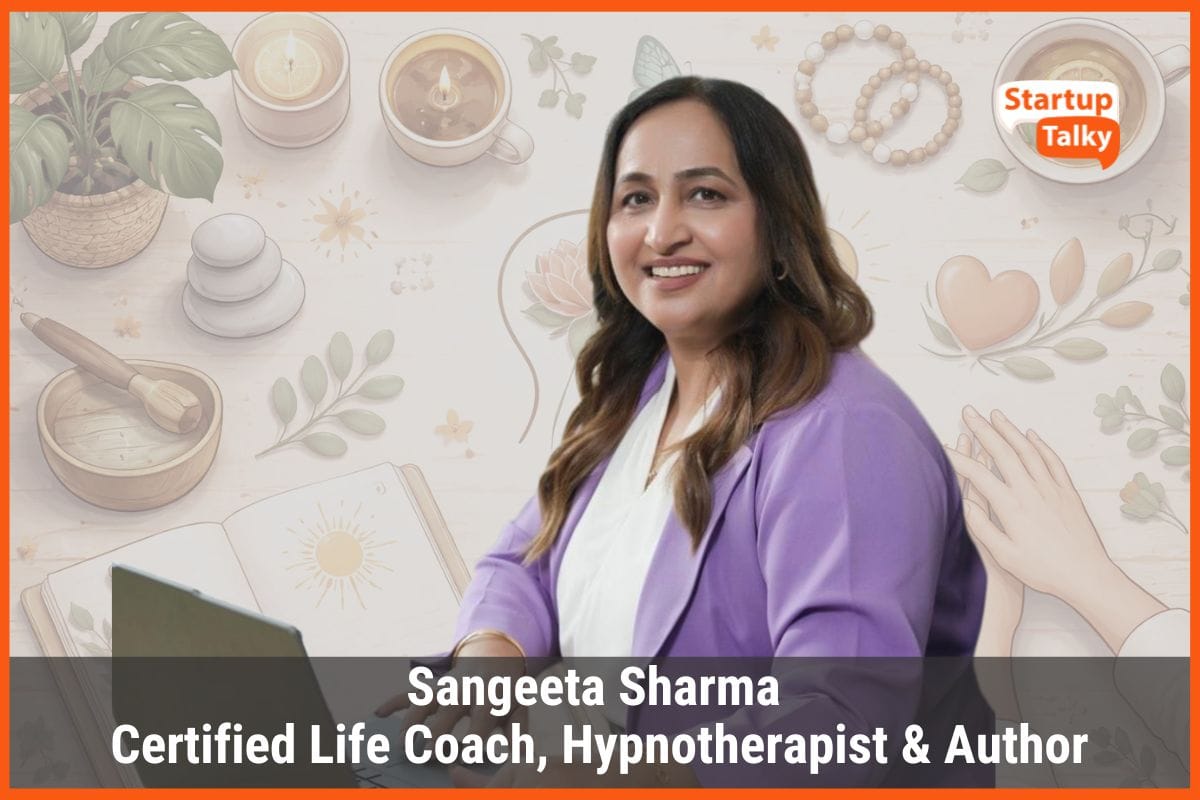
In this conversation, Sangeeta Sharma, a certified life coach, hypnotherapist & author with 11+ years of experience, shares deep insights into generational trauma, emotional regulation, and the inner shifts women need to move from survival to leadership.
How Women Experience Stress & Emotional Healing: What Has Changed and What Hasn’t
StartupTalky: With 11+ years of experience as a Life Transformation & Inner Alignment Coach, what has changed most fundamentally about how women experience stress, trauma, and emotional regulation, and what remains stubbornly the same?
Sangeeta Sharma: In the early days of my journey into life transformation and emotional wellness coaching, I noticed a common pattern, specifically in women clients, an underlying struggle, besides their emotional pain, trauma, or childhood wounds, was deep resistance to seeking support. They would say to me, ‘Ma'am, I want to attend your sessions secretly as my family would never understand or support this.’
The doubt was not about the coaching programme or whether they needed support, but rather about what others would think. It was like admitting weakness or mental illness, so they preferred to hide their coaching journey even from their loved ones. I totally supported them as I believed that the first step is to help them find their ground where they could stand strong, and then only will they be confident enough to overcome the stigma around mental and emotional wellness. What I understood was that for them, the very act of enrolling in life coaching was itself a breakthrough, as they were choosing themselves, even if silently, over other taboos or boundaries set by society.
And over time, I have witnessed a positive shift, where once people felt the need to hide their transformational or healing journey, today they are ready to own it, with only a few exceptions, yet proudly. As society shifts, it is becoming more courageous to seek help rather than be ashamed. The old belief that asking for help was a weakness is gradually dissolving, and people no longer feel the need to conceal their journey of healing; instead, they stand tall in it, embracing it with pride.
Neuroscience also now highlights how hormonal cycles impact women. Moreover, people have started understanding that, in addition to responsibilities as primary caregiver, cultural expectations in patriarchal societies and workplace inequality are triggering anxiety and depression in women.
Yet, even after so much openness, understanding, and awareness, what persists and remains stubborn is the structural imbalance of responsibilities, recognition, and opportunities due to gender discrimination at home and in the workplace, which is still the underlying cause of stress and anxiety in women on a large scale.
Understanding Generational Trauma: What Healing Actually Looks Like
StartupTalky: You work on healing generational trauma in Indian women. What does that work actually look like in a session, and why is it particularly relevant now?
Sangeeta Sharma: Generational trauma from colonization, partition, and patriarchal family structures is inherited as patterns of suppressed emotions and silent sacrifices passed down unintentionally through mothers and grandmothers to modern women of today.
In a session, through inner-child healing work, somatic practices, and inner reflection, I help them process trauma and recognize how these patterns live in their bodies and beliefs. This awareness helps them release and reframe inherited narratives into empowering codes.
This work is particularly relevant now, as modern women are balancing dual responsibilities: part of them carries centuries of cultural conditioning to be nurturers, while another part is pursuing financial independence, leadership, visibility, and additional responsibilities at work.
If not healed, Intergenerational trauma continues to shape stress responses and emotional regulation challenges. By addressing inherited wounds, women today not only heal themselves but also break cycles that have lasted for generations, where courage, clarity, and self-connection can flourish.
Beyond Goal-Setting: The Four-Layer Framework for True Transformation
StartupTalky: You’ve developed a four-layer framework for women to design their dream lives. What are those layers, and why does that structure matter more than just setting goals?
Sangeeta Sharma: The Four Layer Framework is beyond surface-level fixes; it is about deeper pattern recognition at all four layers of our existence, body, energy, and emotions, mind, and releasing, rewiring, reframing, and healing at each level with focus on the client’s core issue.
We are multi-layered beings, and these four layers are like the wheels of our inner vehicle, propelling the soul on its journey. True transformation needs work at each layer in an integrated way, and lasting change doesn’t happen by focusing on just one aspect of us, for example, just setting mental goals without strong passion, conviction, and emotional healing. The mind pushes forward, but the body resists, energy drains, and emotions sabotage progress.
Working in an integrated way brings inner alignment and wholeness, leading to true bliss and happiness. When healing happens through all four layers, change becomes sustainable and embodied, transforming you into a magnet for your dream life.
Structure matters more than setting goals alone, because real, sustainable success is rooted in alignment across body, energy, emotion, and mind, not just in willpower or external achievement. The outer world is a reflection of the inner world, and outer success without inner alignment is unsustainable, like a mirage, dazzling from afar but dissolving when you reach it.
Emotional Regulation & Feminism: The Missing Link
StartupTalky: You describe emotional regulation as “the missing skill in modern feminism.” Can you explain that provocation? What does feminism get right and what does it overlook?
Sangeeta Sharma: When I describe emotional regulation as ‘the missing skill in modern feminism,’ I’m pointing to a gap between external empowerment and inner resilience. Although feminism has fought for rights, equality, acknowledgement, leadership, and non-discrimination, giving women the language and tools to claim their rightful space in the world, what often gets overlooked is the inner world, the stress, trauma, and emotional overwhelm women silently manage while carrying expanded roles and responsibilities.
Feminism wins the outer battle for freedom, but inner alignment acts as the bridge that turns freedom into real fulfilment, allowing women to embody equality with grace and resilience, making freedom a lived experience.
From Trauma to Leadership: The Inner Shift That Changes Everything
StartupTalky: From trauma to authority, that’s a powerful arc. What is the internal shift that has to happen before a woman can move from surviving to leading/
Sangeeta Sharma: Trauma to Authority is a powerful transformation, but it requires an internal shift: when women stop identifying with their older, wounded version and step into their inner power.
Moving from just surviving to leading requires inner alignment, trauma healing, reframing old, painful stories into new, empowering realities, and this happens only when she embodies resilience, clarity, and conviction in her body, energy, emotions, and mind as a true, authentic self. That’s when trauma transforms into authority, and survival evolves into leadership.
The Most Persistent Limiting Belief Women Carry
StartupTalky: After 11+ years of coaching women, what is the most persistent lie women tell themselves that holds them back?
Sangeeta Sharma: The most common lie I’ve seen women tell themselves is, ‘I’m not enough.’ Not smart enough, not strong enough, not deserving enough. Perfectionism, people-pleasing, self-doubt, or shrinking their voice, seeking validation or attention, becomes their way of life. They overgive, sacrificing their needs to be significant in the eyes of others, and this way of being is inherited and reinforced across generations.
The breakthrough comes when they recognize that this ‘not enough’ story is not the truth, but trauma.
Advice for Women Beginning Their Healing Journey
StartupTalky: What advice would you give a woman who is just beginning to recognize that the emotional patterns holding her back might have roots deeper than her own life choices?
Sangeeta Sharma: My advice is to acknowledge this realization as the first step towards true freedom. Transformation begins with awareness: noticing thoughts, patterns, and triggers without judgment, and accepting that her struggles are not just about her choices or personal failures, but are connected to deeper generational, cultural, or emotional patterns. With this understanding, she can stop blaming herself and begin healing at a deeper level by releasing inherited narratives, rewiring the nervous system, reframing beliefs, and aligning body, energy, and emotions, while modelling the importance of not hesitating to seek support when needed.
Through this deeper work, she not only liberates herself but creates a generational shift by weaving a new legacy of courage, clarity, and deep self-connection.
 Subham Kumar