

Aakash Saha on How Magentic Is Helping Companies Move Beyond Chatbots to Real AI Systems
👨💻 StartupTalkers
StartupTalky presents Recap'25, a series of exclusive interviews where we connect with founders and industry leaders to reflect on their journey in 2025 and discuss their vision for the future.
In this edition of Recap’25, StartupTalky speaks with Aakash Saha, Co-founder of Magentic, who reflects on the widening gap between surface-level AI adoption and real, outcome-driven implementation across businesses. Drawing parallels with the early days of the internet, Saha explains how many organisations mistake basic tool usage for transformation, and why true AI adoption requires both deep technical understanding and the imagination to rethink workflows, scale, and value creation.
He goes on to discuss how Magentic is addressing this gap through AI upskilling, specialised AI/ML staffing, and workflow automation designed to deliver measurable ROI within weeks, not years. The conversation also explores the rise of multi-agent AI systems, the importance of pairing technology with training to ensure genuine adoption, and Magentic’s roadmap for 2026, including expanded AI-powered offerings and education initiatives aimed at preparing businesses and talent for the next phase of the AI revolution.
StartupTalky: What was the motivation behind starting Magentic, and what common problems did you see businesses facing while trying to adopt AI?
Aakash Saha: In the 90s, the internet revolution was inevitable, yet businesses fell behind…not because the technology wasn't there, but because they lacked the talent or foresight to navigate it.
Today, we're witnessing history repeat itself with AI.
The AI gold rush is here, and while adoption isn't a hard sell anymore, our experience reveals a troubling truth: 'adoption' means drastically different things to different people.
Most businesses boasting AI adoption have little more than premium chatbot subscriptions scattered across their organization. That's the equivalent of Tesla claiming they've solved full self-driving by providing a human driver with each car.
Magentic AI was founded to bridge this specific adoption gap. We don't settle for the bare minimum, we help organizations dream bigger about what's possible with AI.
StartupTalky: In 2025, what new capabilities, solutions, or service models did Magentic introduce to help clients see faster and clearer ROI from AI adoption?
Aakash Saha: When we analyzed why so many organizations lag in meaningful AI adoption, a pattern emerged. The bottleneck wasn't technology, it was a shortage of talent that truly understands AI combined with a lack of imagination about AI's potential to impact their bottom line.
This insight shaped our core service offerings:
- AI Upskilling: Custom learning and development modules that bring teams up to speed on cutting-edge AI tools and teach them to extract maximum value.
- AI/ML Staffing: Organizations eager to build their own AI systems face a critical challenge: they can't attract or properly vet the right candidates. AI's novelty means traditional hiring approaches fail. As a team that builds similar systems for multiple clients, we've already developed the network and assessment frameworks to identify genuine talent from thousands of applications.
- AI Workflow Automation: This is where we tackle the problem with imagination. We help organizations understand and implement systems like AI-powered CRMs, content pipelines, and custom automations that actually drive revenue, expand margins, and enable true scale.
StartupTalky: Magentic focuses on delivering ROI within 30-45 days. What would you highlight as the key USPs of this outcome-driven approach?
Aakash Saha: Businesses need AI systems to stay competitive, but custom solutions often take time and involve complex setup. While technology typically delivers ROI almost instantly, implementation time remains the critical bottleneck.
We're acutely aware of our impact on client perceptions. If we fail to deliver, they won't just see it as Magentic falling short, they'll see it as AI failing.
This misperception carries steep long-term costs.
To ensure clients see ROI within 30-45 days, we've made several strategic changes. We productized certain agents, like Mira AI (our AI concierge that keeps businesses always-on for customer support and sales), requiring just minutes to set up. We developed templatized implementations that dramatically reduce both time-to-value and client involvement, cutting friction at every turn.
Finally, we recognized a crucial truth: our systems are only as good as the teams using them. It's natural to feel inertia when moving from legacy systems to new approaches. That's why Magentic AI now pairs training with every service and implementation, ensuring genuine adoption.
StartupTalky: How is Magentic using AI agents and automation to simplify complex workflows and improve day-to-day operations for businesses?
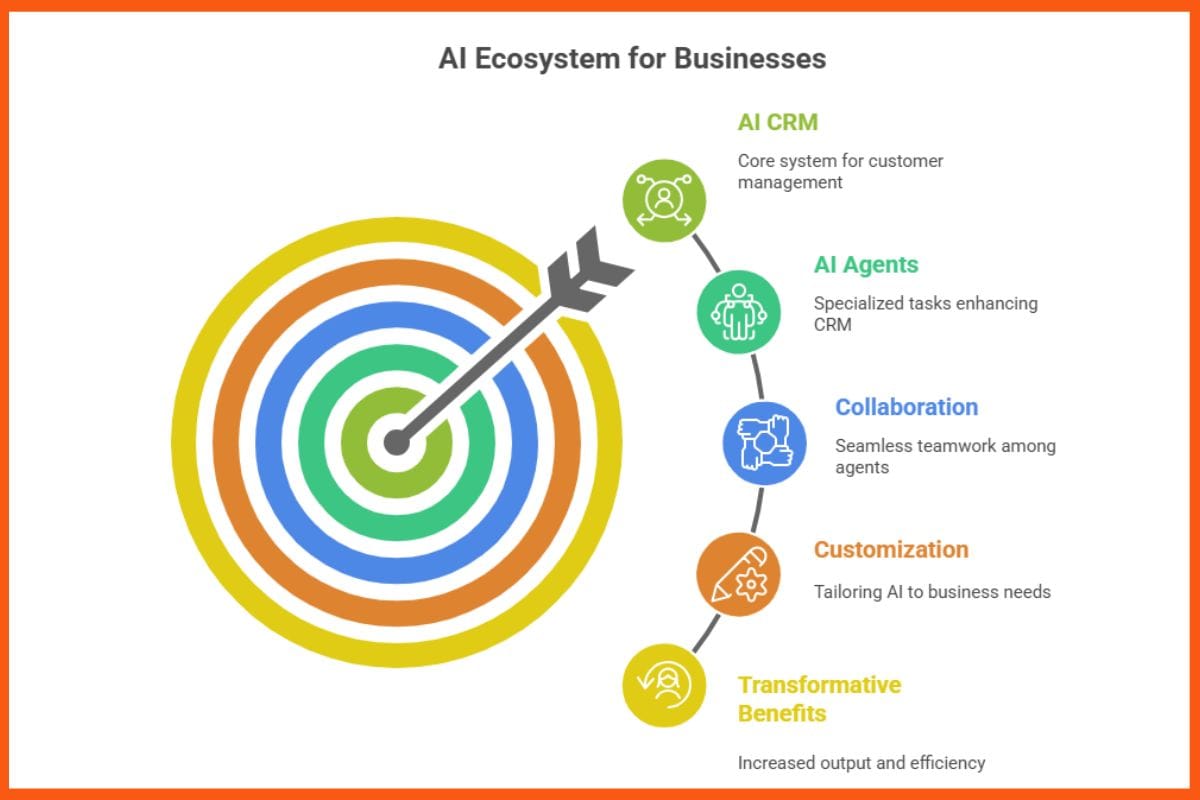
Aakash Saha: Magentic AI was literally named after multi-agentic architecture. We believe deeply in the power of agents working together, it's how most businesses will experience AI's transformative benefits.
Think about your smartphone. Would it make sense if it came preloaded with every app from the app store? Or conversely, if it could never download another app? Both scenarios feel absurd. Add-ons, apps, and plugins make technology what it is. They let customers customize and access new capabilities. We see AI's future unfolding the exact same way.
Businesses won't simply buy an AI CRM and stop there. They'll get a CRM, then deploy multiple AI agents that integrate seamlessly, one agent creating proposals, another researching leads, another documenting meeting notes, all collaborating to drive 10x output per resource.
StartupTalky: Based on your experience working closely with teams adopting AI, what one practical tip would you share with founders or operators planning to use AI in their business?
Aakash Saha: From the frontlines of AI, I'd offer two critical insights.
First, distinguish carefully between what you can automate with logic versus AI.
Not every automation needs artificial intelligence. Consider a simple workflow that filters incoming invoices by sender and routes them to specific departmental folders. Traditional logic handles this perfectly and will run perpetually without fail. Adding AI to parse email intent might sound sophisticated, but it introduces unnecessary complexity, potential errors, and ongoing costs.
In a world drowning in AI agencies and tools, founders must remember that AI isn't the only tool in the toolbox, sometimes a screwdriver beats a power drill.
Second, don't judge AI and automation by where we are now, judge it by where we're heading.
Imagine witnessing the internet in the early '90s. Would you have envisioned broadcasting high-definition video on it? Technology scales at speeds our minds struggle to comprehend. While AI has significant maturation ahead, investing now builds the foundation for when it becomes truly miraculous. Companies that delay risk being dominated (or made obsolete) by competitors who are setting that foundation today.
StartupTalky: Looking ahead, what are Magentic’s key priorities and product plans for 2026, including upcoming offerings like Mira?
Aakash Saha: AI adoption is a trend we see only strengthening in 2026, and we're positioned to lead it. Our goals are ambitious but clear: work with more organizations, drive significantly greater business impact, and launch AI powered verticals to address massive pain points of businesses spending heavily on legacy outdated systems.
We're also committed to education, both for our clients and for the broader market of AI/ML engineers. We plan to release free resources, training modules, and structured programs to help today's youth learn about AI/ML, experiment with projects, and capitalize on emerging job opportunities.
For Mira AI, we're planning integrations with platforms like Shopify and WooCommerce in early 2026, followed by end-to-end automation add-ons that we'll reveal in time. The gold rush is on. The question isn't whether AI will transform your business, it's whether you'll be the one wielding the shovel or watching others strike gold.
Explore more Recap'25 interviews here.