

Adnan Kidwai and Sunil Maddala of FuelBuddy on Scaling Safe Fuel Logistics and Building an Energy-Ready Delivery Platform
📝Interviews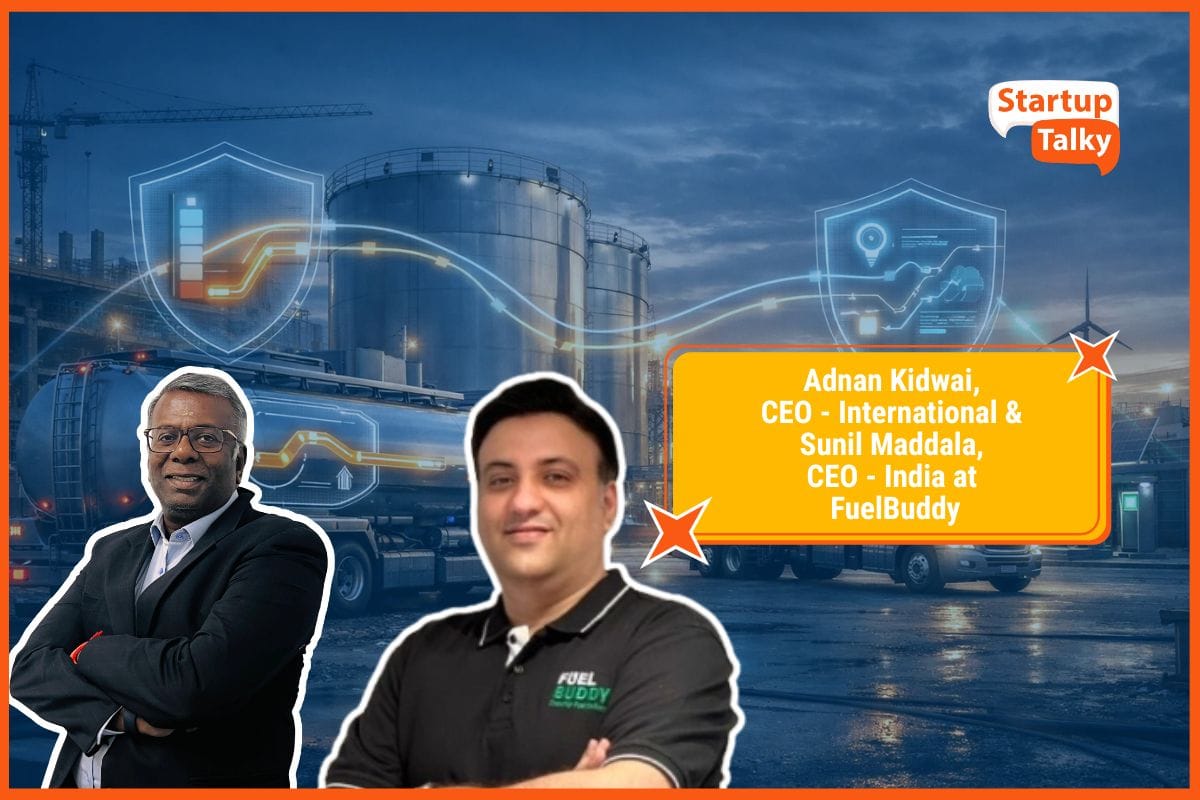
StartupTalky presents Recap'25, a series of exclusive interviews where we connect with founders and industry leaders to reflect on their journey in 2025 and discuss their vision for the future.
In this edition of Recap’25, StartupTalky speaks with Adnan Kidwai, CEO - International, and Sunil Maddala, CEO - India at FuelBuddy, who reflect on a year where operational discipline and compliance became the true differentiators in tech-enabled energy logistics. As FuelBuddy scaled door-to-door fuel delivery across geographies in 2025, the challenge was not just expansion — but ensuring safety, traceability, and regulatory alignment in a sector where margins for error are extremely small.
Kidwai and Maddala share how FuelBuddy embedded safety and PESO compliance directly into system workflows, transforming governance from a manual checkpoint into a technology-driven operating advantage. The conversation explores the non-obvious metrics that define network maturity — from fuel variance and exception density to reconciliation timelines and first-time-right delivery rates — and how predictive routing, consumption-based planning, and real-time monitoring have helped reduce total cost of ownership for industrial clients.
StartupTalky: FuelBuddy operates in a highly regulated sector. What was the most significant regulatory or logistical challenge you overcame in 2025 to ensure safe and compliant door-to-door fuel delivery at scale?
Adnan Kidwai & Sunil Maddala: In 2025, the most significant challenge was scaling operations faster than regulatory frameworks evolved, especially given varying interpretations of doorstep fuel delivery rules across states and international markets. In some regions, we consciously slowed expansion to remain fully compliant rather than compromise on safety or governance. We embedded PESO and safety compliance directly into our operating workflows instead of treating them as checklist items. This helped us standardise safety and quality across a rapidly expanding team, train at scale without diluting on-ground discipline, and remain audit-ready every single day. Ultimately, we turned compliance into a system-driven advantage rather than a manual burden.
StartupTalky: Beyond volume and revenue, what are the two or three non-obvious operational KPIs you track to measure the true efficiency and safety of your last-mile delivery network?
Adnan Kidwai & Sunil Maddala: Beyond conventional metrics, we closely track fuel variance per delivery to monitor discrepancies between ordered, loaded, and dispensed quantities. We also measure exception density, which indicates how frequently deliveries require manual intervention or rerouting, and the ratio of emergency versus planned deliveries. Additional indicators such as reconciliation closure time, first-time-right delivery rate at the site level, and asset idle hours avoided help us understand both operational efficiency and safety maturity across the network.
StartupTalky: FuelBuddy's model relies heavily on technology for route optimization and inventory management. What specific technological advancements were prioritized in 2025 to enhance the total cost of ownership (TCO) for your industrial clients?
Adnan Kidwai & Sunil Maddala: In 2025, we prioritised shifting from static delivery schedules to consumption-based delivery planning, enabling more accurate and efficient replenishment. Predictive routing helped reduce unplanned and short-cycle deliveries, while automated reconciliation significantly lowered manual effort and errors. We enhanced live visibility into fuel dispensing rather than just delivery confirmation and introduced early loss detection through real-time monitoring and alerts. These advancements improved delivery asset utilisation and ensured seamless integration with client finance and operations systems, directly reducing the total cost of ownership.
StartupTalky: The future of energy is shifting towards sustainable sources. How is FuelBuddy strategically positioning itself to integrate alternative fuels and electric vehicle charging into its core service offering in 2026?
Adnan Kidwai & Sunil Maddala: FuelBuddy is building a fuel-agnostic operating framework at a global level to stay future-ready. Internationally, we are already operating across both CNG and solar energy solutions, where demand and regulations permit, including CNG delivery in Nigeria. In India, our primary focus continues to be diesel due to its critical role in industrial operations. At the same time, our systems are being prepared for future expansion across alternative fuels, solar, and EV charging, ensuring diversification remains market-led, regulation-driven, and aligned with operational discipline.
StartupTalky: The USD 20 million funding round was aimed at global expansion and diversification. What is FuelBuddy's biggest product or market bet for 2026, and which new service vertical holds the most promise?
Adnan Kidwai & Sunil Maddala: Our biggest bet for 2026 is expanding into fuel and energy intelligence solutions alongside scaling enterprise-grade fuel management systems globally. We see strong potential in deeper penetration across infrastructure, EPC, and industrial accounts through bundled offerings rather than standalone delivery services. Entry into select international markets with regulatory clarity is also a priority. Platform scalability will take precedence over heavy customisation, with differentiation driven by technology depth and operational discipline.
StartupTalky: Five years from now, what do you hope will be the lasting legacy of FuelBuddy on the global energy distribution landscape, particularly in transforming the traditional fuel supply chain?
Adnan Kidwai & Sunil Maddala: Five years from now, our vision is to make fuel delivery predictable, traceable, and disciplined. Our aim is to transform fuel from an operational risk into a fully managed service, establish global benchmarks for last-mile energy accountability, and replace opacity with real-time visibility in fuel supply chains. We want to prove that physical energy logistics can be technology-driven and enable businesses to focus on execution rather than fuel procurement.
StartupTalky: What is the single most important, hard-won lesson you would share with a founder scaling a tech-enabled logistics business that deals with a highly sensitive and regulated commodity?
Adnan Kidwai & Sunil Maddala: The most important lesson is that control must scale before volume does. Compliance and safety cannot be managed manually at scale; they must be system-driven and embedded into daily operations. Local regulatory realities matter as much as central strategy, and technology should enforce processes rather than bypass them. Short-term speed may offer growth, but in regulated businesses, trust once lost is extremely difficult to rebuild.
Explore more Recap'25 interviews here.