

Arindam Sen of Heartnet India on Scaling Remote Cardiac Care, AI-Led Heart Monitoring, and Expanding Preventive Cardiology Across Bharat
📝Interviews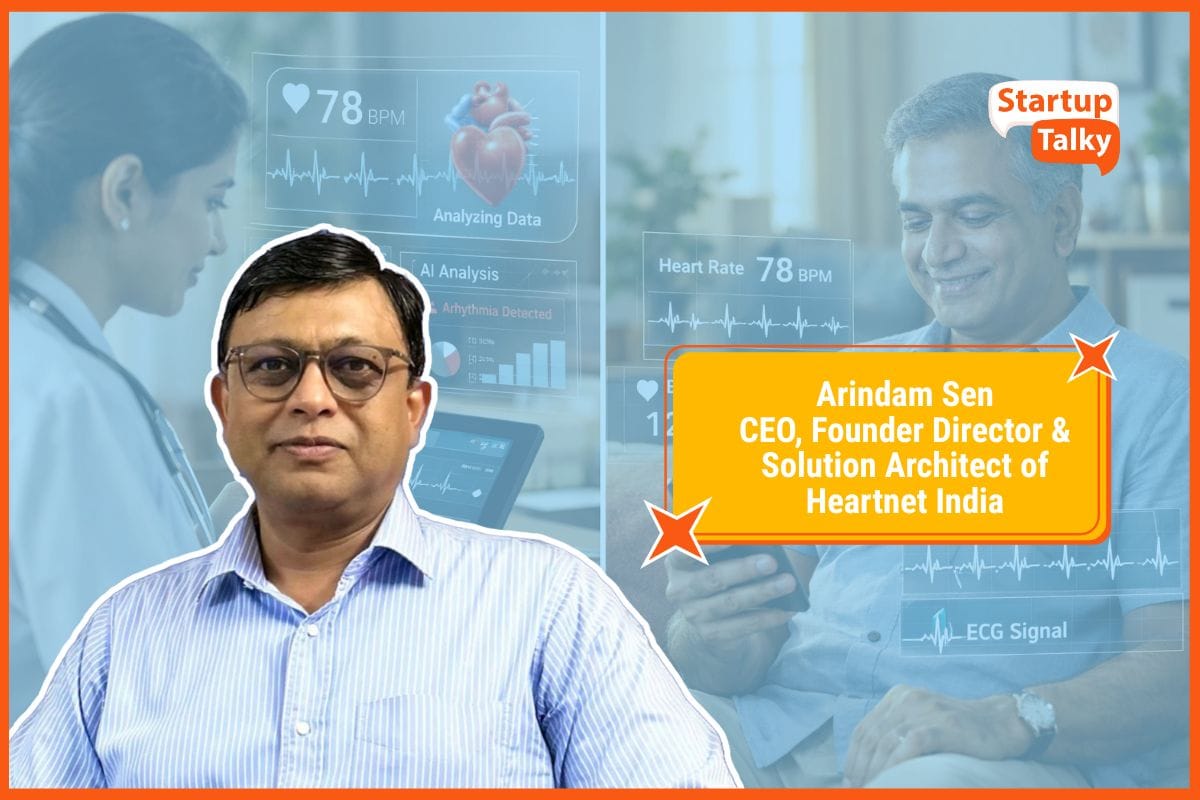
StartupTalky presents Recap'25, a series of exclusive interviews where we connect with founders and industry leaders to reflect on their journey in 2025 and discuss their vision for the future.
In this edition of Recap’25, StartupTalky speaks with Arindam Sen, CEO, Founder Director, and Solution Architect of Heartnet India, who reflects on the company’s journey in expanding access to quality cardiac care through remote monitoring and digital heart health solutions. He shares how Heartnet’s community-focused programs and technology-enabled Continuity of Care model are helping bridge cardiology gaps in Tier 2, Tier 3, and rural regions, where specialist access remains limited.
Sen goes on to discuss Heartnet’s progress in building clinically validated IoT-connected ECG and heart monitoring systems, the role of data intelligence and automation in improving clinical efficiency, and the shift from episodic care to continuous remote monitoring in India’s healthcare ecosystem. The conversation also explores regulatory challenges in healthtech, emerging opportunities in preventive cardiology, and Heartnet’s strategic priorities for the coming year, including AI-driven risk assessment tools, deeper market expansion, and strengthening long-term patient and provider trust.
StartupTalky: How would you summarise this year for Heartnet India in terms of growth, key initiatives, and impact across patient or provider outcomes?
Arindam Sen: This year, Heartnet India experienced modest growth, yet significant growth in advancing access to heart health from local hospitals through remote cardiac monitoring and digital heart health solutions, along with formalising remote assessment of patients with regard to coronary artery disease post-procedure. We extended our reach into a number of community-based health programme areas throughout India, particularly where there remains a shortage of cardiologists available to treat patients with coronary artery disease.
Initiatives such as our Primary Screening and Women’s Heart Health Intervention Program modelled a continuum of access to preventative cardiac services for the communities we serve. Additionally, our technology provided additional enhancements to provider efficiency through the implementation of the Continuity of Care Program and enabled providers to make clinical decisions with accurate data at the time of service provision. Ultimately, 2025 helped to reaffirm Heartnet’s commitment to ensure the availability of high-quality cardiac care is both more accessible and affordable while providing proactive access for the patients served by Heartnet-affected providers.
StartupTalky: What breakthrough innovations or clinical validations did your team achieve this year, especially in areas like AI, digital therapeutics, remote care, or device intelligence?
Arindam Sen: Throughout the year, we worked to make improvements to our remote cardiac monitoring ecosystem with an emphasis on providing clinically relevant and usable data rather than providing proof-of-concept technology or devices. Both the IoT-connected ECG and heart monitor provide continuous transmission of patient data, report data via the Cloud, remote ECG monitoring and can easily integrate into existing clinical workflow processes.
Our solutions have been validated more and more through clinical use – primarily for early identification of arrhythmias and early heart diseases detection. We have also begun to build out the deeper capabilities of our AI-based solutions that will be incorporated into future products as trend analysis and risk stratification continue to grow.
StartupTalky: Healthtech adoption has accelerated across hospitals, insurers, and consumers. What notable shifts or behavioural patterns did you observe in the Indian healthcare ecosystem this year?
Arindam Sen: The transition from episodic, hospital-based healthcare delivery to continuous and distributed monitoring has been one of the greatest visible changes. With chronic diseases such as heart failure and other cardiovascular conditions, hospitals and healthcare professionals have begun to adopt remote diagnostics and telecardiology services as an integral part of their care delivery models instead of simply being viewed as an adjunct service.
On the patient side, we see an ongoing increase in the adoption of monitoring at home and virtual visits due to the convenience, affordability, and trust in digital health technologies. And on the provider side, we see an increasing desire for providers to build solutions that are low-cost, easy to implement, and clinically validated rather than complicated solutions that increase operational complexity.
StartupTalky: How are you using AI, data intelligence, or automation to improve clinical efficiency, reduce costs, or enhance the patient experience? Please share any measurable improvements where possible.
Arindam Sen: The utilisation of data intelligence and automation will allow Heartnet to streamline ECG acquisition, reporting, and clinical review processes with real-time cardic data. The use of automated workflows will allow Heartnet to minimise the amount of manual intervention necessary for the ECG process, thereby enabling quicker turnaround time as well as providing clinicians the opportunity to focus on interpretation as opposed to administration.
Real-time alerts, smart heart monitoring devices, longitudinal data view, and centralised reporting will enable quicker clinical decisions to be made and will reduce unnecessary repeat testing. Even though Heartnet is still developing fully automated AI-driven predictive models, data analytics will continue to provide operational efficiencies and a more seamless patient journey in a high-volume electrophysiology screening environment.
StartupTalky: What were the biggest operational or regulatory challenges your organisation faced, and what helped you navigate them effectively?
Arindam Sen: Navigating through the regulatory compliance landscape, device standards, and data governance is ongoing for many HealthTech organisations in India, including ourselves. Our process has included extensive operational planning to ensure clinical reliability and connected healthcare solutions while enabling us to scale across diverse healthcare environments.
We have done this by coordinating with clinicians and following established medical protocols to ensure process robustness prior to expanding rapidly, and through our partnerships with community health workers and local healthcare providers to increase successful vital cardiology consultation and adoption of our services.
StartupTalky: As you look ahead to the coming year, what major opportunities do you foresee in India’s healthtech landscape, whether in partnerships, technology, policy, or care delivery?
Arindam Sen: With the advent of a developing India’s healthtech ecosystem, the focus will be on the benefits of affordability and scale over the benefit of novelty. Within the preventive cardiology space, this creates an immense opportunity to lower expenditures and reduce morbidity through pre-emptive and predictive treatment models (especially in pre-consumption testing).
In addition, we anticipate further opportunities through partnerships within the public and private sectors, with collaboration between insurers, and through community-based healthcare delivery methods. In addition, through digital telemedicine and continued growth of policies favouring digital solutions, we expect continued growth in the importance of risk assessment and population health screening using AI as data matures.
StartupTalky: What will be your top three strategic priorities for the new year in terms of product roadmap, market expansion, and strengthening patient trust?
Arindam Sen: Our major focus areas over the next twelve months are outlined below:
- We will be adding more enhanced analytic tools, greater ability to determine patient devices, and enhanced AI-based clinical insight tools for cardiac risk assessment while making sure that we maintain reliable and clinically dependable algorithms.
- We will continue to build our footprint within Tier 2, Tier 3, and rural markets by partnering with various hospitals, clinics, and community health organisations.
- With increased emphasis on our data security, greater transparency into how we report outcomes, and increased confidence in our products through long-term partnerships and partnerships that will benefit our clinician partners, the patients they treat, and their communities.
Explore more Recap'25 interviews here.