The New Productivity Stack: Why Automated Documentation Is the Next Big Shift for Indian Enterprises
✍️ Opinions
This article has been contributed by Ashok Kadsur - Co-Founder, Melento (formerly SignDesk)
Indian enterprises work at high speed, yet documentation still pulls teams backward. People spend hours searching for files, rewriting data, or fixing small errors that creep in from manual work. McKinsey reports that knowledge workers lose almost 20% of their week, looking for information. IDC estimates that document related challenges drain nearly 30% of company time.
These losses show up as delayed customer responses, slower internal decisions, higher error rates, and lower morale. In sectors like BFSI, healthcare, logistics, retail, and telecom, documentation is core to operations. When it fails, everything around it slows down.
Why Automated Documentation Matters Now
Automated documentation converts scattered, manual tasks into clean, structured information. It reduces human effort in summarising calls, preparing case notes, filling forms, or validating data. It also brings consistency to workflows where accuracy is non-negotiable. This shift is not only about using new technology. It is about building a productivity base where information is reliable, traceable, and easy to use.
When teams work with organised data, they move faster. They spend less time checking details and more time making decisions. This leads to higher quality outcomes with fewer revisions.
Three Forces Accelerating This Shift
- Regulations are rising: India introduced more than 350 compliance updates in the past year across key industries. Document gaps remain a top concern for regulators, especially in BFSI. Teams need automation to keep up without expanding headcount.
- Employees want lighter workloads: A Gartner study showed almost 70% of employees feel weighed down by administrative work. Repetitive documentation drains focus. Automation gives them room to do better work.
- Customers expect speed and accuracy: KPMG found that documentation delays are one of the biggest reasons behind slow credit decisions, claim settlements, and onboarding journeys. Faster and cleaner documentation improves trust and service quality.
The Five Principles That Define the New Productivity Stack
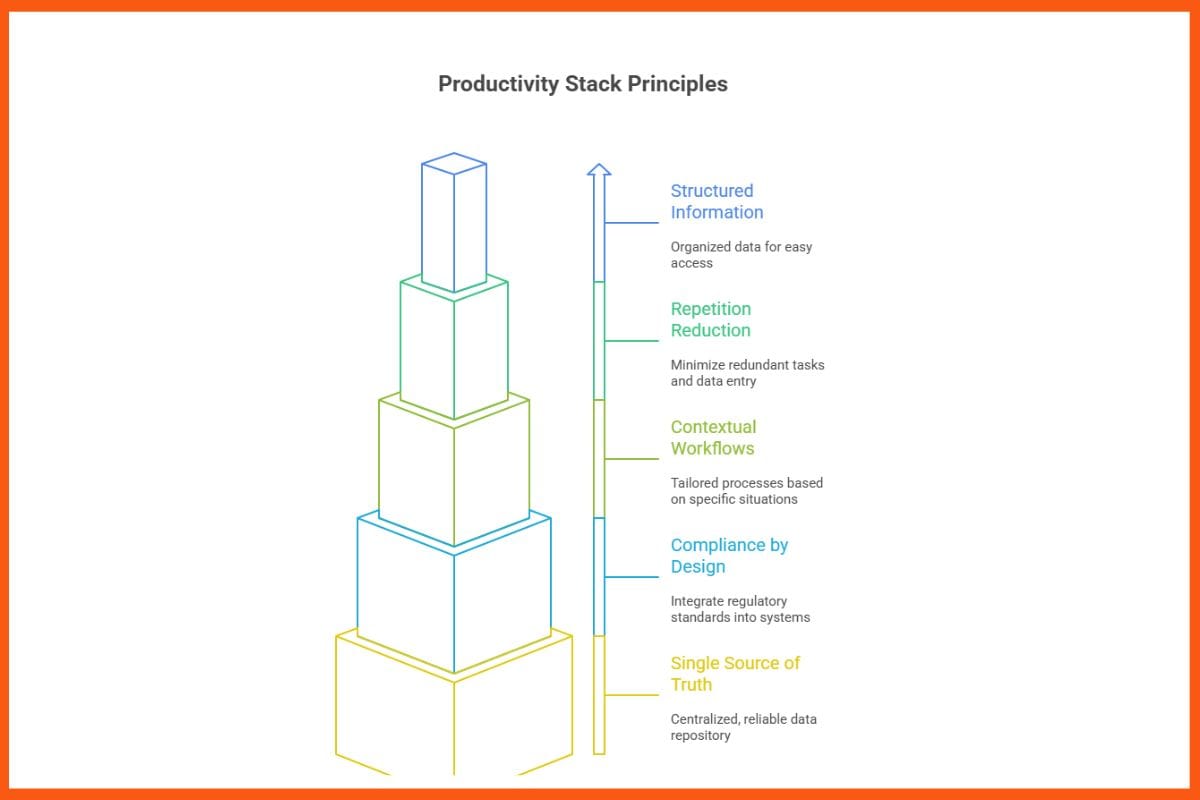
- Keep information structured: Scattered notes and inconsistent templates make teamwork harder. Automation brings order by turning raw inputs into clean formats that teams can reuse and audit.
- Reduce repetition: When people repeat the same steps across calls, cases, and reviews, errors rise. Automation removes these loops so teams can apply judgement instead of retyping.
- Build context aware workflows: Documentation affects underwriting, compliance, risk, operations, and customer service. Automated systems understand context and generate outputs that match the task.
- Ensure compliance by design: Rules change often. Manual tracking introduces risk. Automated workflows embed compliance into every step, reducing regulatory fatigue.
- Create one reliable source of truth: Teams need clarity. Automation centralises information so decisions are faster and miscommunication drops.
Why Indian Enterprises Are Ready
India’s digital foundation is strong. Cloud adoption is high. Employees are comfortable with workflow tools. Customers want clean and transparent service experiences. Boards want predictable compliance and real-time oversight. Automated documentation fits naturally into this environment. It reduces friction without forcing complex organisational change.
It also aligns with India’s growing scale. Whether it is loan processing, claims, onboarding, vendor management, or field operations, documentation volume is rising across industries. Manual execution will not meet the pace that the next few years demand.
Takeaway for Leaders
Automated documentation is not about replacing people. It is about removing the unnecessary weight on their day. It cleans up workflows, reduces mistakes, protects compliance, and improves customer response times. It turns documentation from a burden into a strength. Leaders who invest in this shift early will build teams that work with more clarity and less fatigue. They will also create organisations that react faster to change.
Conclusion
India’s next productivity leap will be powered by cleaner systems, not larger teams. Automated documentation helps enterprises run with less noise and more accuracy. It brings structure, speed, and trust to the heart of operations. As regulations grow and customer expectations rise, this shift will become essential. The organisations that adopt it now will be better prepared for the future and more resilient in the present.
 Vivek Dev Jacob