

Best Product Prototyping Tools for Startups and Enterprises in 2026
🏆 Lists & Rankings
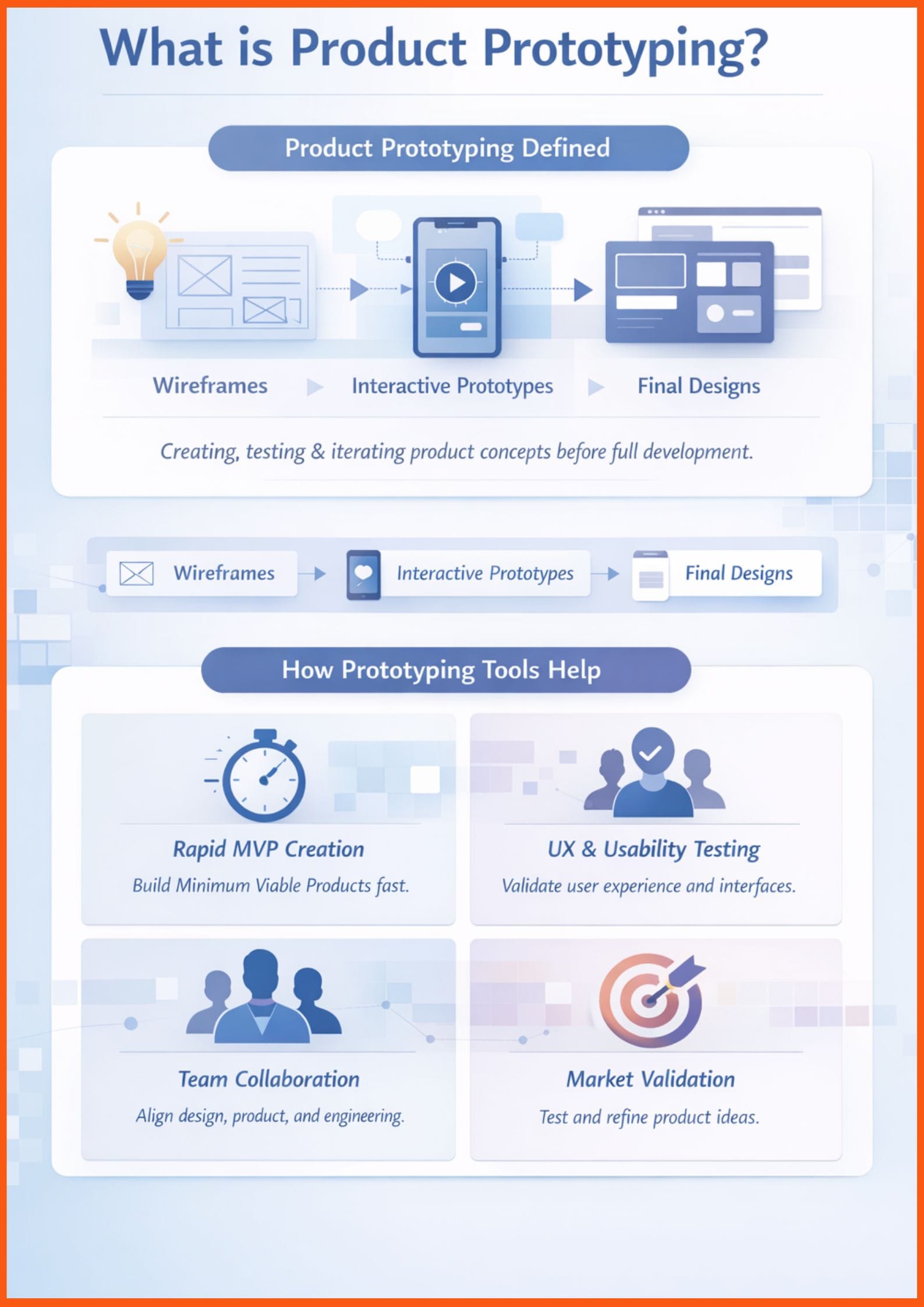
Product prototyping tools are digital platforms that help teams design, visualise, test, and validate products before full-scale development. For startups, they enable rapid MVP creation, user validation, and faster go-to-market execution. For enterprises, they support structured product development, UX consistency, and scalable innovation workflows.
As modern product development increasingly blends design, engineering, and business strategy, these product prototyping platforms play a critical role in UX prototyping, digital product design, validation cycles, and enterprise product innovation, making them essential product development platforms across the lifecycle.
In this article, explore the list of some of the best product prototyping tools for startups and enterprises.
Product Prototyping Tools Comparison
| Tool Name | Founded | Country | Category | Best For | Core Use Case |
|---|---|---|---|---|---|
| Figma | 2012 | United States | Enterprise Collaboration | Cross-team design & UX | Cloud-based design-to-prototype workflows |
| Qt Group | 1995 | Finland | Application Development Tools | Industrial & embedded products | Enterprise-grade product development platforms |
| ProtoPie | 2014 | South Korea | Product Management Tools | Advanced interaction design | High-fidelity UX prototyping tools |
| Anima | 2015 | United States | Generative AI | Design-to-code workflows | AI-powered design-to-prototype platforms |
| Marvel | 2013 | United Kingdom | Product Management Tools | MVP testing | Simple prototyping tools for startups |
| Clutch | 2011 | United States | Enterprise Collaboration | Product collaboration | Feedback-driven prototyping software |
| Proto | 2011 | United States | Software Modelling Tools | System modelling | Enterprise prototyping software |
| Figr | 2023 | India | Software Modelling Tools | Early-stage product teams | AI-first product innovation tools |
| InVision | 2011 | United States | Enterprise Collaboration | Enterprise UX workflows | Design collaboration platforms |
| Mokkup | 2022 | United States | Product Management Tools | Fast mockups | Lightweight digital product design tools |
How We Chose These Tools
We built this list to reflect real-world product-building needs across startups and enterprises. Our goal was to identify product prototyping tools that actually support teams across the full product lifecycle, not just design, but validation, development, and scale. Here’s the framework we used:
- Product lifecycle coverage: We looked at how each platform supports the journey from ideation and concept validation to UX design, prototyping, MVP building, and full product development.
- UX & design capability: We evaluated the strength of each tool as a digital product design platform, including its UX workflows, usability testing support, and overall value as a UX prototyping tool.
- Prototyping depth: We prioritised platforms that support both low-fidelity wireframes and high-fidelity interactive prototypes, helping teams move seamlessly from ideas to validation.
- Collaboration features: We focused on real-time collaboration, feedback systems, stakeholder alignment, and cross-team workflows between product, design, and engineering.
- Enterprise readiness: We assessed scalability, security, governance, and compliance readiness for teams operating in enterprise prototyping software environments.
- Startup usability: We ensured the tools are practical for early-stage teams, with accessible onboarding, fast adoption, and real value for startups building MVPs.
- AI and automation capability: We included platforms that use AI to speed up design-to-prototype workflows, automate repetitive tasks, and accelerate iteration cycles.
- Market adoption: We considered platform trust, real-world usage, ecosystem strength, and adoption across industries and product sectors.
- Platform maturity: We evaluated long-term stability, integrations, reliability, and overall viability as core product development platforms.
This approach helps ensure the tools we’ve listed don’t just look good on paper. They function as real product innovation tools that can support speed, validation, and scalable growth for both startups and enterprises.
List of Best Product Prototyping Tools
Figma
Figma is a cloud-based product prototyping platform that enables teams to design, prototype, and collaborate in real time. It integrates UX design, feedback loops, and developer handoff into a single workflow, making it a core product management tool for both startups and enterprise product teams.
Pros
- Strong real-time collaboration for distributed teams
- Scales well across product, design, and engineering teams
Cons
- Performance constraints on very large design systems
- Advanced features require paid plans
Qt Group
Qt Group provides enterprise-grade product development platforms focused on application development, embedded systems, and UI design. It supports full product lifecycle management, from prototyping and modelling to deployment, making it a strong enterprise prototyping software for complex systems.
Pros
- Strong enterprise and industrial-grade tooling
- Deep integration with embedded and IoT ecosystems
Cons
- Steeper learning curve for startups
- Higher enterprise licensing complexity
ProtoPie
ProtoPie is a high-fidelity UX prototyping tool focused on realistic interactions and complex micro-animations. It allows product teams to simulate real product behaviour, making it ideal for usability testing, validation, and advanced digital product design workflows.
Pros
- Highly realistic interactive prototyping
- Strong usability testing capabilities
Cons
- Limited design creation features
- Requires integration with design tools
 Vivek Dev Jacob
Anima
Anima is an AI-powered design-to-prototype platform that converts designs into functional code and interactive prototypes. It bridges design and engineering, supporting faster MVP building and validation across modern product development platforms.
Pros
- AI-driven design-to-code automation
- Speeds up MVP development cycles
Cons
- Limited control over generated code logic
- Best suited for early-stage prototyping
Marvel
Marvel is a simple, lightweight UX prototyping tool designed for startups and small product teams. It focuses on rapid wireframing, clickable prototypes, and user testing for fast product validation.
Pros
- Easy onboarding and usability
- Strong for quick MVP testing
Cons
- Limited advanced interaction capabilities
- Not built for enterprise-scale workflows
Clutch
Clutch focuses on product collaboration and structured feedback workflows. It enables teams to manage product decisions, feedback cycles, and validation processes, positioning itself as a strategic product management and prototyping support platform.
Pros
- Strong feedback and decision management
- Improves cross-team alignment
Cons
- Not a full design or prototyping engine
- Relies on integrations for design workflows
Proto
Proto is a software modelling and system prototyping platform focused on complex product architectures. It supports structured modelling, simulation, and enterprise-level product validation workflows.
Pros
- Strong system modelling capabilities
- Enterprise-grade product structuring
Cons
- Not design-centric
- Limited UX prototyping focus
Figr
Figr is an AI-first product innovation tool built for early-stage teams and startups. It automates wireframes, layouts, and design generation, enabling faster prototyping and concept validation.
Pros
- AI-driven rapid prototyping
- Startup-friendly workflows
Cons
- Limited enterprise integrations
- Early-stage platform maturity
InVision
InVision is an enterprise UX collaboration and prototyping platform supporting design systems, workflow management, and product collaboration. It helps large teams manage design consistency and validation at scale.
Pros
- Strong enterprise collaboration features
- Design system management capabilities
Cons
- Reduced feature expansion in recent years
- Heavier enterprise focus over startups
Mokkup
Mokkup is a lightweight digital product design and prototyping platform focused on fast wireframes and early product concepts. It enables teams to visualise ideas quickly without complex design processes.
Pros
- Fast mockup creation
- Simple product validation workflows
Cons
- Limited advanced prototyping features
- Not suitable for complex UX systems
Vivek Dev Jacob
Conclusion
Product prototyping tools are no longer just design utilities, they have become core infrastructure in modern product development. Whether you’re a startup building an MVP or an enterprise driving large-scale digital transformation, these product prototyping platforms help you move faster, validate smarter, and build better user experiences.
By connecting UX prototyping tools, digital product design tools, engineering workflows, and business strategy, today’s platforms work as true product innovation tools, not just standalone software. They help teams reduce risk, shorten development cycles, and make better product decisions earlier in the process.
If you’re building serious digital products, structured prototyping isn’t optional anymore. It’s a practical foundation for speed, validation, and long-term innovation, helping you turn ideas into scalable, competitive products with clarity and confidence.