

The Great Debate: Building in Public vs. Stealth Mode for Startups
📰 News
The practice of "Building in Public" (BIP), where a company shares its progress, metrics, and challenges openly with the community, has become a defining trend in the startup world. Proponents argue it fosters community and provides invaluable feedback, while critics contend it is a dangerous distraction that drains vital resources. A recent debate among founders and entrepreneurs on X (formerly Twitter) highlighted the critical nuances of this approach, suggesting that the effectiveness of BIP is highly dependent on a company's stage and resources.
The Case Against Building in Public for Startups
The most vocal opposition to BIP for early-stage companies centers on the concept of finite attention. Nikita Bier, X's head of product and a successful app entrepreneur, argued that for cash-strapped startups, the attention commanded by BIP is a limited resource that is better allocated to core development. This public-facing effort can become a significant distraction, burning finite attention on early pivots and unpolished ideas that may not survive.
A core tenet of the counter-argument is the need for unfettered experimentation in the early stages. Founders like Jason Fried favor early obscurity, or "stealth mode," to allow for free experimentation without the pressure of public scrutiny. This freedom is crucial for achieving Product-Market Fit (PMF). As Christopher Nheu noted, pre-PMF, the biggest barrier is often the founder's own conviction, and everything else, including the noise of public building, is a distraction.
Furthermore, the debate revealed practical drawbacks to the public approach:
- Hype vs. Traction: The excitement generated by public building, such as waitlist signups, does not always translate into real traction or paying customers post-launch, leading to a sense of letdown.
- Oversaturation and Copying: The sheer volume of projects now being built in public has led to a "spamming" of timelines, making it difficult for any single project to stand out. More critically, the risk of a project being copied early has increased "1000x" compared to a few years ago.
- The Burden of Presence: Some founders simply prefer to focus on their product without the added requirement of maintaining a constant "social media presence" to push their product, arguing that some people "just wanna...be".
When Building in Public Is the Right Strategy
While the consensus among critics is that BIP is often the "wrong move for startups", the debate clearly established that the strategy is not universally flawed. Instead, its success is highly contextual, depending on the company's stage, goals, and product type.
The strategy appears to be best suited for established companies or those with proven ideas. For established entities, attention is an advantage, not a finite resource. BIP allows them to pre-announce features, gather early feedback from their existing user base, identify edge cases, and secure buy-in, leading to a launch with "far fewer surprises".
Other scenarios where BIP is deemed effective include:
- Solopreneurs and Personal Brands: Successes like Nomad List, built through open updates, suggest the model works well for solopreneurs or projects where the founder's personal brand is integral to the product.
- Community-Driven Products: If a product requires significant community buy-in, such as those involving presales or tokens, building in public can be an effective way to generate the necessary momentum and conviction.
The core takeaway is that for a startup, "attention is oxygen and it runs out fast," making stealth mode the preferred approach for speed and early pivots. Conversely, for an established company, BIP is an advantage for polish and refinement.
Comparison: Stealth Mode vs. Building in Public
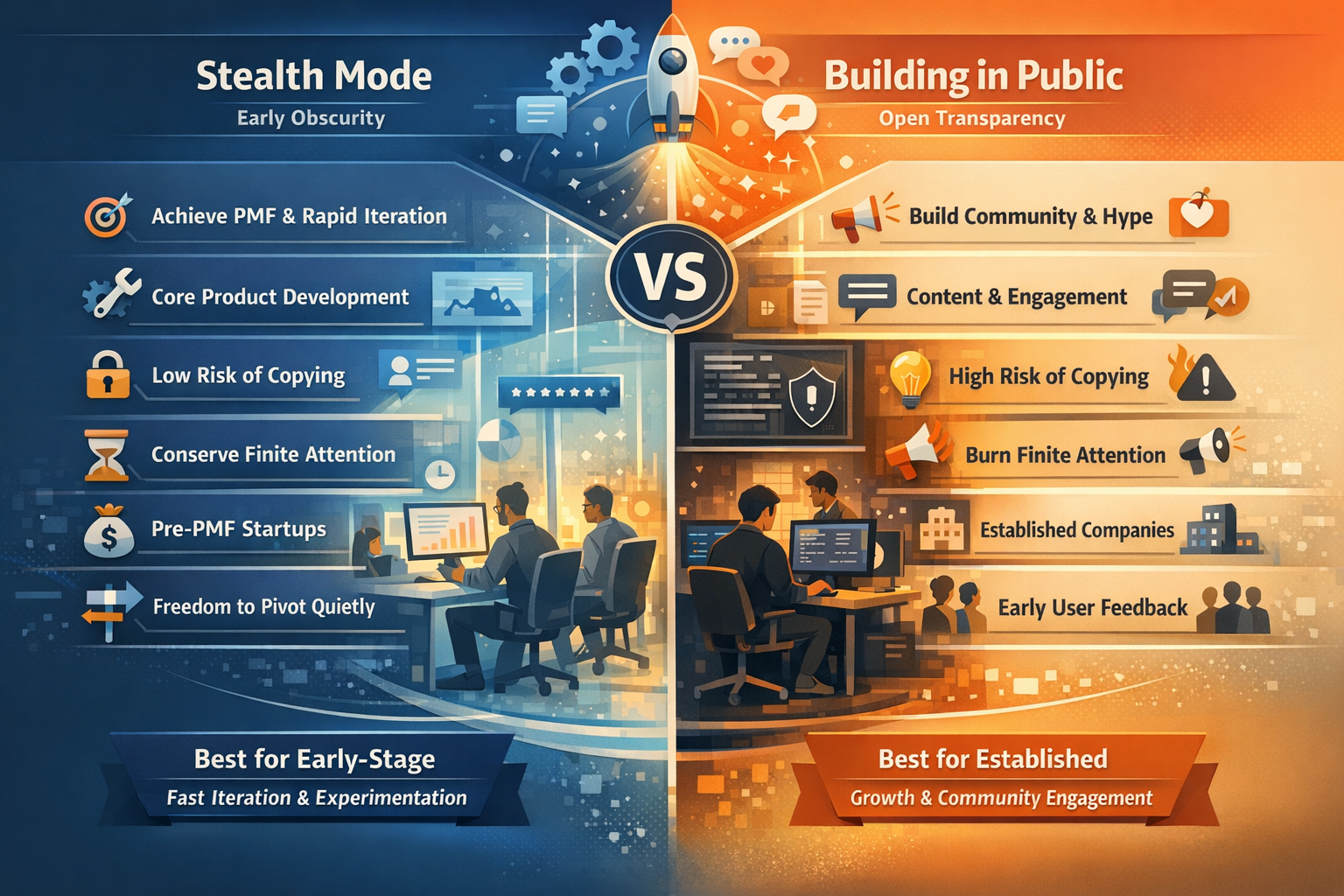
The following table summarizes the key arguments for each approach, highlighting the stage at which each strategy is most beneficial.
| Feature | Stealth Mode (Early Obscurity) | Building in Public (BIP) |
|---|---|---|
| Primary Goal | Achieve Product-Market Fit (PMF) and rapid iteration. | Build community, gather feedback, and generate hype. |
| Resource Focus | Core product development and internal experimentation. | Content creation, community engagement, and public updates. |
| Risk of Copying | Low, as ideas and pivots are kept private. | High, with increased risk of competitors copying early. |
| Attention Economy | Conserves finite attention for internal use. | Burns finite attention on public-facing efforts. |
| Best Suited For | Cash-strapped, pre-PMF startups; projects requiring deep focus. | Established companies; solopreneurs; projects scaling proven ideas. |
| Key Advantage | Freedom to pivot and experiment without public pressure. | Early user feedback and community buy-in. |
Conclusion
The debate over Building in Public is not a binary choice between right and wrong, but a question of context. For the typical, resource-constrained startup, the arguments against BIP, namely, the distraction from PMF, the risk of being copied, and the drain on finite attention, are compelling. The consensus leans toward stealth for speed and experimentation in the early, volatile stages. Once a product has achieved a degree of stability and a proven idea, the shift to the public for polish and community engagement becomes a strategic advantage, leveraging attention to refine and scale the offering.