

Pedals of Hope to Purpose: How Chitralekha Patil is Driving Grassroots Change Through Education and Women Empowerment
📝InterviewsThrough initiatives like Pedals of Hope and Project Drishti, Chitralekha Patil is enabling education access and empowering women in rural India, proving how simple interventions can drive lasting change.
India’s rural education and women empowerment ecosystem is undergoing a steady transformation. According to industry estimates, female literacy in India has crossed 70%, yet dropout rates among rural girls remain a concern, often due to lack of access, mobility, and socio-cultural barriers. At the same time, CSR-driven initiatives and community-led development models are playing a critical role in bridging these gaps and enabling long-term, sustainable impact.
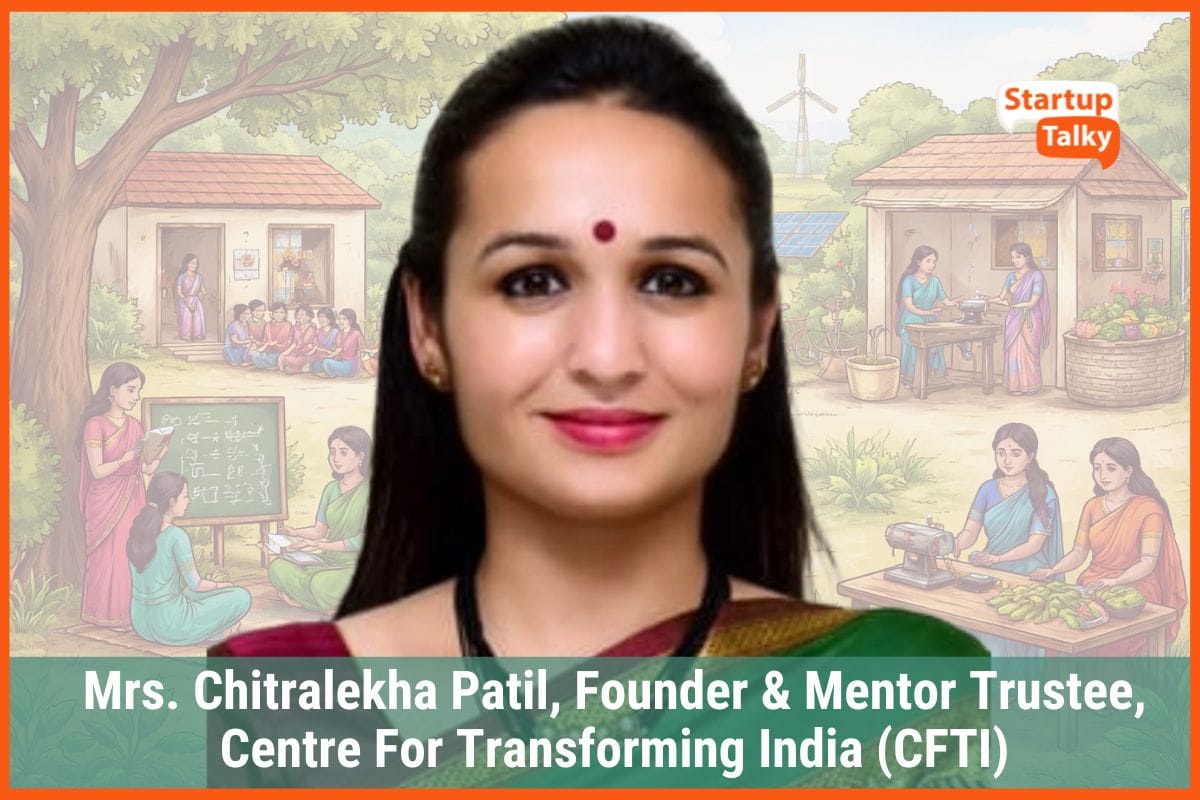
As part of StartupTalky’s International Women’s Day 2026 series, we spoke with Mrs. Chitralekha Patil, who is driving meaningful change at the grassroots level through initiatives like Pedals of Hope and Project Drishti. Her work highlights how simple interventions, when scaled with purpose, can transform education access, women’s leadership, and community development in rural India.
Pedals of Hope: Empowering 40,000+ Students Through Mobility
StartupTalky: Can you share the story behind the Pedals Of Hope campaign and how it has empowered 1,000 rural students in Alibag Taluka, Raigad district?
Mrs. Chitralekha Patil: The idea for Pedals of Hope came from a simple observation during our work in villages in Alibag Taluka. Many children were walking long distances sometimes 3 to 5 kilometres to reach school. This often affected their attendance, and in some cases led to dropouts, especially among girls.
We realized that a bicycle could be a simple but powerful solution. Through the campaign, we began providing bicycles to students from families who could not afford them. So far, more than 40,000 students have received bicycles. The impact has been immediate, better school attendance, more confidence among students, and greater independence for girls. Something as basic as a bicycle can truly change a child’s educational journey.
Women as Institution Builders: From Participation to Leadership
StartupTalky: How does this initiative view women as institution builders, moving beyond participation to leadership in business, community development, and public life?
Mrs. Chitralekha Patil: At CFTI, we see women not just as participants but as leaders and institution builders. When women are given the right support and opportunities, they naturally step into leadership roles. Through our programs, we encourage women to lead self-help groups, run small businesses, and participate in community decision-making.
Over time, we have seen women evolve from quiet participants to confident leaders who inspire others and drive change within their villages. Infact most of my team mates at CFTI are women and I love to see them empowered with every decision they make.
Enterprise Models: Driving Sustainable Development in Rural India
StartupTalky: How can enterprise models drive sustainable development and long-term social impact, especially for women in rural communities?
Mrs. Chitralekha Patil: Enterprise creates lasting change because it builds independence. When women start small businesses, whether in tailoring or catering they bring steady income into their homes. This improves not just financial stability but also confidence and decision-making power within the family. It also strengthens the local economy by creating more livelihood opportunities. For us, sustainable development means helping communities become self-reliant rather than dependent.
Education as a Catalyst for Women Empowerment
StartupTalky: What role does education play in empowering women and girls in rural Maharashtra, and what results have you seen from this initiative so far?
Mrs. Chitralekha Patil: Getting an education is one of the most important ways to help rural women or girls in Maharashtra become empowered. Through education, women/girls are able to increase their confidence, improve their ability to make decisions, and gain long-term economic security.
To help ensure that girls go to school, stay in school, and finish their education, CFTI creates and implements programs to help address barriers that prevent girls from going to school. Examples of barriers include transportation, safety, and access to learning resources.
Because of these interventions, CFTI has successfully improved school attendance rates, retention rates, and community support for girls' right to an education. In addition, over the period of time that these changes develop, new equitable societies will be created where girls can delay marriage, aspire to have bright futures, and women will take a more active and powerful role in the advancement of their communities.
Over time, these efforts contribute to broader social shifts delayed early marriages, increased aspirations among girls, and stronger participation of women in community development.
CSR at the Grassroots: Creating Measurable Impact
StartupTalky: Can you share insights on how CSR initiatives like Pedal's Of Hope & Project Dishti can create meaningful, measurable change for women at the grassroots level?
Mrs. Chitralekha Patil: Programs like Drishti Project & Pedals of Hope show how targeted interventions create measurable effects at the grassroots level. Through Pedals of Hope, girls facing mobility challenges that can hinder their ability to attend school regularly can safely travel and have a better chance to complete their education without dropping out.
The Drishti Project provides restored eyesight through the provision of eyeglasses and cataract surgeries for people who are elderly (mostly women) and impoverished who live in rural areas. These two programs represent the importance of working with communities to develop targeted and need-based programs to increase access to learning, promote dignity and create lasting opportunities for women and girls.
Overcoming Challenges in Rural Development
StartupTalky: What challenges have you encountered in implementing education and empowerment programs in rural areas, and how have you addressed them?
Mrs. Chitralekha Patil: One of the biggest challenges in rural areas is building trust and awareness. Sometimes families are hesitant, especially when it comes to girls’ education or women stepping into leadership roles. Our approach has always been to work closely with the community, engaging with village leaders, teachers, and families.
Once people begin to see real outcomes, children continuing their education and women earning incomes, the mindset gradually changes. Development works best when communities themselves become partners in the process.
Scaling Impact: The Vision for the Future
StartupTalky: What is the long-term vision for this partnership, and how do you plan to scale the impact of women’s empowerment through education and community development?
Mrs. Chitralekha Patil: The ability to make a difference at the ground level with focused, targeted campaigns like the Pedals of Hope initiative and Project Drishti proves that through specific, guided approaches you are able to achieve both a tangible, measurable difference for the participants in question.
With regard to Pedals of Hope, the initiative has had a positive outcome for many boys and girls by providing safe transportation for girls who previously had no means or ability to attend school; as a result, girls will be able to go to school more regularly and have a greater chance of continuing through to graduation than if they had no other options.
On the other hand, Project Drishti focuses on restoring eyesight through either spectacles or cataract removal, which will ultimately improve both children’s and women’s quality of life within rural communities.
Together, both of these initiatives further illustrate, through a focused needs-based program implemented with a community partnership, that they have made a substantive difference in providing improved access to education and improved dignity and will ultimately provide long-term benefits for women and girls.