Purpose Over Profit: How Clelia Cecilia Angelon Built Surya Brasil into a Conscious Beauty Brand
📝InterviewsIn this insightful conversation, Clelia Cecilia Angelon shares how Surya Brasil integrates purpose, sustainability, and Ayurveda to build a conscious global beauty brand. From ethical sourcing to long-term impact, she explains why values-driven growth creates lasting trust and success.
The global beauty and personal care industry is undergoing a major transformation, driven by rising demand for clean beauty, sustainability, and ethical sourcing. The market is projected to surpass USD 750 billion by 2030, with natural and organic beauty products growing at a significantly faster pace than conventional categories. Consumers today are increasingly prioritizing ingredient transparency, vegan formulations, and environmentally responsible brands.
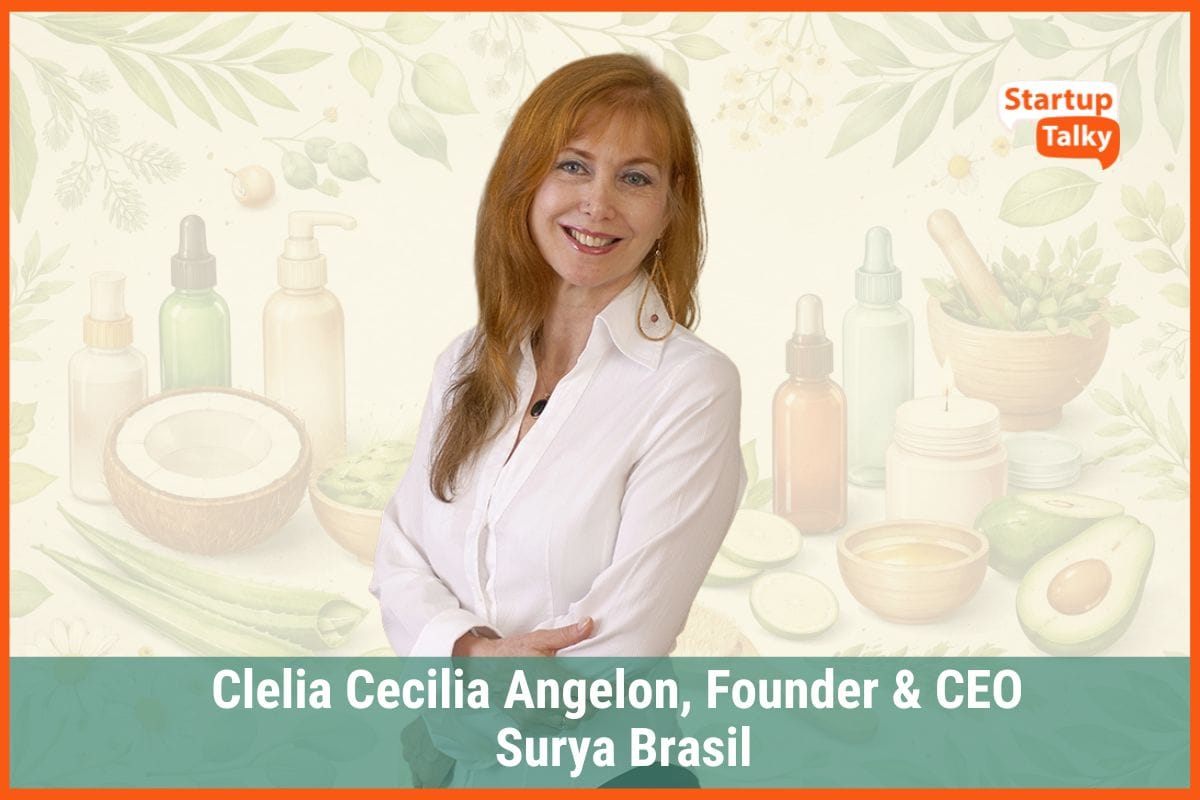
As part of StartupTalky’s International Women’s Day 2026 series, we spoke with Clelia Cecilia Angelon, the founder of Surya Brasil, a brand that has pioneered Ayurveda-inspired, vegan, and sustainable beauty solutions across global markets. In this conversation, she shares how purpose, spirituality, and business can come together to create meaningful impact.
The Founding Belief: Business as a Tool for Conscious Change
StartupTalky: What was the founding belief that everything else was built around?
Clelia Cecilia Angelon: As I embarked on my journey of creating Surya Brasil back in 1995, I didn’t start this company with the intention of launching yet another beauty company. I wanted to show the world that business can be a tool for spiritual awakening. I believed, and I still believe, that we can make beauty products that not only respect health, ethics, and the environment, but also make a positive contribution to the world by honoring all life on this precious earth we live on.
My association with India and Ayurvedic philosophy has been very profound, and I think that this philosophy of interconnectedness between body, mind, nature, and spirit has been the foundation of what I have built with Surya Brasil. I didn’t want to make products that would mask, change, or alter; I wanted to make products that would respect the intelligence of the body and the earth that we live on.
It was unconventional at the time to integrate ethics, sustainability, and global vision. People told me to pursue more conventional, for-profit approaches. But I knew that I had to put integrity before growth. If the foundation is aware, then growth can occur in a natural, sustainable way.
All of what we have created, from our henna cream hair color to our vegan products and our social programs, comes from that same starting point: business must create light, not darkness. Surya means “sun,” and the sun gives without taking away.
Scaling with Integrity: Balancing Hair Care, Sustainability, and Purpose
StartupTalky: How do you maintain a three-way commitment to hair care, sustainability, and purpose as the business scales?
Clelia Cecilia Angelon: Growing while remaining purpose-driven takes discipline and focus. For us, sustainability, effectiveness, and ethics are not three pillars that need to be balanced. Rather, they are incorporated into one framework of decision-making. Every conversation we have about product development begins with the same questions: "Is it safe? Is it responsible? Does it really serve people?"
Trust is what hair care is all about. When a consumer chooses our products, they are trusting us with their well-being. Performance, therefore, can never be sacrificed. However, we also refuse to sacrifice our standards on ingredient integrity. This sometimes means taking longer to formulate, being more selective in our sourcing, or being willing to pay a premium for production in order to retain our standards.
As we expanded into over 40 markets, the level of complexity escalated. Different regulations, different supply chains, and different consumer demands could very easily tempt a brand into taking shortcuts. However, we have been able to develop a robust system of internal governance and partnerships with suppliers that are aligned with our values. We will not be tempted by something that doesn't meet our ethical standards, no matter how attractive it may seem from a business perspective."
Purpose has to be operational, not promotional. It shows up in the raw materials we choose, the way we treat our teams, the pricing we offer, and the education we provide to consumers around Ayurvedic herbs and conscious beauty.
Growing responsibly takes longer, yes. But it also lasts longer. And at some point, consistency breeds trust, and that, my friends, is the most powerful growth strategy of all.
Redefining Profit: Choosing Purpose in Challenging Times
StartupTalky: What does building with purpose rather than profit look like in practice, and where has it been tested most?
Clelia Cecilia Angelon: Building with purpose doesn’t mean we don’t care about profitability. It means we have redefined what profitability means to us. For us, profit is not an objective; it’s a result. The objective is impact, on people, communities, and the environment.
So, it means taking decisions that may not necessarily provide us with a high return in the short term but make sense in terms of long-term values and objectives. Like using certified natural and vegan ingredients even though synthetic ones are widely accepted and cheaper in the market. Or investing in creating awareness about Ayurveda instead of just focusing on aggressive marketing strategies.
This philosophy was put to the toughest test in times of uncertainty, during an economic crunch and the pandemic. When the market is not stable, the temptation to cut costs and compromise on values is high. That’s when your values are really put to the test.
During the pandemic, instead of pulling back, we actually entered new countries. It was a choice to stay positive and purpose-driven. We chose to talk about resilience, about supporting partners, and about innovating, as opposed to responding out of fear.
Purpose also led us to launch social initiatives through Instituto Clelia Angelon. For me, being an entrepreneur means that I am not a separate entity from society.
It takes a lot of courage to build with purpose because the easy way may seem more incremental. But in the end, it leads to building trust, to building loyalty, and to building a relationship with consumers.
Beyond Greenwashing: Building True Sustainability
StartupTalky: How does Surya Brasil ensure its sustainability commitments are substantive rather than superficial?
Clelia Cecilia Angelon: Measurable and embedded sustainability is a must. In the current beauty industry, “green” terminology is sometimes used loosely. Right from the start, we knew that credibility requires transparency and accountability.
First, our products are based on natural, organic, and vegan ingredients. We do not use harsh chemicals because it is currently in vogue. Rather, it is consistent with our founding principles. We are also committed to responsible sourcing, particularly of botanicals.
Second, sustainability goes beyond our ingredients. It also involves our packaging, our manufacturing processes, and our energy consumption. We are constantly looking for ways to decrease our negative impact on the planet without affecting product safety and quality.
Third, education is key. We are open about the Ayurvedic herbs we use and why. Instead of overselling, we break down the science and the tradition behind each ingredient. This helps build trust.
We are also involved in social projects that help empower communities, especially women and at-risk groups. For us, sustainability is not just about the planet but also the people.
Shallow sustainability is marketing-driven. Deep sustainability is operations-driven. It takes time, effort, and sometimes hard decisions. But if your brand identity is based on consciousness, anything less than authenticity would be hypocritical.
Taking Ayurveda Global: Lessons from 40+ Markets
StartupTalky: What has taking an Indian-origin brand to international markets taught you?
Clelia Cecilia Angelon: Bringing Surya Brasil to over 40 countries has been not only inspiring but also educative. As a Brazilian company, our philosophical roots in Ayurveda and Indian culture are fundamental to our being. What I have learned is that being authentic is indeed global, but context is key.
The world over, consumers are becoming more and more interested in ancient wellness practices. Ayurveda, with its philosophy of balance, appeals to something fundamental in human nature. But the language and approach need to vary. In some countries, scientific proof is key. In others, heritage and ritual may have more resonance.
What does not translate is superficialism. When entering new markets, we never positioned Ayurveda as mystical or exotic. We have consistently positioned Ayurveda as a sophisticated and ancient practice that works in harmony with technology.
I also learned that the conscious beauty movement is a global dialogue. From the United States to Europe to Japan, consumers are questioning ingredients, supply chains, and brand values. This opens the door for brands like ours, but it also means staying the course.
Cultural awareness is key. Every region has its own beauty traditions and standards. Listening is as important as innovating.
At the end of the day, what works across borders is authenticity. When a brand truly cares about nature and people, that message translates universally. Consciousness knows no borders.
The Next Frontier: Regenerative and Transparent Beauty
StartupTalky: What is the next frontier for purpose-led beauty brands?
Clelia Cecilia Angelon: Formulation and sourcing that are clean and intentional are becoming the norm, and that is a good thing. But the next frontier is more complex. It is about systemic responsibility and regenerative thinking.
Purpose-driven brands must evolve from reducing harm to making a positive impact. This means regenerative agriculture for botanical sourcing, investment in biodiversity conservation, and making a positive impact on local communities.
Another frontier is radical transparency. Consumers want to know not only what is in a product but also how it is made, who made it, and what the overall impact is. Technology can help make supply chains more transparent.
We also need to think about consumption patterns. Beauty should not be about excess. Brands should design products that are multifunctional, long-lasting, and packaged in a way that is responsible.
Finally, emotional well-being will take center stage. Beauty is not just about aesthetics. It is also psychological and spiritual. The integration of ancient wisdom systems such as Ayurveda and modern science can lead to a more holistic approach to self-care.
Purpose-driven brands need to ask themselves: Are we just reacting to trends, or are we driving a healthier industry? The next frontier is leadership, not compliance.
Advice to Women Entrepreneurs: Values Are Your Strength
StartupTalky: What would you tell a woman entrepreneur pressured to compromise her values?
Clelia Cecilia Angelon: I would say to her, “Your values are not holding you back, your values are your competitive advantage.”
In my own life, I have been told many times to adjust, simplify, or compromise values to grow more quickly. There have been times when the pressure felt like it was extreme. However, every time I have chosen integrity, it has ended up building a stronger brand in the end.
Compromise might build a brand quickly, but it will compromise your identity. Without identity, your business is replaceable. Today, consumers are savvy. They know when a brand is genuine and when it is trying to take advantage.
Of course, being values-driven doesn’t mean being inflexible. It means being clear about what your deal-breakers are. You can innovate, evolve, and adapt, but the essence of who you are must remain the same.
Growth built on compromises can breed internal conflicts. Growth built on conviction can breed internal synergies, with your team, your customers, and yourself.
International Women’s Day celebrates that leadership can be empathetic, moral, and strong, all at once. We don’t have to follow traditional leadership to become successful. We can create new definitions of what that means.
Be patient. Be brave. Build something that makes you proud, not just something that makes you money. The right people will find you.
 Apoorva Bajj