Digital Risk Monitoring Checklist for Organisations That Cannot Afford Blind Spots
📖 Learning
A digital risk monitoring checklist is not a glossy document created to satisfy audit season. It is a working instrument. Something that reflects how the organisation actually operates online, not how it wishes it did.
Most breaches no longer begin inside the firewall. They start in overlooked domains, abandoned cloud instances, exposed credentials, supplier weaknesses, or social media impersonation. The external footprint grows faster than internal teams can track it. New applications appear. Marketing launches a microsite. A developer spins up a test server and forgets to retire it.
Digital risk accumulates quietly.
Security leaders know this. The difficulty lies in keeping visibility aligned with change. Controls drift. Assets multiply. Threat actors adapt faster than governance cycles.
A practical digital risk monitoring checklist forces attention back to the fundamentals. It asks uncomfortable questions about exposure and accountability. It reduces the guesswork that creeps in over time.
Digital Exposure Rarely Matches the Asset Register
Most organisations maintain a configuration management database. Few maintain a reliable picture of their real internet footprint.
Shadow IT remains persistent. Business units purchase SaaS tools on corporate cards. Subsidiaries manage their own hosting. Legacy domains remain live long after campaigns close.
Attackers do not rely on internal documentation. They scan, enumerate and correlate.
A checklist must therefore begin outside the perimeter. It should validate what the organisation looks like from the perspective of an adversary. Not once a year. Continuously.
This is not paranoia. It is realism. Several high-profile breaches in recent years stemmed from forgotten systems exposed to the internet. In many cases, the vulnerability itself was not novel. The problem was visibility.
Core Components of a Digital Risk Monitoring Checklist
The following structure reflects the natural flow of exposure, from asset discovery through to response readiness.
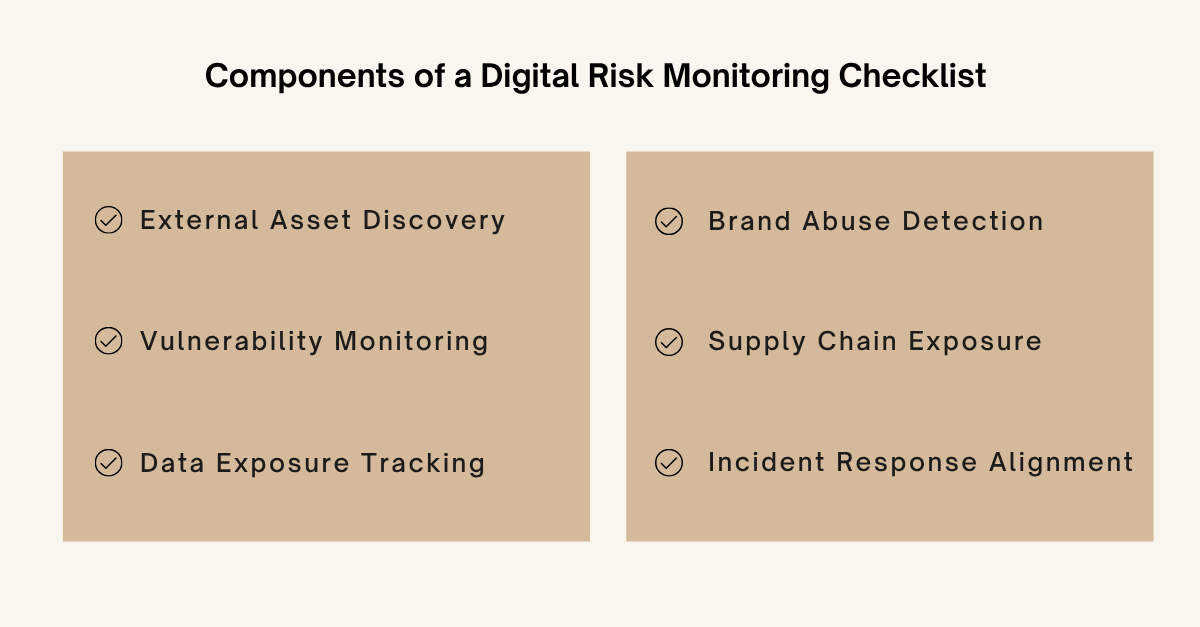
Before listing the elements, it helps to recognise that each one feeds the next. Weak discovery undermines vulnerability tracking. Poor credential monitoring weakens incident response.
External Asset Discovery
Identify all internet-facing assets associated with the organisation. Domains, subdomains, IP ranges, cloud instances, third-party platforms. This includes subsidiaries and acquired brands.
The objective is completeness. Even minor marketing domains matter. Automated scanning combined with periodic manual validation prevents blind spots from forming.
Vulnerability and Misconfiguration Monitoring
Discovery alone changes nothing. Assets must be continuously assessed for known vulnerabilities, exposed services and misconfigurations.
Cloud storage left open to public access remains a common issue. So do outdated content management systems and unpatched VPN gateways.
Monitoring should track new exposures as they appear, not simply produce a quarterly snapshot.
Credential and Data Exposure Tracking
Stolen credentials surface in breach dumps and dark web marketplaces with unsettling frequency. Monitoring for corporate email domains, privileged accounts and executive identities provides early warning.
This is not about reacting to every mention online. It is about identifying genuine credential compromise and responding before lateral movement begins.
Brand and Domain Abuse Detection
Phishing campaigns increasingly rely on lookalike domains and brand impersonation. Typosquatting, cloned websites and fraudulent social profiles erode trust quickly.
A structured checklist includes monitoring for newly registered domains resembling the corporate brand. Early takedown processes should already be defined, not improvised.
Third-Party and Supply Chain Exposure
External risk does not stop at direct assets. Suppliers with access to systems or data introduce indirect exposure.
Continuous assessment of third-party security posture, especially for critical vendors, reduces the chance of inherited vulnerabilities.
Incident Response Alignment
Monitoring without escalation pathways creates noise. Alerts must map to defined response procedures.
Each exposure category should have a named owner. Clear thresholds reduce debate during active incidents. If exposed credentials are detected, the reset and investigation process should be automatic.
The Human Factor in Digital Risk Monitoring
Technology surfaces the signals. People interpret them.
A recurring issue in many organisations is alert fatigue. External monitoring tools generate findings, but internal teams lack the capacity to triage consistently. Over time, lower severity alerts accumulate. Risk becomes normalised.
A checklist should therefore, include operational realism. Who reviews findings daily. Who validates severity. What happens when a critical asset appears unexpectedly.
Without ownership, even the best digital risk monitoring checklist becomes static documentation.
Another complication lies in executive exposure. Senior leaders are frequent phishing targets. Their credentials hold value. Yet executive monitoring is often treated delicately.
Effective programmes address this directly. Monitoring executive email domains and digital footprints should be routine. Quietly managed but not avoided.
Digital Risk Shifts Faster Than Governance Cycles
Boards typically review cyber risk quarterly. Digital exposure evolves daily.
New mergers expand the attack surface overnight. Remote work models increase reliance on cloud platforms. Development teams adopt new services to accelerate delivery.
Governance frameworks rarely move at that pace.
A digital risk monitoring checklist helps bridge that gap. It translates strategic risk awareness into continuous operational visibility. Instead of waiting for annual audits, security teams maintain a living picture of exposure.
Real-world incidents illustrate this point. In several ransomware cases across Europe, initial access was gained through exposed remote access services that had been deployed temporarily during operational change. They remained reachable long after the original need passed.
No exotic zero-day was required. Only an overlooked asset.
Integrating Monitoring into Existing Security Functions
Digital risk monitoring should not operate as a silo.
Threat intelligence teams provide context around active campaigns targeting specific industries. Security operations centres handle alert triage and escalation. Governance teams align findings with regulatory obligations.
The checklist acts as connective tissue. It ensures that external exposure findings are shared with internal defence teams.
For example, the detection of a newly registered phishing domain targeting employees should inform awareness teams. Exposure of cloud storage misconfiguration should trigger configuration reviews across similar environments.
This integration prevents repetitive weaknesses.
Measuring Effectiveness Without Reducing It to Metrics Theatre
Organisations often attempt to quantify everything. Number of assets discovered. Number of vulnerabilities detected. Number of takedown requests issued.
These figures have value. But they can also mislead.
If asset discovery suddenly increases, does that indicate improvement or uncontrolled sprawl. If vulnerability counts drop, is that due to remediation or reduced scanning depth.
A mature digital risk monitoring checklist focuses less on raw numbers and more on trend integrity. Are unknown assets decreasing over time. Are credential exposures being reset within defined timelines. Are phishing domains taken down before large-scale campaigns escalate.
Subtle indicators matter more than headline metrics.
Embedding Digital Risk Awareness into Business Culture
Monitoring tools operate quietly in the background. Cultural change requires conversation.
Business units should understand that launching a new external platform without informing security creates blind spots. Procurement teams should recognise that vendor onboarding introduces digital exposure beyond contract terms.
The checklist can serve as a communication tool. It frames digital risk as a shared responsibility rather than technical policing.
Security leaders who articulate exposure in practical business language tend to gain cooperation faster than those who rely solely on policy references.
Conclusion
A digital risk monitoring checklist is not a compliance artefact. It is a reflection of how seriously an organisation treats its external footprint.
Threat actors already map digital surfaces with precision. Organisations must do the same, or accept asymmetry.
When structured properly, monitoring connects asset discovery, vulnerability visibility, credential tracking and response readiness into one coherent process. It reduces surprise. It shortens response time. It limits reputational damage before it scales.
Many internal teams understand the theory yet struggle with sustained execution. Capacity constraints, fragmented tooling and unclear ownership often weaken consistency.
CyberNX can help you strengthen and operationalise your digital risk monitoring checklist in a way that reflects your real environment, not an idealised architecture diagram. They use cutting-edge software and a team of experienced professionals who can give you a full picture of your security, including any vulnerabilities, dark web behaviours and the risks that come with them.
Digital risk does not announce itself politely. Continuous monitoring ensures it does not remain invisible either.
 StartupTalky Official