
Divya Chandra of Atul Greentech on Scaling Electric Three-Wheelers, Swap-Enabled Last-Mile Mobility, and Building Reliability Beyond Incentives
📝Interviews
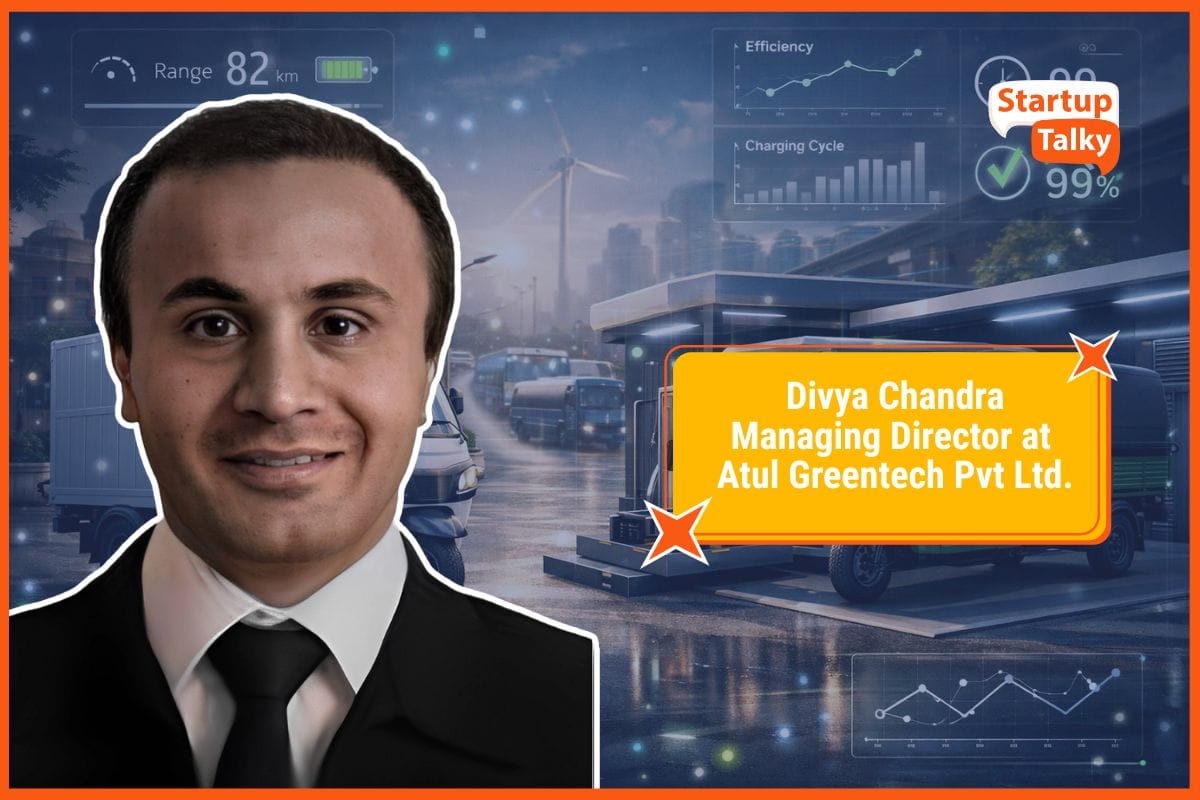
StartupTalky presents Recap'25, a series of exclusive interviews where we connect with founders and industry leaders to reflect on their journey in 2025 and discuss their vision for the future.
In this edition of Recap’25, StartupTalky speaks with Divya Chandra, Managing Director at Atul Greentech Pvt Ltd., who reflects on 2025 as a year of purposeful expansion and operational consolidation for India’s electric last-mile mobility ecosystem. He shares how the company focused not on growth for its own sake, but on entering the right markets with the right product deployments—expanding into new geographies such as the North East, introducing swap-enabled solutions in Bengaluru, and supporting public-sector cleanliness initiatives through electric L5 tippers deployed under the Swachh Bharat Abhiyan.
Chandra discusses how demand for electric three-wheelers has moved into mainstream adoption, with EVs now accounting for a significant share of the category and the L5 segment scaling rapidly across commercial, municipal, and logistics use cases. The conversation explores how supply chain volatility and shifting incentive structures shaped strategy in 2025, pushing stronger localisation, cost discipline, and resilience-led execution. He also highlights how telematics, battery intelligence, and data-driven insights from real-world usage are influencing product development—improving uptime, charging efficiency, and long-term reliability. Looking ahead to 2026, he outlines Atul Greentech’s roadmap to build a pan-India EV portfolio spanning regular charging, battery swapping, and fast-charging technologies, while offering practical advice to founders on building sustainable EV businesses driven by customer trust rather than short-term incentives.
StartupTalky: How would you summarise Atul Greentech’s journey in 2025? What key milestones, product updates, or deployments made this year special?
Divya Chandra: The year 2025 marked a phase of consolidation and purposeful expansion for Atul Greentech. Rather than pursuing growth for its own sake, our focus remained on entering the right markets, deploying the right products, and ensuring that every rollout translated into real-world impact.
One of the most significant milestones was our expansion into newer geographies, including the North East, a region that is increasingly opening up to electric mobility solutions for both commercial and public-sector applications. At the same time, we successfully introduced our swap-enabled products in Bengaluru, a city where operational efficiency and uptime are critical for last-mile operators.
From a customer perspective, seeing several of our vehicles cross the 1 lakh kilometre usage mark was a strong validation of product reliability, build quality, and long-term performance. Beyond domestic deployments, our products were also showcased at the French Bastille Day celebration hosted by the French Consulate at the Taj Hotel, reflecting growing global interest in India’s EV manufacturing capabilities.
Equally important was our contribution to public infrastructure initiatives. Our electric L5 tippers were deployed across multiple municipalities under the Swachh Bharat Abhiyan, supporting cleaner and more sustainable urban operations. Together, these milestones made 2025 a year defined by scale, credibility, and impact.
StartupTalky: What were the biggest challenges you faced in the EV and mobility sector this year, and how did your team navigate them?
Divya Chandra: The EV sector continues to evolve rapidly, and 2025 brought its own set of challenges. One of the most persistent issues was uncertainty around government incentives. While policy support remains important, frequent changes can make long-term planning difficult. To navigate this, we consciously worked towards reducing dependency on incentives by building a business model that is viable on its own fundamentals.
Another major challenge stemmed from global supply chain disruptions and rising costs driven by currency fluctuations, particularly the strengthening USD. These factors put pressure on both procurement and pricing. Our response was to accelerate localisation efforts by increasing the use of indigenous components and suppliers. This not only helped manage costs but also improved supply reliability and reduced lead times.
By focusing on controllable factors such as localisation, cost discipline, and operational resilience, we were able to navigate a volatile external environment more effectively.
StartupTalky: How has demand for electric three-wheelers and last-mile mobility changed in the past 12 months?
Divya Chandra: Over the past year, demand for electric three-wheelers has moved from early adoption to mainstream acceptance. The industry has witnessed a decisive structural shift, with electric vehicles now accounting for nearly 57 percent of the total three-wheeler market.
The L5 electric three-wheeler segment, in particular, has seen rapid growth. Within just three years, it has crossed an annual volume of 2 lakh vehicles, reflecting strong demand from logistics operators, municipal bodies, and commercial fleet owners. Customers today are no longer experimenting with EVs. They are adopting them at scale, driven by lower operating costs, improved product reliability, and expanding charging and service infrastructure.
This shift signals that electric last-mile mobility in India has entered a phase of sustained growth rather than isolated adoption.
StartupTalky: How is technology, especially AI, telematics, and battery intelligence, shaping your product roadmap?
Divya Chandra: Technology plays a central role in how we design, refine, and scale our products. Telematics and advanced battery management systems are no longer optional features. They are foundational to delivering reliable electric mobility solutions.
The data generated through these systems allows us to monitor vehicle health, analyse driving patterns, and anticipate maintenance requirements. This data-driven approach enables faster product iteration, improved energy efficiency, and reduced downtime for customers. Over time, these insights help us enhance range consistency, optimise charging behaviour, and improve overall vehicle lifespan.
By leveraging real-world data, we are able to continuously align our product roadmap with actual customer usage rather than assumptions.
StartupTalky: What operational or manufacturing learnings helped you improve performance, cost efficiency, or reliability this year?
Divya Chandra: One of our most valuable learnings in 2025 came from deeply analysing customer behaviour. Understanding how customers charge their vehicles, the times they operate, and the driving conditions they face has provided insights that directly influence design and manufacturing decisions.
These learnings have helped us improve component selection, refine software calibrations, and enhance thermal and electrical reliability. In many cases, small adjustments based on usage data resulted in meaningful improvements in uptime and durability.
This customer-first feedback loop has become an essential part of Atul Greentech’s operational and manufacturing strategy.
StartupTalky: What partnerships, collaborations, or ecosystem developments played a key role in your company’s growth in 2025?
Divya Chandra: Building a strong ecosystem was a key focus area for Atul Greentech during the year. Expanding our dealer network significantly improved our ability to reach customers, provide faster service, and offer localised support. Access to financing also played a crucial role in accelerating adoption.
By partnering with multiple financial institutions, we were able to offer flexible financing options across diverse geographies, making EV ownership more accessible. Additionally, we worked closely with infrastructure and energy solution providers to improve grid stability at customer locations, addressing one of the practical challenges faced by first-time EV adopters.
These ecosystem partnerships helped create a more holistic ownership experience for our customers.
StartupTalky: What metrics matter the most when evaluating product success and market fit in the EV mobility space?
Divya Chandra: At Atul Greentech, our approach to evaluating success is guided by a clear principle: safety, reliability, and connectivity at an optimum price. Metrics such as vehicle uptime, total cost of ownership, charging efficiency, and system reliability are critical indicators of product-market fit.
Beyond technical metrics, consistent performance under real-world operating conditions is what ultimately builds customer trust and long-term adoption.
StartupTalky: Looking ahead to 2026, what opportunities do you see emerging in India’s EV and last-mile mobility market?
Divya Chandra: As we move into 2026, electric last-mile mobility is expected to gain stronger traction in regions that have traditionally relied on CNG vehicles. Metro cities, in particular, are likely to accelerate EV adoption as air pollution concerns intensify and sustainability becomes a priority for both governments and businesses.
The convergence of policy support, improving infrastructure, and maturing products will create new opportunities across urban and semi-urban markets.
StartupTalky: What is your long-term vision for Atul Greentech, and what strategic steps are planned for the next phase of growth?
Divya Chandra: Our long-term vision is to build a truly pan-India electric mobility company with presence across all states. From a product standpoint, we aim to offer a comprehensive portfolio of electric three-wheelers catering to diverse use cases.
This includes vehicles compatible with regular charging infrastructure, swappable battery solutions, and ultra-fast charging technologies. By offering multiple technology pathways, we intend to give customers the flexibility to choose solutions that best fit their operational needs.
StartupTalky: What practical advice would you give to founders building in India’s EV ecosystem today?
Divya Chandra: India’s EV ecosystem presents a strong long-term opportunity, but it is also a demanding and highly value-driven market. Founders should prioritise building products that deliver consistent real-world performance rather than relying on early hype or incentives.
It is important to design business models that are viable on their own fundamentals, with limited dependence on government support. A deep understanding of customer usage patterns, operating conditions, and service expectations is equally critical, as these factors directly impact reliability and adoption.
In addition, founders should invest early in building a strong ecosystem around financing, service, and infrastructure. In India’s EV space, long-term success will be driven by reliability, cost discipline, and sustained customer trust rather than short-term scale alone.
Explore more Recap'25 interviews here.
Must have tools for startups - Recommended by StartupTalky
- Convert Visitors into Leads- SeizeLead
- Website Builder SquareSpace
- Run your business Smoothly Systeme.io
- Stock Images Shutterstock