
Gaurav Dagaonkar of Hoopr on Simplifying Music Licensing and Powering the Creator Economy
📝Interviews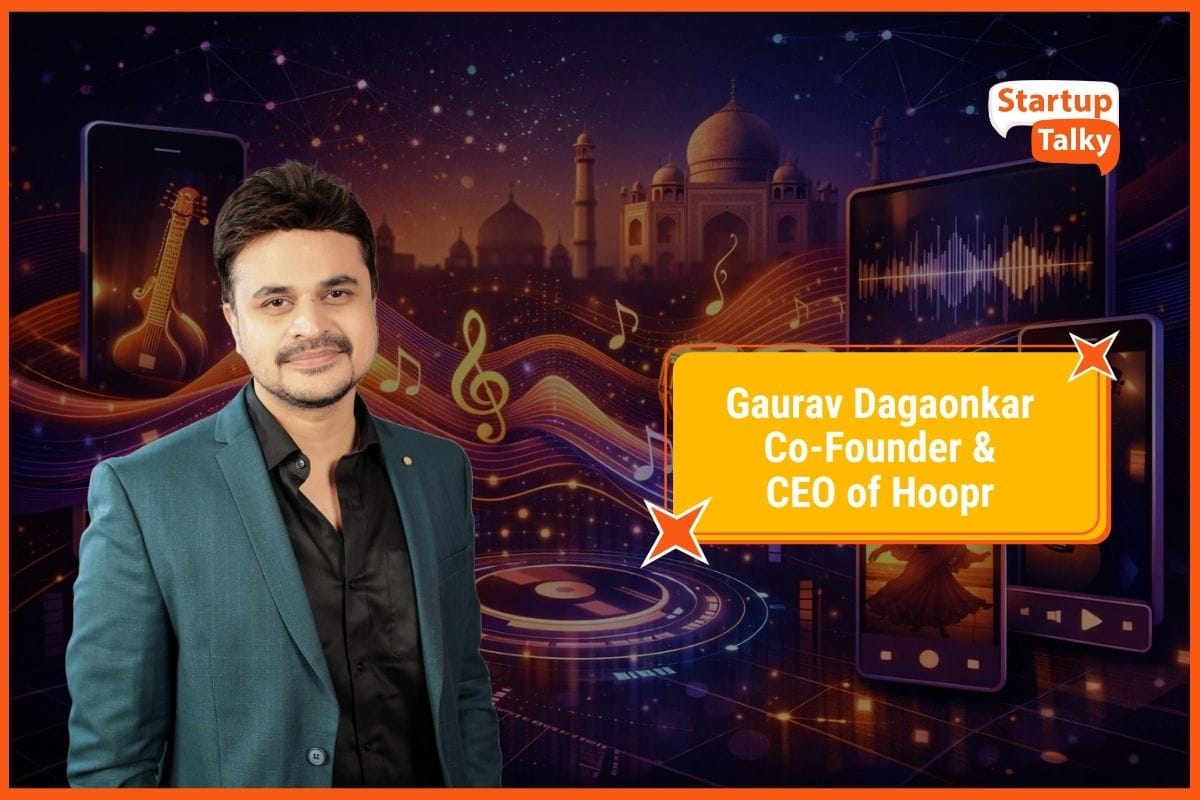
StartupTalky presents Recap'25, a series of exclusive interviews where we connect with founders and industry leaders to reflect on their journey in 2025 and discuss their vision for the future.
In this edition of Recap’25, StartupTalky speaks with Gaurav Dagaonkar, Co-Founder & CEO of Hoopr, who reflects on how India’s rapid shift toward digital-first content has fundamentally changed the role of music in advertising, branding, and the creator economy. Drawing from his personal experience as a musician and entrepreneur, Dagaonkar explains how music in India was long treated as a free commodity—and why the rise of short-form video, influencer marketing, and stricter copyright enforcement has made ethical, scalable music licensing a business necessity rather than an afterthought.
He goes on to discuss how Hoopr is addressing this gap by building a fast, transparent, and AI-led music licensing ecosystem that enables brands and creators to discover, license, and deploy culturally relevant Indian music at scale—while ensuring fair and consistent compensation for artists. The conversation also explores Hoopr’s expansion into brand solutions, film and OTT content, the growing importance of data-driven music selection, and how AI-powered discovery tools are helping brands achieve higher engagement while redefining how music is valued in India’s digital economy.
StartupTalky: What service does Hoopr provide? What was the motivation/vision with which you started?
Gaurav Dagaonkar: Hoopr is India’s leading music licensing and music-led brand solutions platform, enabling brands, creators, agencies, and broadcasters to legally discover, license, and deploy culturally relevant Indian music at scale. The business operates across two core verticals: Licensing and Brand Solutions.
Under Licensing, Hoopr offers a subscription-led, self-serve model that allows creators and businesses to license original Indian music seamlessly. This is complemented by Hoopr Smash, where the platform partners with independent artists as well as major music labels to make trending and popular tracks legally accessible for branded content, influencer campaigns, and digital advertising. AI-powered tools such as Brand Match Score and Content Idea Generation further accelerate music discovery and campaign ideation, enabling faster, more contextual, and culturally resonant content creation.
The second vertical, Hoopr Brand Solutions (HBS), is a tech and product-led offering built on Hoopr’s proprietary AMP Framework (Artist–Music–Promotion). This data-driven approach ensures the right artist, the right music, and the right amplification strategy are aligned for every campaign.
Hoopr has also expanded into films and OTT, with licensed music now featured in long-format content—most notably Saali Mohabbat, a track that went on to inspire the title of Tisca Chopra’s debut OTT film.
Hoopr was born out of a personal experience in 2019, when a piece of music I had created was used in an advertising campaign without consent or compensation—highlighting a systemic issue where music in India was largely treated as a free commodity. With the industry losing an estimated INR 3,600 crore annually due to copyright infringement, Hoopr was built to create a simple, fast, and transparent licensing ecosystem that ensures fair compensation for artists. Today, Hoopr supports 1500+ artists, works with over 400,000 creators, and has paid out more than INR 4.5 crore in royalties—helping redefine how music is valued and used in India’s digital economy.
StartupTalky: What new services have been added in the past year? What is/are the USP/s of your service?
Gaurav Dagaonkar: Over the past year, Hoopr has evolved beyond being a licensing platform into a full-fledged music intelligence and brand solutions company. With the launch of Hoopr Brand Solutions (HBS), we now enable brands to deploy music more strategically and measure its real impact within campaigns. Through HBS, we’ve delivered music-led work for brands such as Himalaya, ITC Bingo! Tedhe Medhe, and UltraTech Cement, powered by our proprietary AMP Framework (Artist–Music–Promotion). Unlike traditional agency models, AMP is data-driven and product-led, ensuring music choices are aligned with brand identity, audience behaviour, and campaign outcomes.
We’ve also expanded into film and OTT, enabling licensed music usage in long-format content. A notable example is Saali Mohabbat, where a track licensed via Hoopr went on to inspire the title of Tisca Chopra’s debut OTT film—signalling a natural extension of our role beyond short-form digital content.
Hoopr’s core differentiation lies in offering copyright-safe, scalable access to culturally relevant Indian music across Bollywood, independent, and regional catalogues. While Bollywood remains a dominant cultural force, our catalogue is curated to reflect what audiences are engaging with today. Hoopr data shows that branded videos using trending music drive 25–35% higher engagement.
Beyond discovery and licensing, Hoopr provides end-to-end copyright coverage—including IPRS-linked rights and transparent artist payouts built directly into the licensing cost—eliminating fragmented negotiations. This integrated combination of music, rights, data, and scale remains unmatched by global libraries or traditional licensing models in India.
StartupTalky: How has the industry you are in changed in recent years and how has Hoopr adapted to these changes?
Gaurav Dagaonkar: The shift to digital-first consumption is now structural, not cyclical. Advertising budgets have decisively moved from traditional media to digital platforms, with digital accounting for approximately 45% of total media spend in India—overtaking television for the first time. This transition has significantly amplified the role of music across Reels, Shorts, and branded videos, alongside the rapid expansion of the creator economy.
At the same time, streaming payouts to labels and artists have continued to plateau or decline, making it increasingly clear that passive listening alone cannot sustain the music ecosystem. As a result, labels and rights holders have become far more vigilant about how music is used commercially, accelerating the industry’s shift toward ethical, licensed, and enforceable usage models.
Hoopr anticipated this inflection point early. Today, Indian brands create over 32,000 pieces of branded digital content every day—each requiring instant access to safe, clearly licensed music. Rather than building for streams, we built for usage. Through micro-licensing and data-led music discovery, Hoopr enables brands to move at digital speed while ensuring artists are paid fairly and transparently. This approach has positioned us at the centre of India’s transition toward scalable, compliant, and future-ready music licensing.
StartupTalky: What key metrics do you track to check the Hoopr growth and performance?
Gaurav Dagaonkar: At Hoopr, we track conventional growth indicators such as creator, brand, and agency acquisition, monthly licenses issued, and overall revenue growth. However, these are not our north star.
Our true measure of success is the tangible value we create for our label partners and artists. The most important signal for us is simple and uncompromising: are artists getting paid meaningfully and consistently? When royalties flow regularly and at scale, it tells us that the ecosystem is working the way it should.
Beyond payout volumes, we closely monitor repeat licensing behaviour and catalogue reuse, which indicate sustained demand and long-term earning potential for artists rather than one-off usage. Together, these metrics allow us to evaluate not just platform growth, but ecosystem health—ensuring that scale, fairness, and sustainability move forward in tandem.
StartupTalky: What were the most significant challenges Hoopr faced in the past year and how did you overcome them?
Gaurav Dagaonkar: One of our biggest challenges was shifting a deeply entrenched belief that music is essentially free—especially as short-form branded content began scaling at unprecedented speed across platforms and markets. Music choices were being made in real time, while legacy licensing systems, built for films and television, simply couldn’t operate at that velocity. This gap became increasingly risky as labels and platforms tightened copyright enforcement, with high-profile legal actions and takedowns making muted campaigns and legal exposure a tangible concern for brands and creators alike.
Our response was to re-engineer music licensing for the realities of modern content creation—fast, intelligent, and safe at scale. By investing heavily in automation and AI-led discovery, we enabled instant access to clearly licensed, culturally relevant music with transparent usage rights. Tools like Brand Match Score help brands quickly identify tracks that align with their identity, while our AI Content Idea Generator converts music into ready-to-use campaign ideas, dramatically shortening decision cycles.
At the same time, as AI-generated music flooded the market, we made a conscious choice to stay highly curated—prioritising quality, originality, and clean rights. This ensures that brands can scale content with confidence, without compromising on speed, credibility, or creative integrity.
StartupTalky: What are the different strategies you use for marketing? Tell us about any growth hack that you pulled off.
Gaurav Dagaonkar: Our growth approach is intentionally blended. We combine product-led growth, performance marketing, and ecosystem-driven brand building—but we’re clear-eyed about what actually builds trust in a space like music licensing. While performance marketing plays a role, credibility in this category is earned far more through third-party validation than self-promotion. That’s why we’ve leaned heavily into creator advocacy, industry partnerships, and real-world product usage as proof points, rather than relying solely on traditional brand messaging.
Hoopr is a clear example of this philosophy in action. By reducing music licensing to a few intuitive clicks, we removed friction at the point of use. That simplicity drove organic adoption across creators and agencies, leading to strong repeat usage, referrals, and growth—largely without heavy marketing spends. For us, the product itself became the most effective growth engine.
StartupTalky: What are the important tools and software you use to run your business smoothly?
Gaurav Dagaonkar: We operate with a data-first mindset, using a layered analytics stack to drive efficiency and alignment across teams. This includes deep analysis of user behaviour through traffic and engagement analytics, platform-level performance tracking, real-time audience and brand sentiment monitoring via social listening tools, and end-to-end campaign management through marketing automation systems. Together, these insights enable our teams to collaborate seamlessly, respond faster to market signals, and make informed, high-impact decisions at every stage.
StartupTalky: What opportunities do you see for future growth in your industry in India and the world? What kind of difference in market behavior have you seen between India and the world?
Gaurav Dagaonkar: Developed markets present mature monetisation opportunities, as consumers in regions such as the United States and Europe have long been accustomed to paying for music and digital content. Subscription pricing for music and video services is significantly higher, and consumers willingly absorb this cost as part of their broader entertainment spend. This has created a deeply entrenched culture of paid consumption and formal licensing, supported by higher ARPU levels and well-established copyright frameworks.
India, however, operates on a fundamentally different consumption model. The market is highly price-sensitive, with users traditionally favouring ad-supported experiences over paid subscriptions. At the same time, India has one of the world’s largest creator ecosystems on a per-capita basis, making it an exceptionally fertile market for both creator-led and brand-driven content at scale.
This divergence presents a powerful opportunity. As brands, creators, record labels, and artists increasingly recognise the importance of copyright compliance and fair usage, India is beginning a gradual but meaningful shift toward ethical, legally compliant licensing models. While such structures are well established in developed economies, they are still evolving in India—creating a long-term growth runway for music and video platforms, licensing marketplaces, and the creator economy at large.
In effect, India is not lagging—it is leapfrogging, building licensing models that are native to digital-first consumption rather than retrofitting from legacy systems.
StartupTalky: How are you using AI, whether in service delivery, internal processes, or customer experience, and what impact has it created?
Gaurav Dagaonkar: At Hoopr, AI is fundamentally deployed to enhance discovery, precision, and content intelligence. Our Brand Match Score evaluates a brand’s digital footprint—including tone of voice, past campaigns, and audience behaviour—to surface tracks that are not only relevant, but culturally aligned and emotionally impactful. Once a track is shortlisted, our AI Content Idea Generator converts it into execution-ready campaign concepts, complete with hooks, CTAs, and beat-synced cues—dramatically compressing planning and turnaround times.
From an outcomes perspective, this intelligence layer has transformed how brands license music. Campaigns powered by AI-led recommendations have consistently delivered 25–35% higher engagement compared to conventional selection methods, enabling brands to move faster with greater confidence. Internally, AI also helps us identify emerging demand patterns and high-potential tracks, allowing us to sharpen curation, guide artist development, and optimize catalogue performance.
Ultimately, AI at Hoopr doesn’t replace creativity—it amplifies it. By removing friction from discovery and decision-making, we allow brands and creators to focus on storytelling, while making music licensing smarter, faster, and more effective.
StartupTalky: How do you plan to expand the Customers, service offering, and team base in the future?
Gaurav Dagaonkar: Our expansion strategy is deliberately multi-pronged. On the demand side, we are focused on scaling beyond our current base of 180+ brand partners and 30,000 creators by driving deeper adoption across digital-first brands, regional agencies, and global clients. With Deborah Smith joining us as Head of International Licensing & Sync, we have begun onboarding international catalogues—positioning Hoopr to serve markets such as the US, UK, Korea, and the UAE, while also enabling Indian brands to seamlessly access global music for their campaigns.
On the product and services front, we are accelerating the growth of Hoopr Brand Solutions and Hoopr Smash, with a strong emphasis on AI-led content ideation, regional-language campaign execution, and advanced analytics to quantify music-driven ROI.
From an organisation standpoint, we are investing aggressively in creative, technology, and data talent—spanning AI engineers, music curators, and campaign strategists—to future-proof the platform. By FY28, we aim to scale revenues to INR 100–130 crore, building a globally relevant, culturally rooted music-licensing ecosystem that delivers sustainable value for brands while ensuring long-term, fair monetisation for artists.
StartupTalky: One tip that you would like to share with another Service company founder?
Gaurav Dagaonkar: Obsess relentlessly over solving a real problem for your customers and the ecosystem you operate in. In service-led businesses, it’s easy to get distracted by feature checklists or vanity scale, but sustainable growth only comes when what you build genuinely makes life simpler, faster, or more secure for the people using it. At Hoopr, that clarity led us to focus on two things: removing friction from music licensing for brands, and creating fair, transparent revenue pathways for artists. Once we anchored ourselves to that problem, everything else—adoption, trust, and growth—fell into place. When the problem stays at the center, alignment follows.
 Muskaan Kapoor
Explore more Recap'25 interviews here.