The H-1B Visa Crisis: Backlogs, Policy Shifts, and the Looming Talent Drain
🔍Insights
The United States H-1B visa program, a critical conduit for skilled foreign talent, is currently facing an unprecedented crisis, particularly impacting Indian professionals. A confluence of new security protocols, policy changes, and operational backlogs has led to visa stamping interview appointments in India being pushed back to 2027, effectively stranding thousands of workers and creating significant disruption for American businesses. This detailed analysis explores the causes, the human and corporate impact, and the broader policy implications of this evolving situation.
The Anatomy of the 2027 Backlog
The core of the current crisis stems from a dramatic slowdown in consular processing at U.S. posts in India. Appointments originally scheduled for early 2026 have been systematically cancelled and rescheduled, with the first available slots now appearing in May 2027.
The primary drivers of this severe backlog are two-fold:
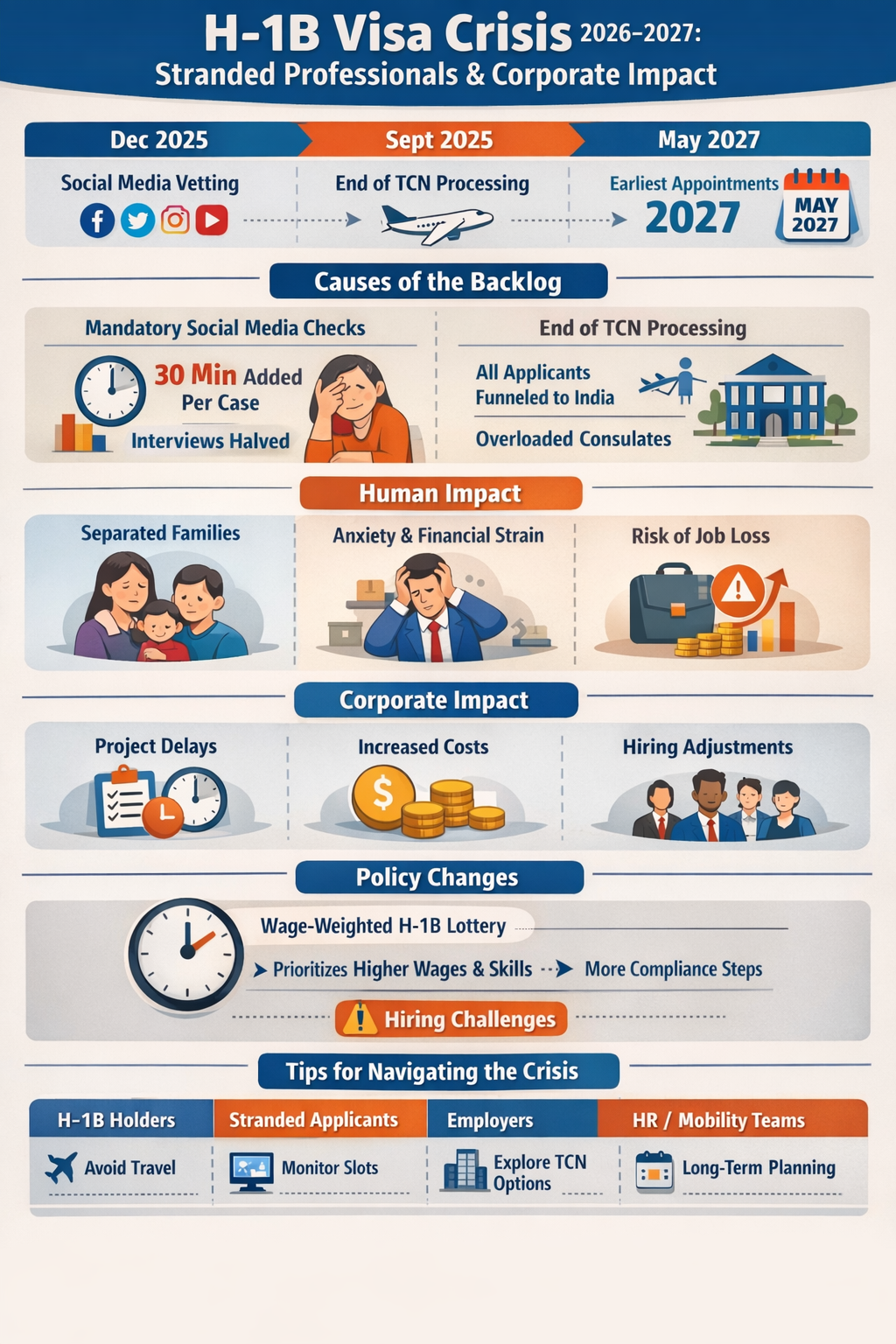
- Mandatory Social Media Vetting: Effective December 15, 2025, the U.S. State Department implemented mandatory social media screening for all H-1B and H-4 visa applicants. This enhanced vetting process requires consular officers to review an applicant's online presence, a step that adds an estimated 30 minutes to each case review. This additional time has reportedly halved the number of daily interviews that can be conducted, causing the immediate and widespread cancellation of existing appointments.
- End of Third-Country National (TCN) Processing: In September 2025, the State Department ceased TCN visa processing for Indian nationals. Previously, applicants could seek quicker appointments in neighboring countries like Canada or Mexico, or other global hubs like Frankfurt or Dubai. With this option severely restricted, all demand has been funneled back to the five U.S. consulates in India: New Delhi, Mumbai, Chennai, Hyderabad, and Kolkata, overwhelming their capacity.
The result is a logistical nightmare. For thousands of H-1B holders who traveled to India for routine visa stamping, a mandatory step for re-entry after international travel, the routine process has become a multi-year ordeal, leaving them unable to return to their jobs and lives in the U.S.
Policy Shifts: The New H-1B Landscape
Adding to the consular crisis, the U.S. Citizenship and Immigration Services (USCIS) has introduced a significant change to the H-1B lottery system. The new rule replaces the previous random selection process with a wage-weighted selection model for the Fiscal Year 2027 lottery.
This revised system is designed to prioritize applicants with higher skills and experience by giving greater weight to those with higher Occupational Employment and Wage Statistics (OEWS) wage levels. The stated intent is to favor more specialized and higher-paid roles, thereby better protecting American workers and ensuring the H-1B program is used to fill high-value talent gaps. While this policy aims to improve the quality of the H-1B pool, it introduces new compliance steps for employers, further complicating and slowing the overall case review process.
The Human and Corporate Toll
The visa crisis carries profound consequences for both the individuals involved and the American economy.
The Human Cost
For Indian professionals and their families, the delays translate into severe personal hardship. Stranded applicants are separated from their spouses and children, who may be attending school in the U.S. The uncertainty breeds immense anxiety, financial strain, and the risk of job loss due to prolonged absence. As one affected applicant noted on a social media platform, an appointment scheduled for February 2026 was unilaterally rescheduled to May 2027, underscoring the arbitrary and devastating nature of the delays.
The Corporate Impact
U.S. companies, particularly in the technology, healthcare, and education sectors, are feeling the strain. Multinationals that rely on H-1B workers for specialized skills and rotating offshore talent face:
- Project Delays: Critical projects are stalled as key personnel are unable to return to the U.S. or new hires cannot mobilize.
- Increased Costs: Companies are forced to absorb higher costs for premium processing or explore expensive stop-gap measures, such as transferring employees to subsidiaries in Canada or Mexico.
- Hiring Adjustments: Firms are increasingly adjusting their strategies by hiring more local talent or shifting tasks to circumvent the unpredictable visa environment.
The 60-Day Grace Period: A Separate Talent Crisis
A separate but related policy issue is exacerbating the talent crisis: the 60-day grace period for laid-off H-1B workers. This rule grants workers 60 days to find a new employer or change their visa status after their employment is terminated.
Experts argue that this period, especially amid widespread tech layoffs, is creating a "talent crisis" and increasing hiring bias. Companies are becoming hesitant to hire H-1B workers, knowing they might suddenly lose critical team members if the worker cannot secure a new visa sponsorship within the short window. This situation forces companies to choose between hiring the best developers and ensuring predictable staffing, leading to a "two-tier system where visa status trumps coding ability".
Navigating the Uncertainty: Advice and Workarounds
In the absence of a clear policy resolution, immigration attorneys and experts offer the following advice for those affected:
| Stakeholder | Recommended Action |
|---|---|
| H-1B Holders in the U.S. | Avoid Travel: Do not travel to India for visa stamping until the situation demonstrably improves. |
| Stranded H-1B Holders | Monitor Slots: Continuously monitor the U.S. TravelDocs portal, as earlier appointment slots are occasionally released at short notice. |
| Employers (for Critical Travel) | Explore TCN Options: Book "visa runs" to posts that still accept some third-country nationals, such as Frankfurt, Singapore, or Dubai, though capacity is limited. |
| HR/Mobility Teams | Long-Term Planning: Budget for 18-to-24-month lead times for mobility planning and secure remote-work approvals for employees stuck abroad. |
Industry bodies, including NASSCOM and the U.S.-India Business Council, have petitioned Washington for a temporary remote-validation solution, similar to a pilot program from the early 2000s. However, officials have indicated that current security directives make such a solution unlikely before late 2026.
Conclusion
The current H-1B visa crisis represents a significant challenge to the U.S. strategy for attracting and retaining global talent. The combination of the 2027 interview backlog, the new wage-weighted lottery, and the pressure of the 60-day grace period is creating an environment of profound uncertainty. The prolonged delays risk driving highly skilled professionals to other nations with more streamlined immigration processes, ultimately undermining American competitiveness in key sectors.
Until a clear, operational solution is implemented to resolve the consular backlog, Indian professionals and their employers must navigate the longest H-1B visa-stamping wait times on record, requiring a multi-year horizon for mobility planning.
 Adepu Bindu