

How AI Copilots, Code Generation, and Automated QA Are Reshaping Delivery Economics
✍️ Opinions
This article has been contributed by Rahul Jain, Founder & CEO, Pixeldust Technologies
Across industries, product leaders are now realising a new truth: the traditional engineering delivery model is reaching its limits. Budgets are tighter, consumer expectations are rising, and teams are under pressure to deliver faster than ever. Yet even with larger teams, delivery cycles often remain slow, unpredictable, and heavily dependent on manual processes.
A profound shift is underway, one where companies are moving away from scaling through headcount and instead scaling through intelligent engineering. AI copilots, code-generation tools, and automated QA systems are enabling teams to deliver more with less, reduce operational overhead, and dramatically improve speed-to-value. This new model is not just making engineering faster; it is fundamentally changing the economics of building and shipping software.
What’s happening is not incremental improvement. It is a shift in the economics of building software, a shift from manpower-heavy delivery to intelligence-heavy delivery. And its impact is profound.
The first and most immediate change is psychological. Engineers who once spent large parts of their day writing boilerplate code or performing repetitive checks now begin their work at a higher baseline. They are not “doing more with less” in the traditional sense; they are doing more meaningful work because the system itself is taking care of the repetitive layers beneath. AI copilots allow developers to think in terms of intent, not syntax. When the mechanical aspects of coding are removed, what remains is the essence of engineering, design, clarity of thought, and problem-solving.
Why Copilots Redefine How Engineers Work
This shift fundamentally alters the value equation inside engineering teams. In a typical project, nearly 30-40% of the effort goes into scaffolding: setting up environments, writing foundational code, configuring integrations, documenting flows. When AI absorbs this layer, delivery no longer expands by adding people; it expands by elevating the baseline at which people operate. Teams become smaller, but the creative and architectural output expands. In economic terms, the marginal cost of building software begins to fall.
But AI copilots are only the first layer. The emergence of advanced code-generation systems accelerates this shift even further. These tools don’t merely suggest improvements, they can generate entire functional components based on a specification or even a prototype. And because they are trained on diverse patterns, they often produce cleaner, more consistent code structures than hurried engineering teams working under pressure.
The impact is twofold: the time required to move from idea to implementation collapses, and the variability of human-generated code reduces substantially. This has downstream consequences that many organisations underestimate. Consistent structures reduce future maintenance cost. Faster prototyping enables quicker validation cycles. Experiments that were once expensive become routine. A product that might have taken weeks to validate can now be tested the same afternoon.
The third and perhaps least glamorous, but most economically powerful shift is happening in QA. Historically, quality assurance has been the silent tax on software development. Bugs caught late in the cycle cost exponentially more to fix. Regression testing consumes days. And QA teams often struggle to keep up with the pace of change in rapidly evolving products. Automated QA powered by AI doesn’t just reduce effort, it changes the sequence of events. Testing becomes continuous instead of episodic. Errors surface at the moment they are introduced, not weeks later. AI-generated test cases cover edge conditions that humans may never have anticipated.
The result is a dramatic reduction in rework, the single biggest hidden cost in software delivery. When fewer defects reach staging and production, timelines shorten, firefighting reduces, product stability improves, and the overall delivery curve becomes more predictable. Predictability is not just a technical advantage; it is a business advantage. Leaders can commit to timelines more confidently, allocate budgets with more accuracy, and scale without the fear of compounding technical debt.
Looking ahead, this shift is only the beginning. The next wave involves agentic AI systems, tools that don’t just assist but act. Systems that can read documentation, parse requirements, generate code, run tests, and even suggest deployment strategies. Systems that maintain context across product modules and interact with other enterprise systems autonomously. When agentic systems reach maturity, delivery economics will shift again, from AI-assisted workflows to AI-executed workflows with human supervision.
The Next Leap: Agentic AI and Autonomous Workflows
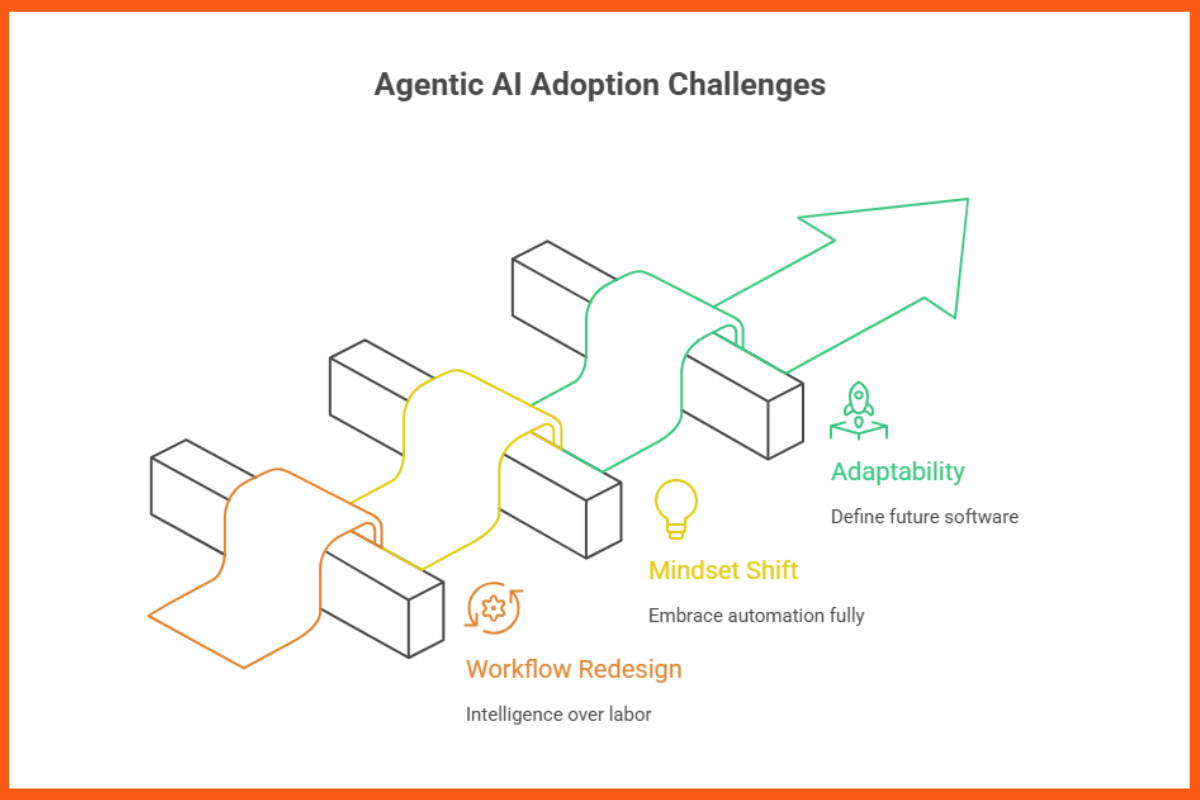
The organisations preparing for this future are the ones redesigning their engineering pipelines today. They are not asking, “How many people do I need to deliver this?” They are asking, “How much of this can be automated, and how do we redesign the workflow around intelligence, not labour?”
The companies that embrace this mindset will build faster, scale smarter, and operate with better margins. Those that cling to linear growth models will find themselves unable to compete with teams that can deliver in days what previously took weeks.
Software engineering has always evolved with new tools, but AI is not just another tool. It is a new foundation, a new way of thinking about how products come to life. Delivery economics are being rewritten, and the organisations that adapt now will define what the next decade of software looks like.
 Muskaan Kapoor