

How AI, IoT, and Data Analytics are driving Efficiency in Fuel Retail?
✍️ Opinions
This article has been contributed by Vaibhav Kaushik, Co-founder & CEO of Nawgati
The Indian fuel retail market is approximately $160 billion, as per a recent Financial Express article, which makes us one of the largest and fastest-growing markets across the globe. Today, there are over 90,000 outlets live and active, and yet, unpredictable demand, supply chain management issues, and equipment breakdown are taking away comfort, convenience, and control from the hands of the users.
Just like a coin, the fueling industry has two sides: end consumers and retailers, and both sides of the users are looking for a change from these traditional, slow, and inefficient processes. To meet these growing demands, fuel companies are opening new stations throughout the country, especially in Tier 2 and Tier 3 cities, to power trade, mobility, and everything in between. However, the challenges highlight a pressing reality of India’s fuel retail, that is, scale is not enough for the change in customer expectations.
Where Should We Be Looking: Intelligent Systems
For decades, fuel retail operations relied on manual monitoring, routine checks, pen and paper record-keeping, and reactive decisions to manage supply and service. While this worked earlier, these methods struggle to keep up with today’s pace of mobility and customer expectations. Moreover, these issues were draining their margins, affecting their operations, and impacting both trust and profitability.
To remain competitive and offer better consumer behaviour, the sector must shift from manually run, reactive processes to technology-driven, predictive systems.
AI, IoT, and data analytics are changing this approach. These technologies are reinventing the way users understand fuel operations. For example, AI models can forecast demand by analyzing sales history, traffic patterns, and even weather data, IoT-enabled sensors track stock levels, equipment performance, and safety compliance in real time, and analytics platforms then convert this data into insights that allow operators to act proactively rather than reactively.
How Can AI, IoT, and Analytics Make a Difference?
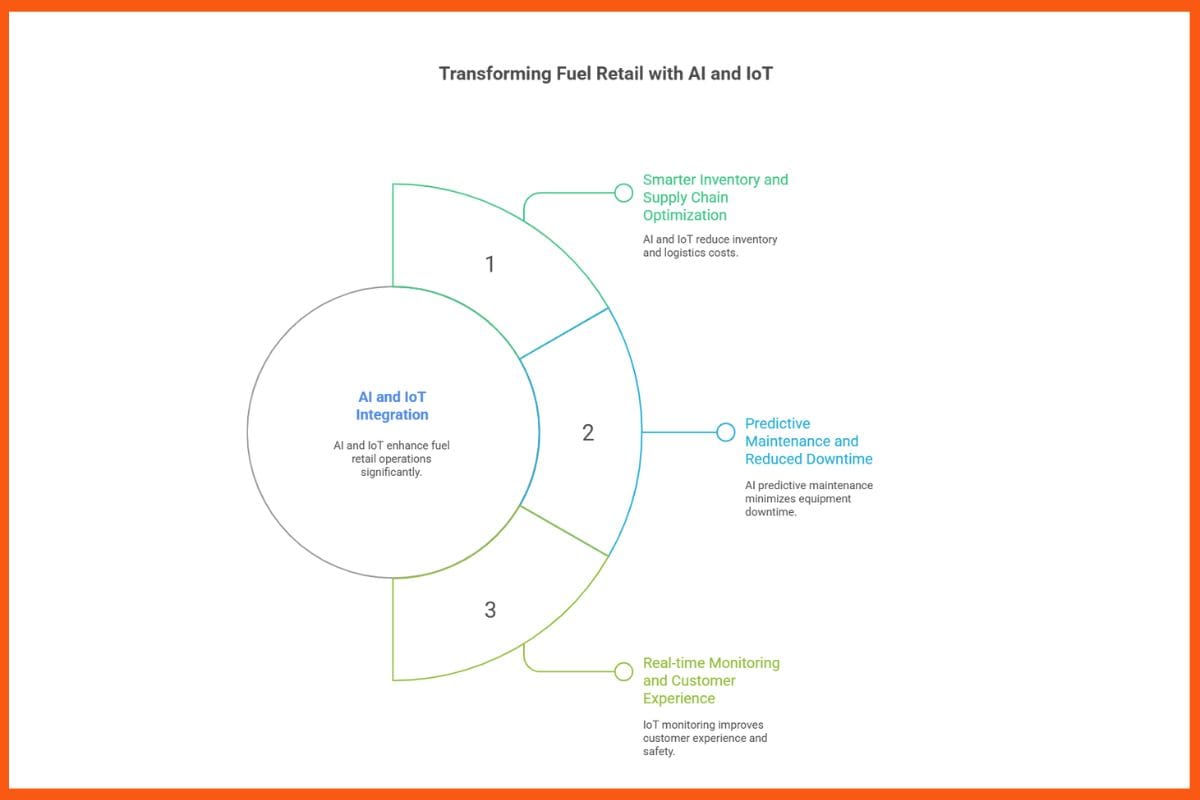
If and when applied effectively, these technologies can deliver measurable benefits across the value chain, improve operations and profitability for fuel providers, and enhance the overall customer experience for end consumers by providing transparency into wait times, fuel availability, and a better quality of life.
- Smarter inventory and supply chain optimization: Fuel distribution is complex, as it can tip the scales towards overstocking or complete stockouts, which could negatively affect capital or customer trust. AI-driven forecasting and IoT-enabled monitoring are changing this equation. According to McKinsey, embedding AI in distribution, warehousing, and planning can reduce inventory by 20–30% and logistics costs by 5–20%. For fuel retailers, this could mean reduced wastage, resilient supply chains, and improved bottom line.
- Predictive maintenance and reduced downtime: A fuel station’s efficiency depends on the performance of its pumps, storage tanks, and safety systems, and unplanned downtime can cause financial losses by frustrating customers. According to a Deloitte study, AI-driven predictive maintenance can reduce equipment downtime by up to 30% and extend machine life by 20%, which could ensure uninterrupted operations and higher customer satisfaction.
- Real-time monitoring and customer experience: IoT sensors bring visibility into every aspect of day-to-day operations, from monitoring tank levels to tracking forecourt activity, and these systems generated insights allow operators to respond instantly to issues. The result is faster refueling, shorter queues, and improved safety compliance. This improves efficiency but also enhances the customer experience, such as shorter queues, safer operations, and smoother service. In a market with multiple alternatives, this consistency is a real competitive edge.
Technology That Could Go Beyond
Besides financial metrics, technology-driven efficiency has the potential to support India’s broader sustainability goals. Fuel retailers could manage their inventory smartly using AI, IoT, and analytics, which could reduce unnecessary transportation trips, lowering carbon emissions. Predictive maintenance could extend equipment life, reducing the generation of unprecedented amounts of waste. Real-time analytics could help minimize fuel loss through evaporation or leakage, directly reducing environmental impact.
As India transitions toward cleaner fuels like CNG, EV, and eventually green hydrogen, these digital foundations will be even more critical. Managing a multi-fuel, diversified retail ecosystem will require predictive intelligence and real-time coordination on a scale that manual methods simply cannot achieve.
What Are The Challenges To Look For?
Adopting AI, IoT, and analytics comes with its own pros and cons. While we have discussed the greater impact it’ll have on the fueling ecosystem, it comes with challenges such as infrastructure costs, data security, and skill gaps, which remain major barriers. How we integrate AI and IoT solutions could be crucial in the process, as it will require upfront investment in infrastructure and training. Another challenge in implementation could be resistance to change.
Moreover, solutions must be tailored to India’s unique conditions, high-traffic urban centers, remote rural areas, and diverse fuel preferences, demand flexible, context-specific solutions.
The Road Ahead
The Indian fuel retail sector stands at a turning point. It has both the scale and the urgency to adopt technologies that drive efficiency, reduce costs, and elevate customer experience.
While the integration of AI, IoT, and Data Analytics sounds futuristic, it is already happening. Predictive intelligence is making supply chains leaner, IoT sensors are ensuring real-time operational visibility, and data analytics is empowering decision-making at unprecedented speed.
Moreover, we are also uniquely positioned to lead this change. As one of the world’s top 10 global tech hubs, our country has access to a deep pool of talent capable of building solutions tailored to its fuel retail ecosystem. Today’s consumers demand faster fueling, smoother transactions, and better service experiences, and the right application of these technologies can deliver just that.
The real question now is not whether India’s fuel retail will adopt these technologies, but how quickly. Those who lead this transformation will set new benchmarks for efficiency, sustainability, and customer trust in one of the world’s most vital industries.
 Arbaz Sayed