

Why a ₹70 Lakh German Luxury Car Costs Far More in India Than Dubai | India vs Dubai Tax Comparison
🔍Insights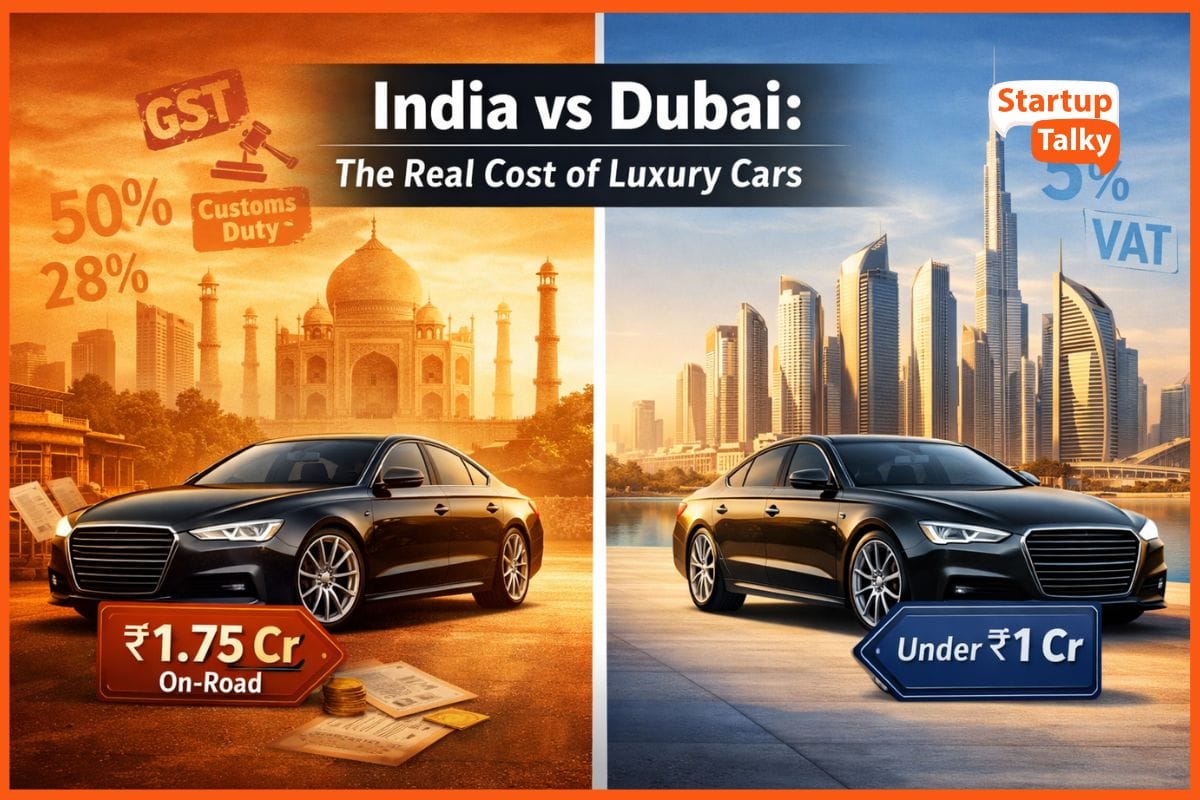
Many Indians are shocked at how expensive luxury imported cars are in India compared with prices abroad, especially in Dubai, UAE. A recent LinkedIn post by entrepreneur Ashish Gupta sparked debate by highlighting the sharp difference in how much freelancers or high-earning professionals need to earn in India to afford a luxury imported car compared with Dubai.
Let’s break down the facts, timeline and the current policy environment.
What Is the Real Cost of Imported Luxury Cars in India?
Imported luxury cars attract very high taxes and duties in India, much higher than in most other countries.
A typical luxury vehicle imported into India goes through several layers of charges:
- Import duty (customs duty) is often 60%-100% of the car’s factory price.
- GST (Goods and Services Tax) of 28%.
- Compensation cess up to 15%-22% ,depending on engine size and vehicle type.
- State road tax and registration fees vary widely by state.
These taxes can more than double or even triple the price of a car when it reaches the buyer. For example, if a car’s factory price (in Germany, say) is ₹70 lakh, its on-road price in India with all duties and taxes included can be around ₹1.7-1.8 crore or higher.
That means more than half of what you pay in India goes to tax, duties and statutory charges.
How Much Revenue Is Needed to Buy That Car in India?
To buy an imported car at an on-road price of around ₹1.75 crore in India:
- You need to generate that much net personal income.
- Considering India’s personal tax regime (which includes income tax and GST on services you sell as a freelancer), your gross revenue requirement can exceed ₹3.4 crore.
This assumes standard tax rates and typical income tax slabs as applicable for Indian residents.
In simple terms, you might need to earn more than twice the price of the car in gross revenue to have enough net income to afford the purchase after all taxes.
Why the Same Car Is Cheaper in Dubai
In contrast, in Dubai (UAE):
- There is no personal income tax on individuals. Freelancers keep 100% of their earnings.
- Import duty on cars is typically a flat 5%, and VAT is only 5% on purchases.
- Fuel, insurance and ongoing running costs are generally lower than in India.
Because of this lighter taxation structure, the same luxury imported car worth ₹70 lakh could cost under ₹1 crore on the road in Dubai, significantly cheaper than in India.
In the calculation shared by the entrepreneur:
- In India, you might need to generate ~₹3.44 crore in revenue to end up with enough net income.
- In Dubai, a freelancer might need only around ₹95 lakh in revenue to afford the same vehicle.
That’s a striking contrast of nearly a 3.5-times difference in needed revenue.
What Drives These Tax Differences?
India’s Tax Policy
India’s high import duties and layered taxes on luxury vehicles are primarily meant to:
- Protect domestic manufacturers.
- Control foreign exchange outflows.
- Treat luxury imports as non-essential goods.
Historically, these duties were occasionally above 100 %, though recent trade negotiations are reducing import tariffs on some European models under free-trade discussions.
In late January 2026, India agreed in principle to cut tariffs on high-end EU car imports to about 30% as part of a trade deal with the European Union — down from very high rates of 70%-110% in many cases. This change could moderate prices over time, but doesn’t immediately eliminate most taxes charged at the retail level.
Dubai’s Tax Environment
In Dubai:
- Personal income tax is zero.
- VAT is 5 %.
- Import duties are generally low.
This makes owning and importing cars far more affordable for residents and expats alike.
What Does This Mean for Wealthy Individuals and Professionals?
This large price gap can influence financial decisions for people with high incomes:
- Many professionals and entrepreneurs from India consider relocating or registering businesses abroad to reduce their overall tax burden.
- However, relocating for tax purposes requires meeting specific legal criteria. Indian tax residency rules are strict, and simply spending time in another country may not exempt you from Indian taxes unless you fully sever tax residency links.
For genuine non-residents, Dubai or other low-tax jurisdictions can make luxury purchases more affordable, but the decision requires tax planning and compliance advice.
Bottom Line: Taxes Make the Difference
In straightforward terms:
- India’s layered duties and high indirect taxes can push an imported luxury car’s price to more than double its factory cost.
- Dubai’s tax-light system keeps prices closer to the base cost of the vehicle.
- This creates a wide affordability gap between the two markets.
Whether this will drive high-net-worth individuals to relocate or rethink where they live and work is an open question, but the numbers clearly show why luxury imports cost substantially more in India today.
 Damini Bhandary