

Krisneil Peres Explains How Fame Keeda Is Rethinking Digital Marketing with UGC-First Performance Systems
📝Interviews
StartupTalky presents Recap'25, a series of exclusive interviews where we connect with founders and industry leaders to reflect on their journey in 2025 and discuss their vision for the future.
In this edition of Recap’25, StartupTalky speaks with Krisneil Peres, Co-Founder of Fame Keeda, who reflects on how digital marketing in 2025 shifted from scale-driven visibility to system-led, outcome-focused growth. Drawing from on-ground campaign performance, Peres explains why attention scarcity, creative fatigue, and rising accountability forced brands and agencies to rethink how content, creators, and distribution work together.
He goes on to discuss how UGC-first performance systems, micro-creator clusters, and continuous creative experimentation delivered stronger business outcomes than traditional campaign-led approaches. The conversation also explores the role of AI in accelerating creative iteration and insight discovery, the growing importance of trust-led storytelling, and Fame Keeda’s long-term vision of reducing randomness in marketing through creator-led growth engines and its proprietary platform, Fame Dash, as brands prepare for 2026.
StartupTalky: How would you describe the biggest shifts in digital marketing in 2025? What stood out most in consumer behaviour, content formats, or brand expectations?
Krisneil Peres: If 2024 was about scale, 2025 was about correction.
The industry finally admitted something it had avoided for years: attention is no longer abundant, and content alone doesn’t guarantee impact. What changed most in 2025 was the realisation that content and distribution can’t exist as separate conversations anymore. Great content without a system to test, amplify, and learn from it simply disappears.
Consumer behaviour reflected this shift. Audiences became sharper, more selective, and far less tolerant of exaggerated brand narratives. What worked was proof-led storytelling: UGC, product demos, founder-led narratives, and community-driven content.
Short-form still dominated but expectations rose dramatically: faster clarity, real utility, and transparent messaging.
From a brand perspective, the biggest shift was accountability. Brands stopped asking for “visibility” and started demanding full-funnel outcomes. Trust, engagement quality, and measurable business impact. Marketing in 2025 stopped being about moments and became about systems.
StartupTalky: Which campaigns or strategies delivered the strongest results for your clients this year? Any learning that changed your approach going forward?
Krisneil Peres: The best-performing campaigns were the ones that didn’t look like campaigns at all.
What consistently worked was UGC-first, always-on performance systems, where creator content became the primary engine not a supporting layer. Instead of betting on one big idea, we saw far stronger results by running weekly creative experiments: multiple hooks, formats, narratives, and rapid iteration based on real performance signals.
One pattern stood out clearly: micro and regional creator clusters outperformed scale-first strategies. Trust density mattered more than reach. When paired with the right landing experience and retargeting flow, these clusters delivered better engagement quality and more stable conversions.
The biggest learning that reshaped our approach was this: creative fatigue is now the biggest growth constraint, not targeting. Going forward, the focus is on building content pipelines, systems that keep ideas, creators, and formats flowing rather than one-off deliverables.
StartupTalky: AI adoption grew across the industry in 2025. How has AI changed the way your agency works, across creative, media planning, performance, or client servicing?
Krisneil Peres: In 2025, AI helped in removing the friction from creative thinking.
Its biggest impact was speed and iteration quality. On the creative side, AI enabled faster ideation, scripting, alternate hooks, and content variations, allowing teams to test more ideas in less time.
On the performance side, it helped synthesise insights faster and identify patterns earlier in the campaign lifecycle.
In client servicing, AI enabled quicker reporting narratives and sharper “what worked / what to do next” learning loops.
Importantly, AI worked best when paired with strong human judgment. The agencies that struggled were those chasing automation without a strategy. The ones that won used AI to free teams from manual execution and refocus them on creative judgment and system-level thinking
StartupTalky: As a full-service digital agency, what were the toughest challenges you faced this year, and how did you tackle them?
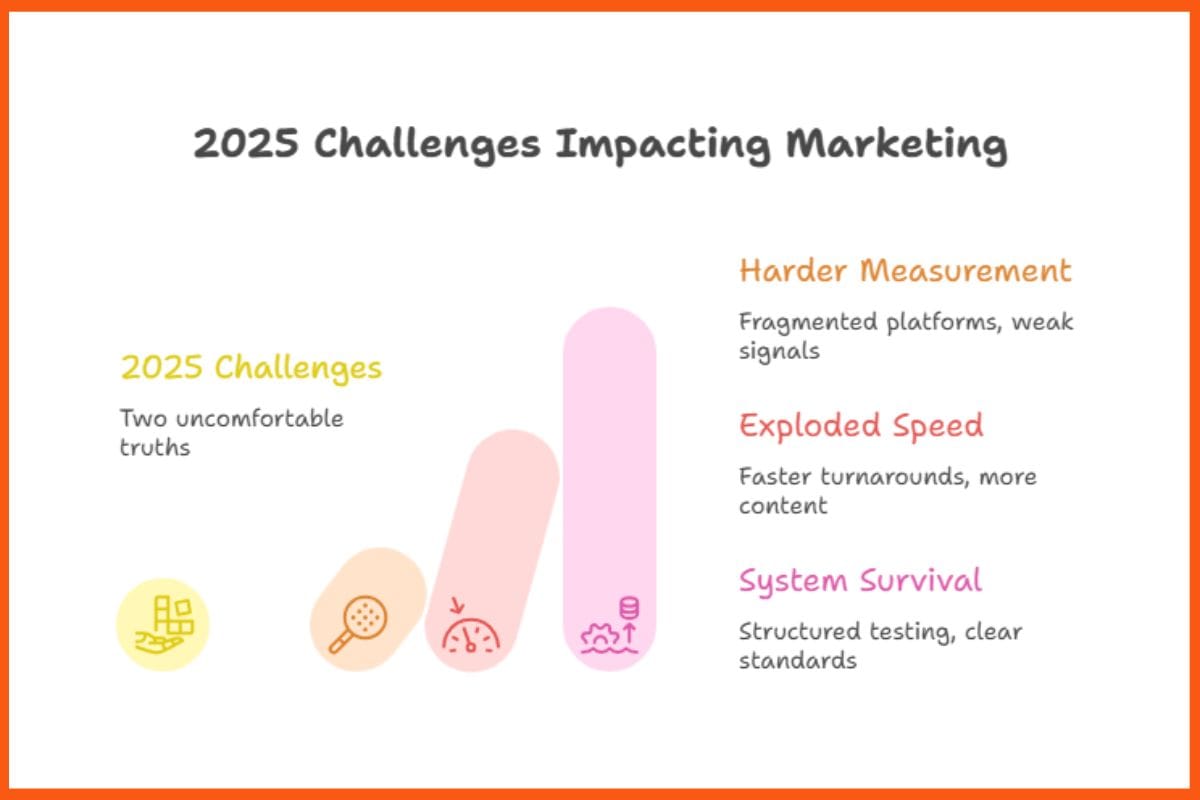
Krisneil Peres: 2025 exposed two uncomfortable truths.
First, measurement became harder. Platforms fragmented further, signals weakened, and connecting influencer impact to real business outcomes became complex.
Second, speed expectations exploded. Brands wanted faster turnarounds, more content, and more experimentation without compromising brand safety or creative quality.
The only way to survive this was through systems. We moved away from ad-hoc execution toward structured testing frameworks, clearer creative standards, stronger SOPs, and disciplined feedback loops. Visibility into execution and learnings became as important as creativity itself.
StartupTalky: What metrics matter most to you today when evaluating the success of a campaign or a long-term brand engagement?
Krisneil Peres: The biggest mindset shift was moving away from asking, “Did this post perform?” to “Did this system improve outcomes over time?”
We now evaluate success across three layers:
- Business outcomes: revenue, qualified leads, CAC/CPA, ROAS.
- Full-funnel indicators: engagement depth, click behaviour, assisted conversions.
- Content quality signals: hook rate, watch time, drop-offs, sentiment, and reusability for paid amplification.
What matters most is learning velocity, i.e., how quickly a campaign gets smarter week after week.
StartupTalky: Which sectors or client categories showed maximum growth momentum this year? Any category that behaved differently from expectations?
Krisneil Peres: The fastest growth came from sectors where trust directly influences purchase decisions, such as personal care, health and wellness, F&B, hospitality, and education-led platforms.
What surprised us was not the growth itself, but the shift in mindset. Many brands stopped chasing scale at all costs and became deeply unit-economics focused. Efficiency, retention, and quality of acquisition took priority over vanity growth, making creator-led performance strategies far more valuable.
StartupTalky: What tools have become essential for your team in 2025? Are there any AI tools or platforms that now play a major role in your workflow?
Krisneil Peres: In 2025, the essential stack for a high-output team became:
- In-house ops + reporting: Fame Dash(our homemade AI software) for campaign workflows, creator collaboration visibility, and performance learnings.
- Platform-native performance tools: Meta/Google/TikTok ad ecosystems for distribution and testing.
- Analytics & dashboards: GA4 + reporting dashboards for funnel visibility.
- AI tools: for faster scripting, creative iterations, ideation, and content repurposing, helping us scale output without sacrificing strategy.
Our USP is not “using tools,” it’s how we combine them into a repeatable growth system: strategy → creators → content → amplification → insights → iteration.
StartupTalky: Looking ahead to 2026, what trends in content, paid media, or tech-led marketing do you think will shape brand strategy?
Krisneil Peres: Three forces will define 2026:
- Creator commerce at scale – shoppable content, affiliate models, and always-on UGC libraries powering paid media.
- AI-driven content saturation – differentiation will come from real proof, not louder messaging.
- Trust as a growth lever – transparency and consistency will outperform aggressive growth hacks.
We believe 2026 will be won by brands that build content engines (not campaigns) and partner with teams that can deliver speed + quality + measurable outcomes. This is exactly where Fame Keeda’s full-service model and Fame Dash-backed execution become a strong advantage.
StartupTalky: What is your long-term vision for Fame Keeda, and what strategic moves are planned for the next phase of growth?
Krisneil Peres: Our long-term vision is to build Fame Keeda into a creator-led, tech-enabled growth partner where creators are not just an “awareness channel,” but a core business lever across brand, performance, and community.
Strategically, our next phase focuses on:
- Scaling always-on creator programs for key categories
- Strengthening performance creative capabilities (UGC-to-ads pipeline)
- Expanding and deepening our creator ecosystem
- Evolving Fame Dash as the backbone that standardizes execution and makes learnings reusable across campaigns.
The goal is simple: reduce randomness in marketing outcomes.
StartupTalky: What key advice would you give to brands planning their 2026 marketing strategies?
Krisneil Peres: Plan for learning, not perfection.
- Allocate budgets for testing, not just production.
- Build UGC libraries early that power both organic and paid.
- Diversify channels, but unify the narrative.
- Treat consumer trust as a compounding asset.
- Partner with teams that operate as systems, not vendors.
2026 will reward brands that move faster and think deeper
Explore more Recap'25 interviews here.