

Maaz Ansari Explains How Oriserve Is Turning Enterprise Conversations into Real Business Outcomes
👨💻 StartupTalkers
StartupTalky presents Recap'25, a series of exclusive interviews where we connect with founders and industry leaders to reflect on their journey in 2025 and discuss their vision for the future.
In this edition of Recap’25, StartupTalky speaks with Maaz Ansari, Co-Founder of Oriserve, on how enterprise conversational AI evolved from basic automation to outcome-driven, multilingual AI agents in 2025. He shares how Oriserve addressed the limitations of traditional IVRs and generic chatbots by building emotionally intelligent, compliant systems designed for real business impact in regulated and high-volume environments.
Ansari also highlights key product advances in multilingual speech models, domain-specific AI agents, and real-time voice intelligence, along with the measurable gains clients achieved across efficiency, collections, and renewals. Looking ahead, he outlines the rise of autonomous, auditable AI agents and the sectors set to drive large-scale adoption in India and global markets in 2026.
StartupTalky: Oriserve has been shaping the future of enterprise communication with emotionally intelligent multilingual AI agents. What core problem were you originally solving, and how has that mission evolved this year?
Maaz Ansari: We set out to solve a single practical problem. Enterprises needed conversational systems that could handle large volumes of voice and chat interactions while staying compliant, measurable, and emotionally intelligent. Traditional IVR and scripted chatbots were brittle at scale, failed to reflect local languages and accents, and delivered poor conversion and recovery outcomes for revenue facing operations. Our work focused on building AI that could speak business language and follow rules without losing empathy.
However, since 2025 the mission matured from building reliable conversational automations to delivering domain tuned, outcome oriented AI agents that operate end to end in mission critical workflows. The focus shifted to three priorities simultaneously
- Multilingual robustness to handle Hindi Hinglish and Indian accents at production scale.
- Explainability and compliance by design for regulated verticals such as BFSI.
- Measurable business outcomes for collections, renewals, lead qualification and revenue operations.
StartupTalky: What were the most impactful product advancements or AI capabilities Ori introduced this year especially around multilingual models and domain specific LLMs?
Maaz Ansari: Our Major advancements were:
- Open source Speech to Text model Whisper Hindi2Hinglish Apex that is tuned for Hindi Hinglish and Indian accented English and trained on large, real life call data sets. This materially reduces recognition errors in multilingual, noisy call environments.
- OriTTS, our recently launched proprietary Text to Speech engine, is a major upgrade that delivers production ready, human quality voices across 10 plus Indian languages, including Hindi and Hinglish, English, Telugu, Tamil, and Malayalam. It also supports dialects such as Maithili and Bhojpuri. The engine achieves best in class sub 100 milliseconds latency for real time conversations and delivers around 80 percent lower cost compared to leading third party providers.
- Domain specific agent stacks for BFSI that combine speech, NLU, policy engines and compliance rules so agents act like trained domain specialists rather than generic chatbots. The stacks include Brand GPT style models that surface product and policy answers consistent with corporate rules.
- Multimodal voice and chat orchestration that provides the same conversation continuity across voice chat and back office systems, enabling measurable automation of lead qualification and collections workflows.
StartupTalky: How have enterprises expectations from conversational AI changed in 2025 and what patterns did you observe across customer behaviour automation needs or CX transformation?
Maaz Ansari: Enterprises now demand outcome first thinking. They expect AI to deliver conversion or recovery uplift and not just reduce handle time. They also expect tight controls on safety and compliance and operational metrics that map directly to business KPIs. Some patterns that we have observed:
- Customers increasingly prefer voice interactions for transactional journeys when the agent can understand local language and sentiment.
- Automation targets moved beyond simple FAQs to full lifecycle tasks such as lead qualification, policy renewal and staged collections.
- Demand for observability and conversation analytics rose sharply so organisations could audit intent, escalate risky calls and measure agent performance.
StartupTalky: What measurable outcomes did your clients achieve in 2025 using Ori’s AI agents whether in efficiency engagement or cost optimisation?
Maaz Ansari: Customers running ORI agents reported measurable business impact in production deployments. Key outcomes included 30 percent efficiency gains in agent workflows and double digit uplift in collections and renewals. Large deployments also drove major reduction in cost to serve and faster time to resolution. These improvements were delivered while preserving compliance and customer empathy.
StartupTalky: As generative AI moves toward autonomy how is Oriserve addressing accuracy emotional intelligence and safety three areas where enterprises demand high reliability?
Maaz Ansari: We treat speech and text accuracy as a data and product problem. That means domain fine tuning, real life call training data, noise resistant STT models such as Whisper Hindi2Hinglish Apex, and continuous evaluation against production calls. This reduces word error rates and improves downstream intent decisions.
Whereas, emotion aware models are integrated into the conversation flow so agent responses adapt tone and escalation logic based on customer affect. Empathy templates and supervised examples ensure the agent remains human like while following policy rules. Throughout the process, safety is enforced through layered controls. Conversation policies, automated compliance checks, deterministic policy engines, and audit logs are standard. For regulated sectors we run policy gating before any action that affects account state or finances so autonomy is bounded by explainable rules and human in the loop checkpoints.
StartupTalky: What will define the next leap in enterprise conversational AI in 2026 especially with the rise of AI agents replacing traditional chatbots and IVR workflows?
Maaz Ansari: We feel the defining elements for 2026 will be:
- Agent autonomy that is verifiable where agents can take multi step actions but leave an auditable trail and deterministic rollback paths.
- True multimodal continuity so customers switch between voice chat and digital channels without losing context or compliance constraints.
- Industry tuned LLMs that embed domain rules and regulatory constraints rather than generic language models.
- Outcome centric SLAs where vendors are measured on business KPIs such as conversion uplift increase and cost to serve reduction rather than only technical metrics. These elements together will move organisations from experimental pilots to mission critical deployments.
StartupTalky: What is your outlook for scaling AI led communication in India and global markets and which sectors do you expect to adopt AI agents the fastest next year?
Maaz Ansari: India will be a leading adopter because of language diversity and high mobile voice volumes which create both demand and data advantage for multilingual voice agents. The demand curve for enterprise voice AI will accelerate globally as vendors prove domain specific ROI and compliance models that large enterprises can trust.
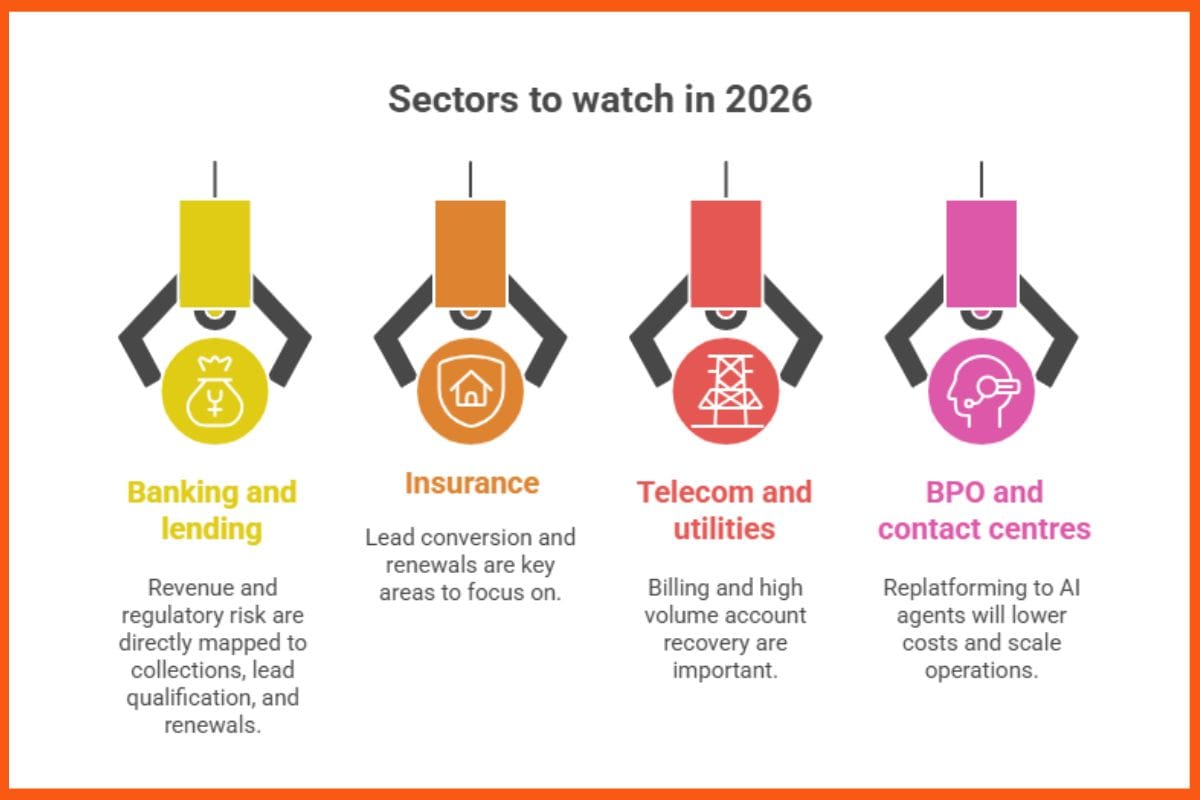
Sectors to watch in 2026
- Banking and lending because collections, lead qualification and renewals map directly to revenue and regulatory risk.
- Insurance for lead conversion and renewals.
- Telecom and utilities for billing and high volume account recovery.
- BPO and contact centre led verticals that will replatform to AI agents to lower costs and scale operations quickly.
Explore more Recap'25 interviews here.