

Ducati Looks to India-EU FTA Amid High GST Burden on Luxury Motorcycles
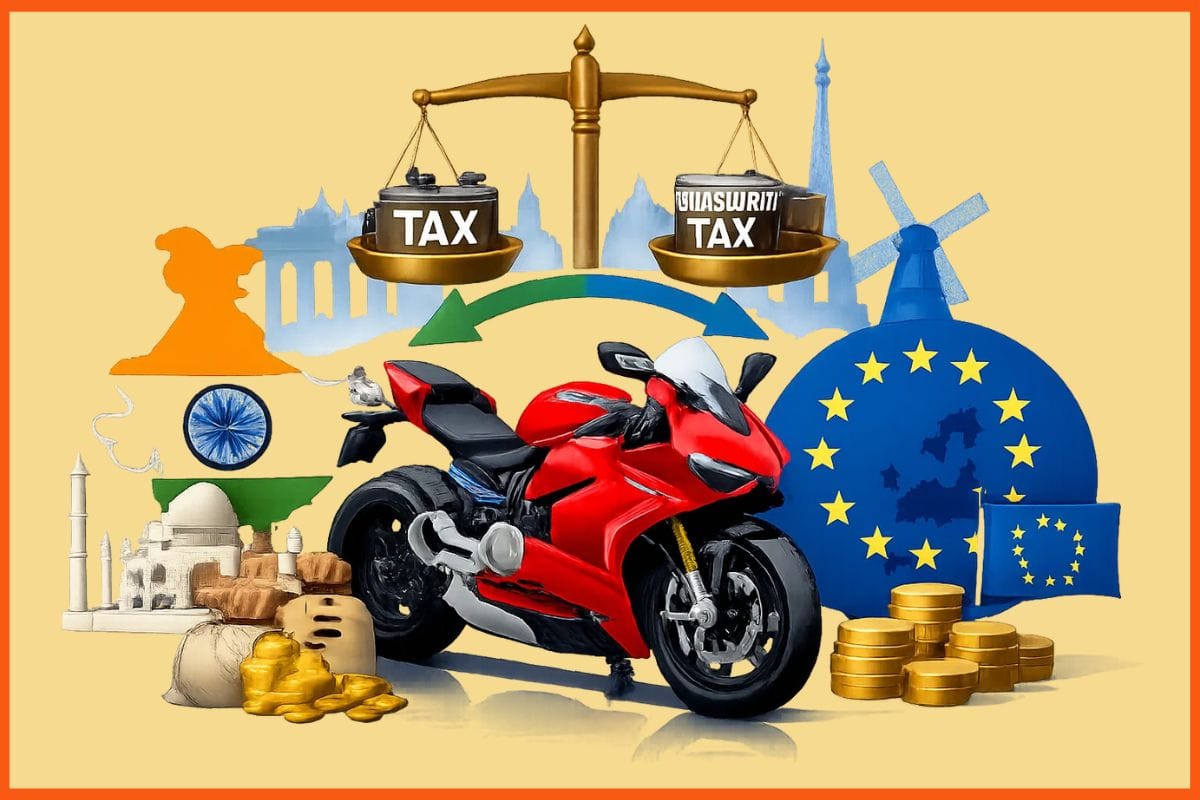
Ducati India is counting on the India–EU Free Trade Agreement (FTA) to be a game-changer for the luxury motorcycle sector, as the country's premium motorcycle market struggles with a high 40% GST on bikes larger than 350 cc. The Italian superbike manufacturer claimed that an already specialised industry is now under further strain as a result of the significant GST hike. By reducing import taxes on luxury motorcycles made solely in Italy, a favourable India-EU free trade agreement may help balance recent tax increases, benefiting both manufacturers and consumers.
Speaking of the GST hike from 28% to 40% on large-capacity motorcycles, Bipul Chandra, managing director of Ducati India, stated that while the impact is not catastrophic, it is undoubtedly negative. In the past, Ducati motorcycles were subject to a 3% cess in addition to 28% GST, making the effective rate 31%. Ducati's tax burden has increased by almost nine percentage points as a result of the change.
FTA a Big Hope for Ducati India
According to Chandra, the company is still unsure if the FTA will result in a 100% duty-free motorbike policy or something less, or if it will be applied gradually or all at once. He added that only if the agreement is officially approved would a definitive evaluation be feasible. Any favourable result, according to Chandra, would immediately help Ducati's entirely imported, Italian-made models, whose customs taxes are presently "on the steeper side".
The biggest impact would be on flagship motorcycles made in Italy, including the Superleggera and Panigale V4. According to Chandra, Ducati's customers and riders in India will gain a lot more from this, and it may also encourage large bike and track riding in the nation. Similar to other two-wheeler manufacturers like Royal Enfield, Chandra cautioned that increased taxation risk is reducing volumes and stalling the development of big-biking culture in India.
Players Engaging with the Government for a Relief
Businesses like Siam are currently contacting the government to request relief, claiming that persistently high taxes may further limit demand in a market that is still developing. Ducati has passed on the full price rise to customers due to its limited capacity to absorb cost increases. While passion for high-end motorcycles is still present, Chandra added that increased prices are affecting capital allocation and purchase timing considerations. "I am grateful that our clients have continued to buy despite the price increase."
Notwithstanding these obstacles, which included the GST reforms, the switch to E20 fuel, and a difficult financial climate, Ducati India's sales in 2025 were essentially unchanged from the year before. The sales figures were not made public by the corporation. Nonetheless, they noted robust expansion in clothes, accessories, spare parts, and after-sales, making 2025 one of the strongest years for commercial after-sales performance in India.
In 2026, the corporation intends to expand its portfolio in India, and several new launches are planned. These include a variety of limited-edition cooperation motorcycles, updated versions of models like the Monster, DesertX, and Hypermotard, and Ducati's foray into the motocross market. Although Ducati does not currently have any intentions to localise assembly in India, it nevertheless purchases a number of parts from Indian vendors.
|
Quick Shots |
|
•Ducati
India pins hopes on India–EU FTA to ease tax pressure on luxury motorcycles •Premium
bikes above 350 cc face a steep 40% GST in India •GST
hike raises Ducati’s effective tax burden by nearly 9 percentage points •Earlier tax structure included 28%
GST plus 3% cess |