

India and EU Seal Historic Free Trade Agreement, ‘Mother of All Deals’ Expected to Boost Growth
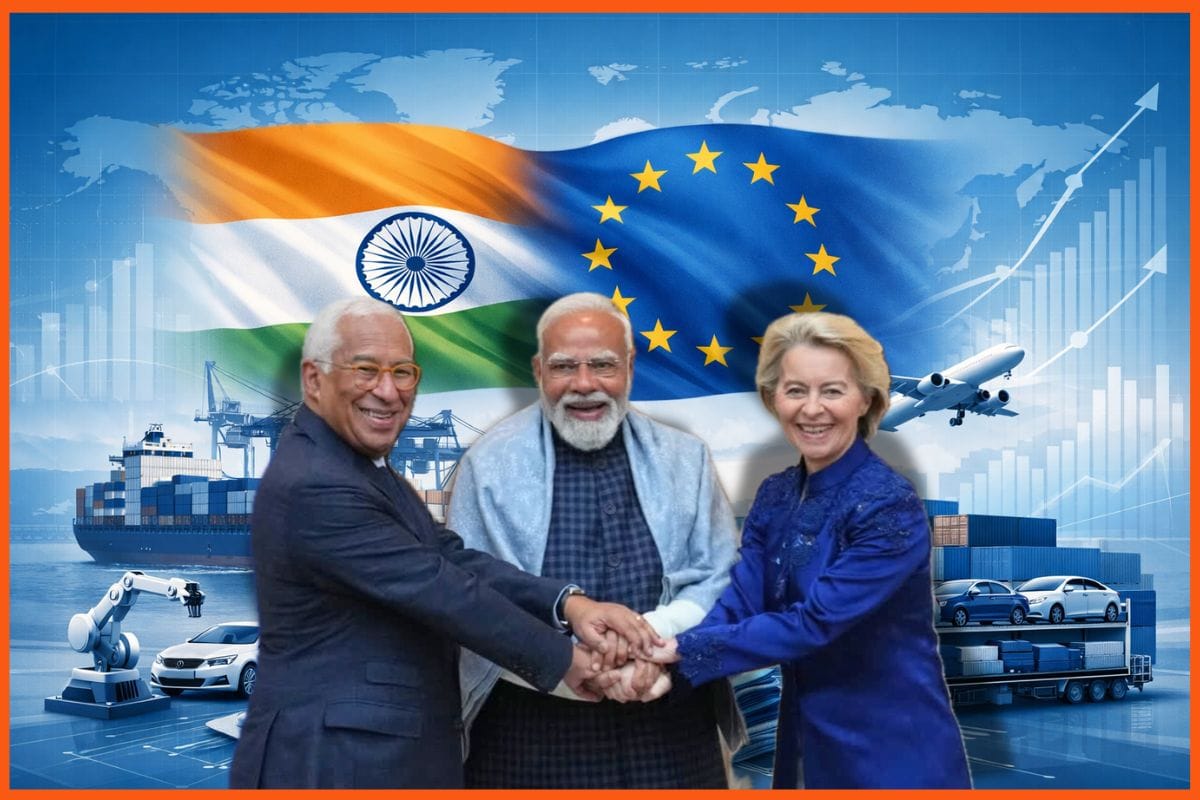
India and the European Union (EU) have reached a landmark free trade agreement (FTA) after nearly 20 years of talks, transforming economic ties between the world’s fastest-growing major economy and Europe’s 27 member states. Leaders have hailed the pact as the “mother of all deals”, with potential long-term benefits for business, trade and investment on both sides.
The agreement was formally announced during India’s 16th India-EU Summit in New Delhi, where Prime Minister Narendra Modi and European Commission President Ursula von der Leyen highlighted its strategic importance at a time of major changes in global trade.
Key Highlights of the India-EU Free Trade Agreement (FTA)
| Aspect | India-EU Trade Deal Details |
|---|---|
| Total Market Size | Nearly 2 billion people across India and the 27 EU member states |
| Share of Global GDP | Approximately 25% of global GDP |
| Current Bilateral Trade | Over $136 billion in goods trade (FY 2024–25) |
| Tariff Coverage | More than 90% of traded goods to see tariff reductions or elimination |
| EU Export Duty Savings | Estimated savings of around €4 billion per year for EU exporters |
| Car Import Duties in India | Reduced from up to 110% to around 40% initially, with further cuts planned |
| Electric Vehicles (EVs) | Excluded from tariff cuts for the first five years |
| Key Indian Export Sectors | Textiles, leather, chemicals, pharmaceuticals, gems and jewellery, machinery |
| Key EU Export Sectors | Automobiles, machinery, medical devices, electronics, aircraft |
| Services Trade Value | Over $83 billion, including IT, telecom and business services |
| Expected Implementation | Early 2027, after legal review and ratification |
Massive Market Access and Economic Scale
The new FTA will create one of the world’s largest free-trade areas, linking a market of roughly 2 billion people and representing around 25% of global GDP and one-third of global trade.
Trade between India and the EU was already substantial, with bilateral goods trade valued at about $136.5 billion in fiscal year 2024-25. Indian exports were around $75.85 billion, and imports stood at $60.68 billion, giving India a goods trade surplus of over $15 billion. Services trade, including sectors such as telecommunications, IT and business services, was worth more than $83 billion in the same period.
Under the agreement, tariffs on over 90% of goods traded between India and the EU will be either eliminated or significantly reduced, according to officials. For EU exporters, the deal is expected to eliminate duties on almost 97% of EU goods, saving an estimated €4 billion per year in tariffs.
Key Sectoral Changes: Cars, Textiles and More
Automobiles and Consumer Goods
One of the most notable aspects of the deal is India’s agreement to sharply reduce import duties on European cars. Currently, fully built imported cars can attract tariffs as high as 70-110%. Under the new framework, tariffs on select European cars priced above €15 000 will be cut to 40% initially, with further reductions planned over time to around 10%.
However, battery electric vehicles (EVs) are expected to be excluded from duty cuts for at least the first five years to protect India’s growing domestic EV industry.
Labour-Intensive Exports and Indian Goods
Indian exporters in labour-intensive sectors are also likely to benefit. Products such as textiles, leather, gems and jewellery, chemicals, footwear and electrical machinery are expected to gain easier access to European markets with reduced barriers. These sectors traditionally faced higher EU tariffs — often around 10 per cent, compared with the EU’s weighted average tariff of 3.8 per cent.
India’s major export baskets to the EU include petroleum products, electronics (including smartphones), machinery, organic chemicals, pharmaceuticals and iron and steel. On the EU side, machinery, transport equipment, medical devices, electronics and aircraft are significant import categories.
Services, Investment and Strategic Cooperation
Beyond goods, the India-EU deal includes commitments on services trade, investment protection, intellectual property and simpler customs procedures. These elements aim to facilitate cross-border business activities and strengthen legal frameworks for investors.
The agreement also sets out a trade and sustainable development chapter, focusing on environmental protections, climate cooperation and labour rights. The EU has pledged up to €500 million in support to assist India’s climate goals and industrial transformation over the next two years.
Industry experts believe the agreement could reshape global supply chains and accelerate India–EU economic cooperation over the next decade.
Munjal Almoula, Managing Partner - Tax & Regulatory Advisory, BDO India, “After nearly two decades of negotiations, India and the EU finalised the landmark Free Trade Agreement on January 26, 2026, hailed by many as the "mother of all deals." Pioneering as a "living agreement" with built-in digital trade, AI/semiconductor collaboration, and CBAM offsets (via India's CCTS linkage), it eliminates tariffs on 96%+ of EU goods (machinery 44%→0%, autos 110%→10%) across 27 nations representing 25% of global GDP. Textiles, gems & jewellery, leather, pharma, and high-tech engineering will surge, and are expected to double to $136B in bilateral trade by 2032, amid the ongoing US tariff disruptions, while easing professional mobility and data-secure status for India's services edge. This multipolar pivot fuses EU precision manufacturing with India's scale, redefining resilient supply chains ahead of 2027 rollout.”
Timing and Future Steps
While the political agreement has been announced, the formal signing is expected later in 2026, after legal review and ratification by the European Parliament, the European Council and India’s Union Cabinet. Officials estimate the agreement could be implemented by early 2027.
The deal is widely being seen as part of India’s broader strategy to reduce dependence on any single market, diversify export destinations, and build stronger economic partnerships in an era of global trade tensions and protectionism.
Global and Strategic Impact
Analysts say this FTA sends a strong signal about the resilience of rules-based global trade cooperation at a time when tariffs and barriers have been rising in other major economies. The pact is expected to encourage investment, boost manufacturing, and strengthen strategic ties between India and Europe, while complementing other recent agreements India has signed with markets like the UK, New Zealand and Oman.
As the India-EU FTA moves towards ratification and implementation, businesses, consumers and exporters on both sides stand to benefit from deeper economic integration and expanded opportunities in one of the world’s most significant trade partnerships in decades.