
India Signals Green Light to Innovation: MeitY’s AI Guidelines Explained
India’s new AI policy is easing restrictions on AI. Balaraman Ravindran (Head of Data Science and AI Department at IIT Madras) clarifies that India chooses growth, ensuring safety, and accountability...

India is taking baby steps towards AI governance amidst the rise of AI. The Indian government’s Ministry of Electronics and Information Technology (MeitY) on November 5 announced a document called "India AI Governance Guidelines.” Not just jobs, but people lost their lives due to AI. A teenage boy named Adam Raine committed suicide using ChatGPT. The Israeli military allegedly used Microsoft AI for a mass surveillance program targeting Palestinians in Gaza and many more. So, rules are mandatory. And many wonder if AI would become much stricter in the country? What do these rules say? Will it affect the growth of AI in India? For all that, learn more.
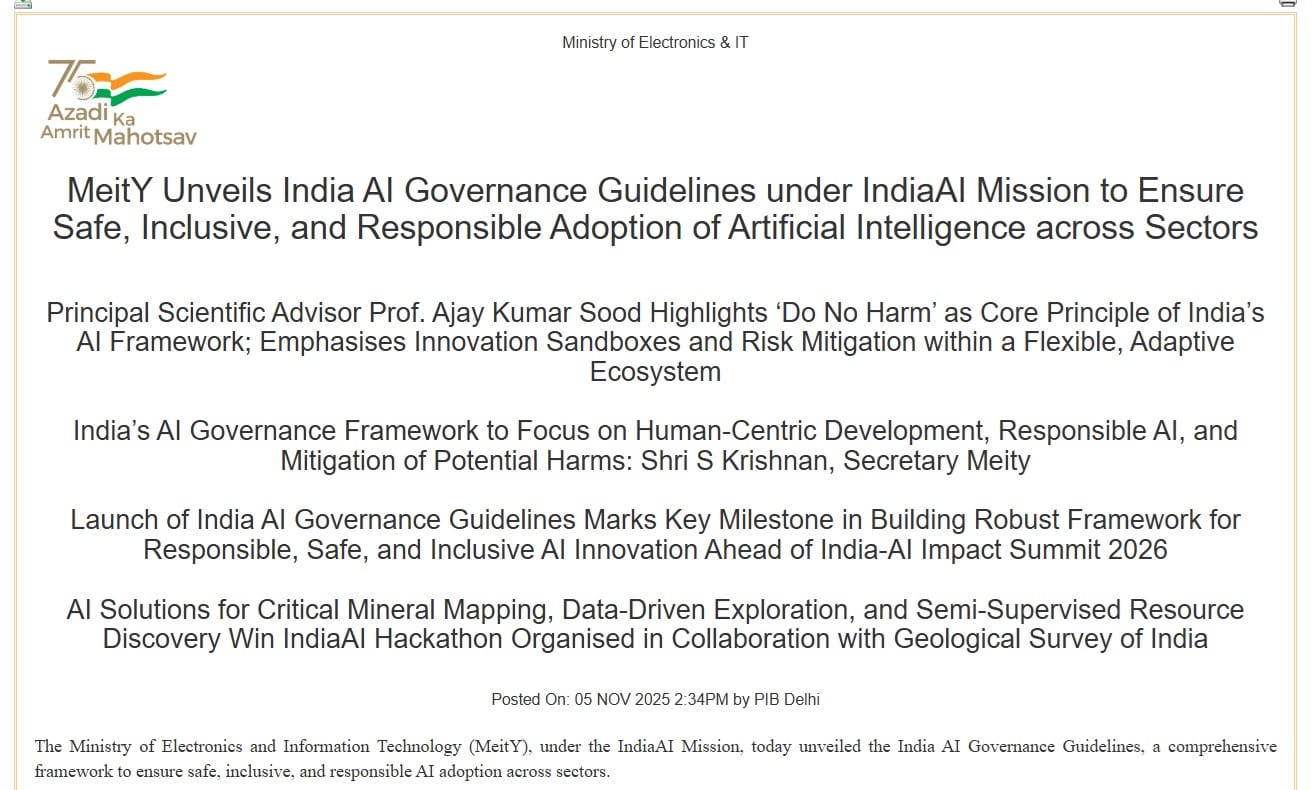
Who Made “India AI Governance Guidelines?”
- In July 2025, a committee was formed and led by Balaraman Ravindran, Head of Data Science and AI Department at IIT Madras.
- There's a previous version for the same, created by Ajay K. Sood, the Principal Scientific Adviser to the Government of India. It was out in January 2025.
- However, this new version is very different. It has less emphasis on controlling the risks and more on the growth of AI. So, it's good news for new AI startups in India.
Not a New AI Law (Yet!)
- Make no mistake, these rules are not a law. They lean more towards recommendations and a roadmap (for the future of AI).
- According to the Indian government, it apparently has no plans to introduce a separate AI law.
- However, it's not a never situation given that AI can become much riskier and powerful in the future.
Separate From Social Media Rules
There are separate rules for social media. It's quite different from the guidelines for AI. According to the Indian government, there's a proposal under public discussion on labelling AI-generated content on social media. For instance, any post created via AI will have a visible tag indicating that it is AI-generated.
The Main Goal: “Innovation With Guardrails”
The idea is not to restrict or make stricter rules for AI. The government wants AI to grow freely in the country. For instance, helping startups, businesses, and researchers, but of course, with safety principles in place to prevent any harm.
Here are the seven core principles of the report:
- Trust – People of the country should be able to trust AI systems freely.
- People-centricity – AI should serve people’s needs and work for people.
- Responsible innovation – Companies building new AI systems should prioritise ethics first.
- Equity – There shall be no space for bias and treat everyone equally.
- Accountability – Those making AI and using it should be responsible for their own actions.
- Understandability of LLMs – Big AIs like ChatGPT should be more clearly explainable and understandable.
- Safety, resilience, and sustainability – The AI should be secure, reliable, and environmentally responsible.
Mr Ravindran enunciated on these and said that India doesn’t want to “throttle” or slow down AI growth. He clearly mentioned that these guidelines will enable adoption, not restrict it.
India-Specific AI Risk Framework
The report also highlighted six recommendations for how India should move forward with AI. Here they are:
- Expand access to AI infrastructure – The AI shall be accessible to everyone in the country.
- Utilise India’s digital public infrastructure – meaning the use of AI systems (such as Aadhaar and UPI) that benefit the country's people.
- Skill development in AI – Training the people of the country in AI technologies.
- Adopt flexible rules – The regulation should be flexible as the technology evolves.
- Look at India-specific risks – To focus on risks and challenges specific to India, not just copying others, for instance, data privacy, inclusion, or local language AI.
- Improve accountability and transparency – To make AI companies transparent about how their AI systems use data.
What Will Happen Next?
The report recommended two goals:
Short-term actions:
- Establish key governance institutions (official bodies responsible for overseeing AI).
- Create India-specific risk frameworks.
- Give people more access to AI safety tools.
Medium-term actions:
- Amend and make the existing laws flexible (like IT laws) when needed.
- Develop systems to track AI-related incidents, particularly those related to cybersecurity.
- To integrate AI with India’s existing digital systems, like Aadhaar and Digital Public Infrastructure (DPI)
Note: These guidelines will be announced at the Delhi AI Impact Summit, scheduled for February 2026.
 Adepu Bindu