

OpenAI Tech to Power Burger King’s New Employee Monitoring System
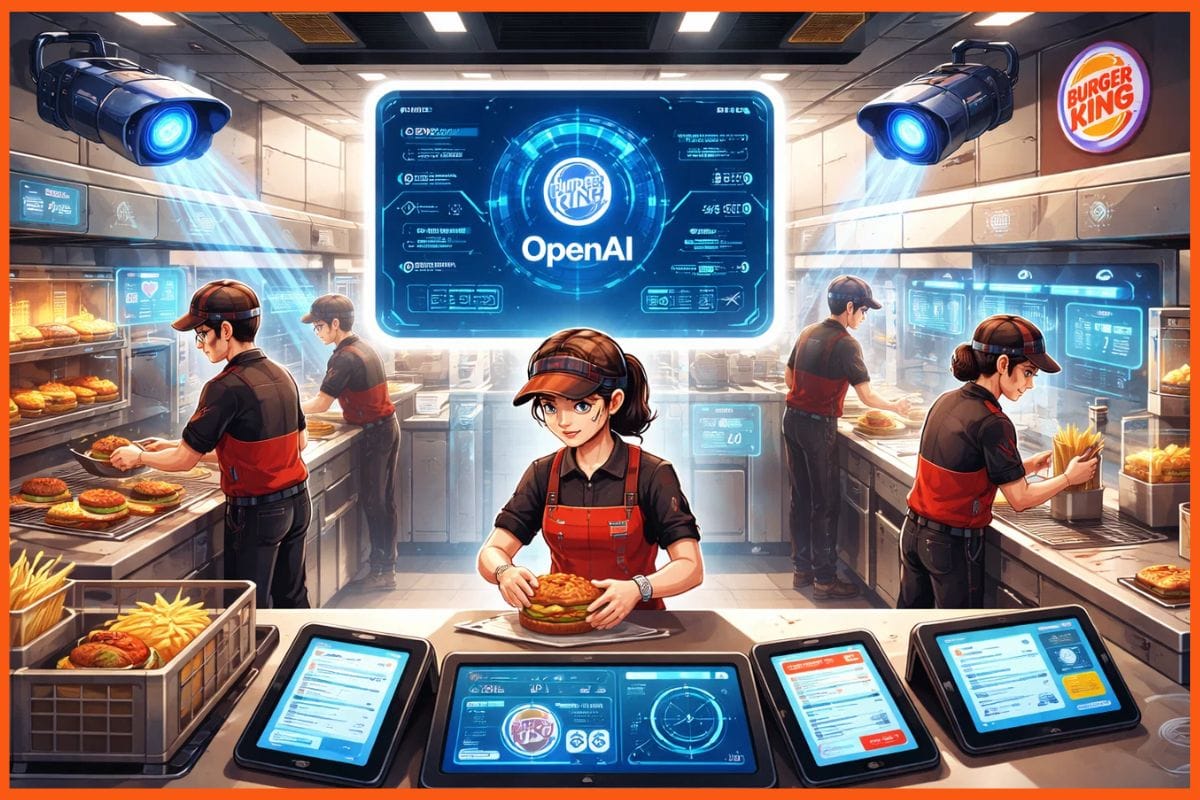
Hundreds of Burger King locations in the United States will soon be equipped with headsets that use an OpenAI chatbot. As the business puts it, this is a necessary step in gaining insight into "overall service patterns" for management. Part of a larger artificial intelligence platform meant to assist with restaurant operations, the fast-food giant has announced that it is implementing the program, which is called BK Assistant.
A voice-enabled chatbot named "Patty" is part of the system that links to the headsets that employees wear. Whether or not staff members greet customers with "please", "thank you", or "welcome" is something the chatbot can pick up on. Burger King stated that the function is not meant to assess individual employees but rather to shed light on service trends.
Why Burger King is Infusing AI?
The system is not intended to monitor or assess employees based on the words or phrases they speak, according to the corporate representative. The representative went on to say that BK Assistant is an operational and coaching tool that helps teams handle complexity and provide better service to guests. The voice-enabled headsets are slated to be released nationwide by the end of 2026 after undergoing a test programme in 500 US locales.
Besides keeping an eye on the language used by the service, the platform also handles operational duties. This feature can notify managers when certain items are no longer accessible on digital menus and the Burger King app.
It can also remind teams of maintenance needs, such as when the restrooms need to be cleaned, and walk them through the recipe assembly process after an order has been placed. In addition to taking drive-through orders, the technology will analyse them for coaching insights and to improve accuracy. Quickly following the release, there was a social media response in which detractors portrayed the technology as invasive and representative of overly stifling corporate control. This backlash is indicative of a larger concern about implementing AI in frontline jobs, especially those where performance reviews are already rigorous.
Changing Phase of AI in QSR Sector
This change heralds a new era in the hotel industry's use of artificial intelligence, one in which the focus moves from analytics in the background to coaching and supervision in real time. As the pilot program grows, the most important question will be whether BK Assistant really helps with service and efficiency or if worries about workplace monitoring and spying outweigh its benefits. The deployment occurs more than a year after McDonald's reduced the scope of its own AI experiment at drive-throughs.
As a result, over 100 McDonald's restaurants in the United States have been forced to remove an automated voice-ordering system due to operational difficulties. Burger King takes a different tack by enhancing existing employees rather than replacing them at the point of sale. The choice to include AI in real-time customer interactions, however, highlights the relentless pursuit of automation by quick-service companies in their pursuit of consistency, error reduction, and operational data extraction.
|
Quick Shots |
|
•Burger King is deploying OpenAI-powered chatbots in
employee headsets across US outlets. •The system is part of its AI platform called BK
Assistant. •A voice-enabled chatbot named “Patty” will analyse
customer–staff interactions. •The tool tracks service patterns, such as use of
polite phrases like “please” and “thank you.” |