

Razorpay Receives RBI Approval to Expand into Physical Payment Aggregation
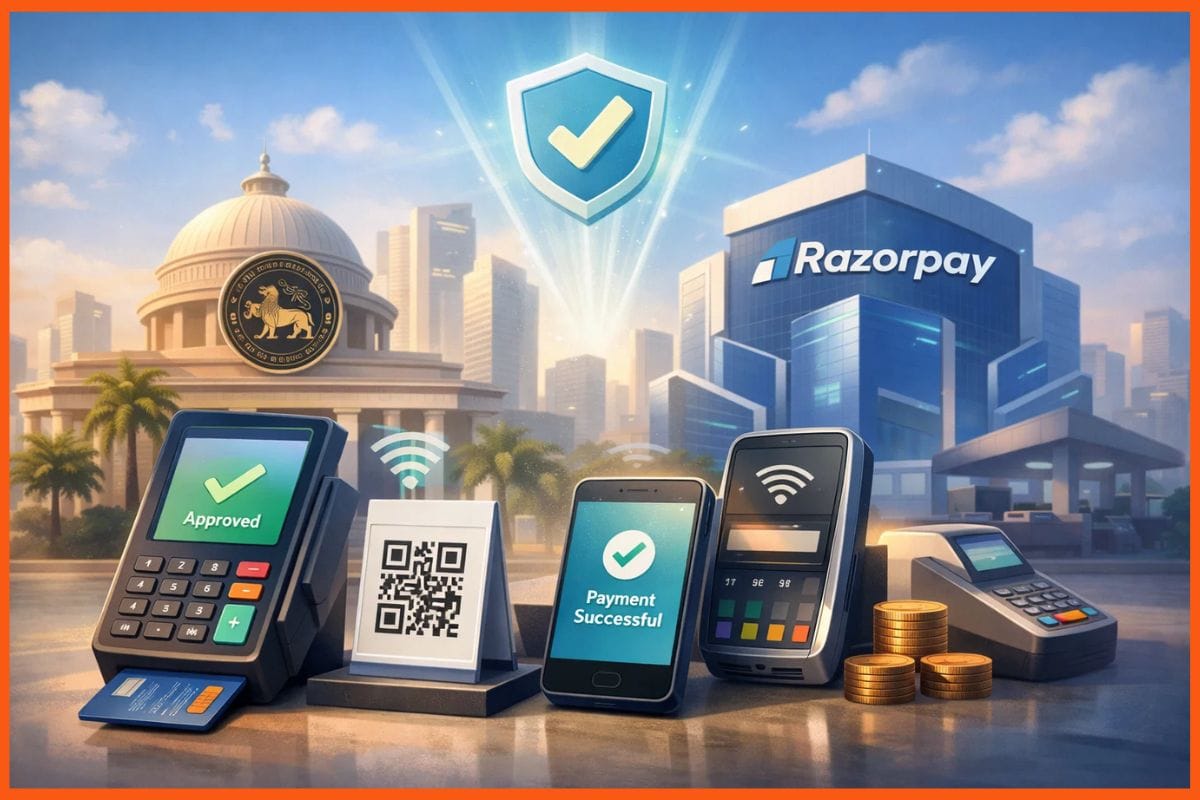
The Reserve Bank of India granted the Payment Aggregator-Physical (PA-P) licence to Razorpay POS, the company's offline payment division. Razorpay POS can now function as an offline payment aggregator for in-store transactions thanks to this licence. The fintech stated that it now possesses three significant RBI licences, which it obtained last month in December. These include the payment aggregator–online licence (PA-O), the payment aggregator–physical licence (PA-P), and the payment aggregator–cross-border licence (PA-CB). How this lincence will benefit Razorpay let’s explore.
The Licence will Enhance Razorpay’s Operations
Razorpay will be able to strengthen high-volume transactions by improving its in-store payment infrastructure thanks to the PA-P licence. According to PTI, these transactions would occur across a range of industries, including small and medium-sized businesses (SMEs) and major retail chains. Shashank Kumar, MD and co-founder of Razorpay, said that the company views regulation as fundamental to its development process rather than an afterthought.
Razorpay's capacity to assist companies with scalable, legal in-store payments as they grow their omnichannel presence is further strengthened by obtaining the RBI's Offline Payment Aggregator Licence. In December 2025, the fintech company obtained a significant Payment Aggregator – Cross-border (PA-CB) licence. Through this permission, the business was able to obtain regulatory authority to facilitate cross-border payments both inward and outward, making it one of the few select operators in India.
Explaining PA-P Licence and Payment Aggregator
A payment aggregator, according to the RBI, enables payments between consumers and retailers through physical or online channels and then sends the money to the retailers. A governmental permission known as a "payment aggregator-physical licence" permits payment aggregators such as Pine Labs, Paytm, and others to handle payments made by customers in person at the actual point of sale.
This includes scanning QR codes, swiping credit or debit cards, and more. The RBI grants these licences in accordance with its regulated system, which includes paying merchants in accordance with legal criteria. In order to access India's offline payment infrastructure, Razorpay purchased Ezetap in August 2022. At the moment, the fintech provides a range of hardware, including soundbox devices, magnetic POS (mPOS), and Android Smart POS.
|
Quick Shots |
|
•RBI grants Payment Aggregator–Physical
(PA-P) licence to Razorpay POS for in-store transactions •Razorpay now holds three RBI licences:
PA-Online, PA-Physical, and PA-Cross-Border •Licence enables Razorpay to expand offline
payment infrastructure across retail and SME sectors •Supports omnichannel businesses with
compliant, scalable in-store payment solutions •Strengthens Razorpay’s role in high-volume
physical transactions like QR and card payments •PA-P allows handling of POS, QR code, and
card swipe payments under RBI norms |