Bhanzu’s Prachotan D L on AI-Powered Learning, Cognitive Skill Focus, and Scaling to 50,000+ Learners Across 16 Countries
📝Interviews
StartupTalky presents Recap'25, a series of exclusive interviews where we connect with founders and industry leaders to reflect on their journey in 2025 and discuss their vision for the future.
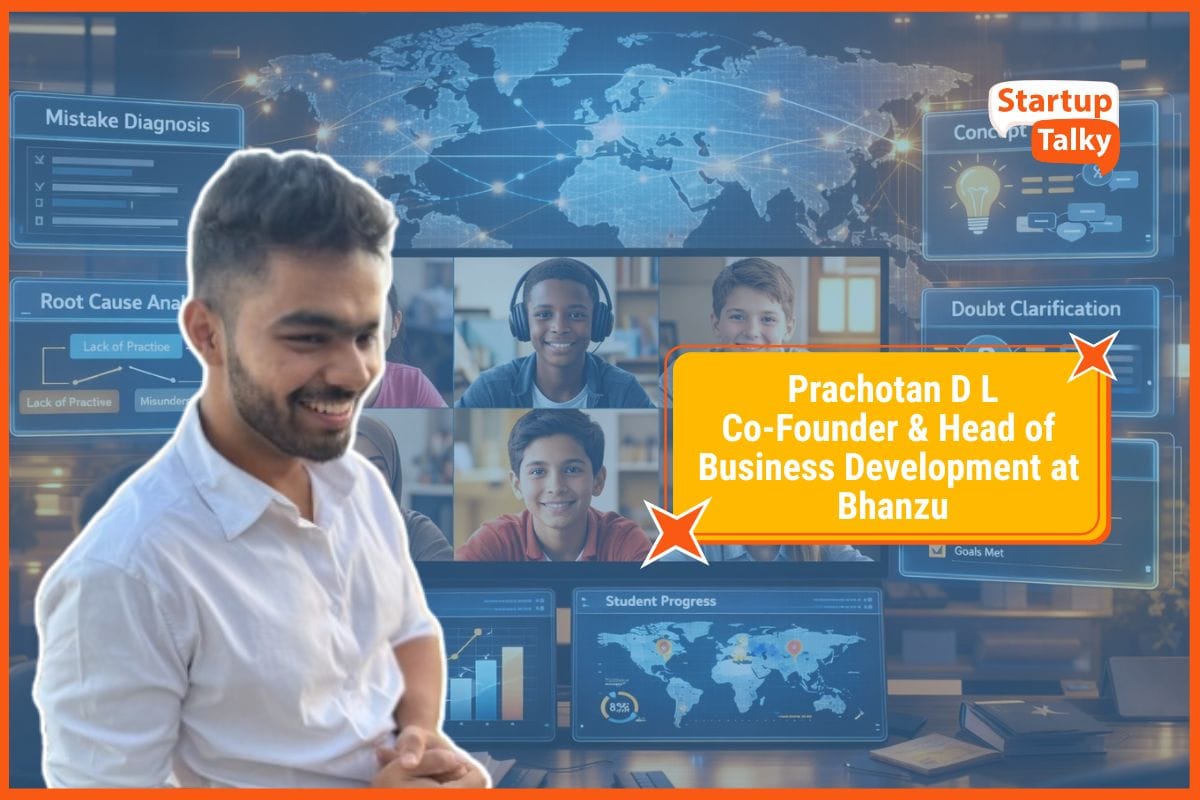
In this edition of Recap’25, StartupTalky speaks with Prachotan D L, Co-Founder and Head of Business Development at Bhanzu, who reflects on how the platform scaled globally in 2025—expanding across 16 countries and surpassing 50,000 learners. He shares how Bhanzu strengthened learner engagement through the introduction of GenAI-powered interactive learning features, including doubt clarification boards and concept explainers that support students in real time and make learning more responsive inside online classrooms.
Prachotan also discusses how learner expectations evolved this year, highlighting a growing shift among parents toward prioritising foundational cognitive skills such as language understanding and quantitative ability. The conversation explores Bhanzu’s view on the real role of personalisation in multi-student learning environments, and how AI-driven mistake diagnosis and root-cause analysis can accelerate learning outcomes by helping educators identify gaps faster and more consistently.
StartupTalky: Looking back at 2025, what were the most significant milestones or improvements your company achieved in platform features, content, or learner engagement?
Prachotan D L: 2025 has been a wonderful year for Bhanzu. We have grown significantly across 16 countries and officially surpassed 50,000 learners in 2025. Although we have accomplished a great deal more as a social initiative, actually reaching 50,000 learners with online class platforms has been a significant achievement. Along with this, we have improved student engagement massively. With the advent of Gen AI, we have even launched a few products that students can directly interact with, such as doubt clarification boards, concept explainers, and these have massively skyrocketed student engagement. Another significant milestone for Bhanzo has been to launch its first in-person class centre, and this has happened in Dallas, Texas. We are extremely proud of this achievement and we are thinking of growing further and further in the years to come.
StartupTalky: How did learner behaviour and expectations evolve this year? Were there any notable trends in engagement, course selection, or skill demand?
Prachotan D L: Though there have been a lot of technological advancements and even AI-based learning platforms that have come up newly in 2025, the base expectation of parents across ages of children has not varied a lot, counter-intuitively. And more importantly, there has been a lot more emphasis on improving cognitive abilities, even when it comes to parents, because they understand how institutional education can change over time very rapidly, and the core skill set which is language understanding and quantitative acumen still remain at the heart of one's cognitive abilities.
So the parents' ability to understand what is more foundational has improved massively in 2025, and I as a founder couldn't be happier about it.
Though screen time is a valid concern even today, parents do recognise that it is inevitable and it's part of how we are evolving as a collective human society. Having said that, replacing the screen time with a lot of screen time that is related to learning is something that parents are heavily encouraging. So that has been a very positive sign in 2025 as well.
StartupTalky: Technology and AI are increasingly shaping digital education. Which tools or innovations had the biggest impact on learning outcomes, personalisation, or operational efficiency in 2025?
Prachotan D L: There's a lot of myth around personalization in a multi-student environment, which is the most optimal way to learn. Personalization can only be done up to some degree. And this personalization has to be catered to very wisely, otherwise learning will lose its structure.
And when it comes to personalization, AI has helped a lot. In recent times, for example, in a 10-student environment, based on how students respond to a concept or a set of questions, the mistake diagnosis of every student and the root of the mistake can be easily identified. And that is when teachers or anyone who is delivering content has a greater ability to infer learning progression. This has a direct correlation to how learning outcomes are achieved and it helps students rectify mistakes way quicker than what it was previously.
The moment we depend on the teacher's ability to infer a mistake, that is when a lot of things are left to uncontrollable factors. But inducing some sort of tech innovation in terms of mistake diagnosis and root cause analysis of a student's learning progression definitely helps in achieving learning outcomes more effectively and quickly.
StartupTalky: The EdTech sector saw shifts in enrolment patterns, regional adoption, and digital accessibility this year. What patterns stood out to you?
Prachotan D L: The biggest pattern that stood out for us is how a few facets of learning are driven by motivation and a few facets of learning are not. With any facet of learning that is not driven by motivation, it has been proven that it can be easily automated or AI-led. But having said that, anything that deals with motivation or has a huge cultural baggage in terms of how students and learners perceive it across the world, that is where there is still an element of human understanding of teaching and human arbitrage of how content is delivered. That has been the biggest pattern that I have observed.
StartupTalky: What challenges, whether in content delivery, learner engagement, or technology adoption, did your team face in 2025, and how were they addressed?
Prachotan D L: Customising content based on the students' persona when they come from different segments of social and cultural backgrounds has been challenging to understand and the reason is that it's pretty nuanced to understand in the first place. So, how to make a classroom environment so customised that even people from different geographies sit together and can learn effectively? It's a problem that we are willing to solve and this requires a lot more data crunching, observation, and derivation of insights that we are willing to do. This has been a great challenge to tackle.
StartupTalky: Looking ahead to 2026, which learner segments, courses, or technologies do you see growing fastest, and why?
Prachotan D L: Learning for adults and language learning to grow exponentially from here on. The LLMs are actually pretty good at curating learning pathways for language learning. There has been a lot of institutional knowledge that has already seeped in. When it comes to learning for adults, anyone who is self-motivated can easily learn, and those segments will grow exponentially. Vocational training can be automated up to a great extent, especially when it comes to softer skills within that. So that is another segment that will grow very well.
StartupTalky: From your experience, what long-term changes do you anticipate in the EdTech landscape, particularly around AI, personalised learning, and global accessibility?
Prachotan D L: AI will have a huge impact on education as a whole. First things first, the entire ecosystem of testing, assessing a student, showcasing outcomes and giving feedback and mistake diagnosis, this is the entire loop that will first get automated. And it can easily be replaced by AI, and AI genuinely thrives in this segment. How a concept is taught and how do you incrementally learn from there on? There is a lot more work to be done when it comes to personalising it. Yeah, that is one prediction that is pretty straightforward in my opinion.
Explore more Recap'25 interviews here.
Must have tools for startups - Recommended by StartupTalky
- Convert Visitors into Leads- SeizeLead
- Website Builder SquareSpace
- Run your business Smoothly Systeme.io
- Stock Images Shutterstock