

Prassana Kumar C of VilCart on Revolutionizing Rural Commerce, Tech-Enabled Supply Chains, and Building a Trust-Driven Retail Ecosystem
📝Interviews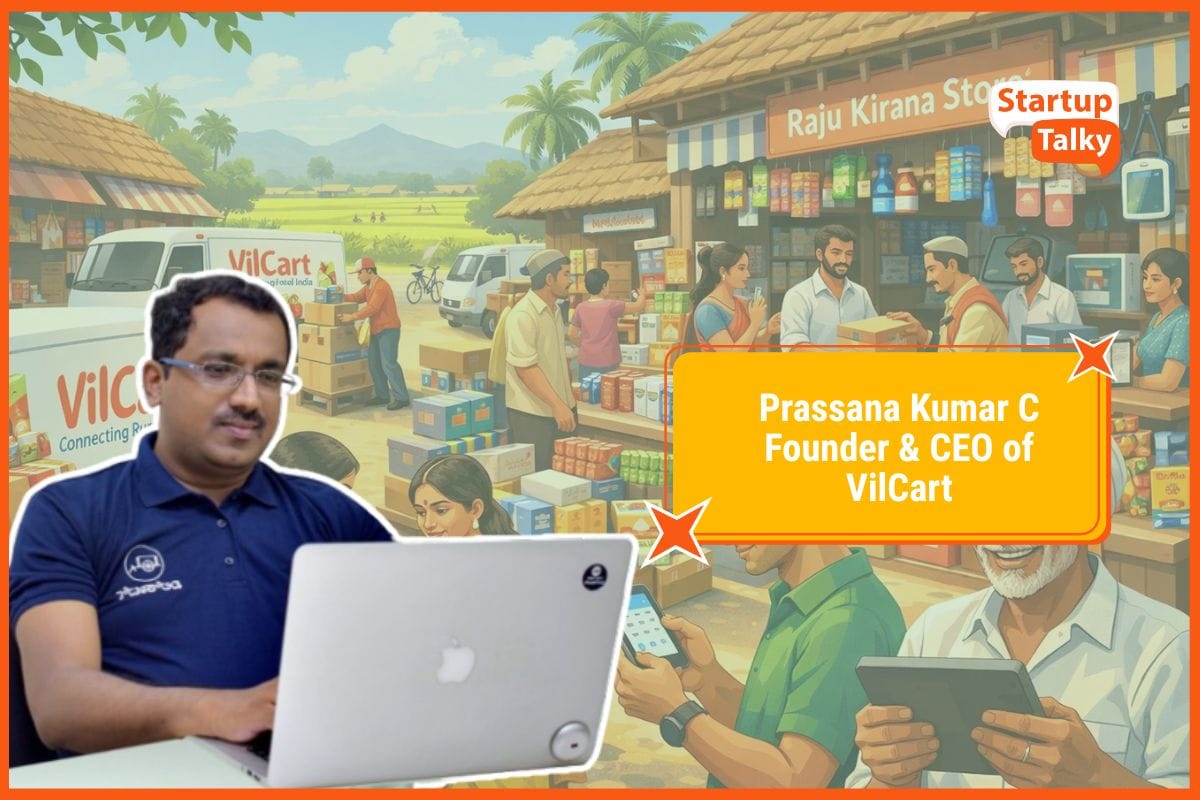
StartupTalky presents Recap'25, a series of exclusive interviews where we connect with founders and industry leaders to reflect on their journey in 2025 and discuss their vision for the future.
In this edition of Recap’25, StartupTalky speaks with Prassana Kumar C, Founder & CEO of VilCart, who reflects on building a tech-enabled rural commerce platform that bridges the gap between manufacturers and village retailers across India. Driven by a vision to resolve the “Rural Logistics Paradox,” Kumar shares how VilCart empowers small kirana stores by combining technology, last-mile delivery, and deep local insights, making products—from FMCG to electronics—accessible in even the most remote villages.
He goes on to discuss how VilCart has adapted to shifts in rural retail through data-driven demand forecasting, AI-enabled logistics planning, and a relationship-led operational model. The conversation also explores VilCart’s innovative “Farmer-to-Farmer” supply approach, strategies for scaling to over 1,00,000 kirana stores, initiatives to expand private label revenue, and the roadmap for AI-driven predictive inventory, smarter logistics, and long-term growth in India’s rural commerce ecosystem.
StartupTalky: What service does VilCart provide? What was the motivation/vision with which you started?
Prassana Kumar C: VilCart is a tech-enabled rural commerce platform that bridges the gap between manufacturers and the rural retail ecosystem. We operate a sophisticated, end-to-end supply chain that connects Big Brands, Manufacturers, Farmer Producer Organizations (FPOs) directly to smallest village retailers. We provide a wide catalog of products from groceries and FMCG to electronics that were previously inaccessible to rural retailers. A last-mile delivery network that reaches deep-interior villages ensuring doorstep delivery within 24-48 hours.”
The idea for VilCart was born from my own experiences growing up in Mandya, Karnataka, where I saw firsthand the challenges faced by village kirana store owners. Many of these small retailers had to close their shops for an entire day, losing crucial revenue, just to travel to the nearest town or city to procure stock. They struggled with high transportation costs, inconsistent pricing and limited product variety. In 2018, I founded VilCart to address what we call the ‘Rural Logistics Paradox’ bringing efficiency, reliability and choice to small retailers while ensuring they never have to compromise on serving their communities.
StartupTalky: What new services have been added in the past year? What is/are the USP/s of your service?
Prassana Kumar C: We have broadened our service offerings beyond core procurement to more effectively support the day-to-day needs of small retailers. Our advanced demand forecasting enables partners to plan inventory with greater precision, while strengthened logistics and last-mile delivery capabilities ensure faster and more reliable fulfillment. We have also introduced data-driven insights that help retailers and brands make smarter decisions about pricing and assortment. Our key USP is the integration of technology with a strong on-ground understanding of local markets particularly rural India, allowing us to operate a relationship-driven, high-trust model at scale. This balance of human connection and technology truly sets VilCart apart in the market.
StartupTalky: How has the industry you are in changed in recent years and how has VilCart adapted to these changes?
Prassana Kumar C: Over the past few years, our industry has evolved rapidly, driven by the digitization of retail, rising expectations around availability and speed and a growing need for efficiency across fragmented supply chains. Traditional distribution models are giving way to data driven, tech enabled platforms, while retailers especially kiranas and rural stores are increasingly open to adopting digital tools that simplify procurement and inventory management. At VilCart, we have adapted by building a technology first, yet relationship led model that combines demand forecasting, smarter logistics and deep on ground engagement. This approach has allowed us to reduce inefficiencies, improve service reliability, and scale sustainably, while staying closely aligned with the trust-based nature of the markets we serve.
StartupTalky: What key metrics do you track to check the VilCart growth and performance?
Prassana Kumar C: At VilCart, our growth is measured by the tangible value we return to the rural economy. While we track standard financial indicators like our ARR and GMV, our true North Star metrics are Kirana penetration and fulfillment reliability. By maintaining a 99% order fulfillment rate across 1,00,000 stores, we ensure that rural retailers can operate with lower inventory costs and higher turnover. Furthermore, the expansion of our private label brands, now contributing over 20% of revenue, demonstrates our ability to deliver high-quality, affordable goods that resonate specifically with the rural consumer base.
StartupTalky: What were the most significant challenges VilCart faced in the past year and how did you overcome them?
Prassana Kumar C: Over the past year, we have navigated a rapidly evolving retail landscape marked by supply chain volatility, fluctuating demand across categories and the challenge of onboarding and enabling a diverse base of local vendors at scale. These pressures were further intensified by rising logistics costs and the need to maintain consistent service quality across regions. We addressed these challenges by strengthening our supplier partnerships, investing in smarter demand forecasting and inventory planning and streamlining last mile operations through technology-driven processes. By focusing on operational efficiency, vendor empowerment and customer centric execution, we not only stabilized our operations but also emerged more resilient, agile and better positioned for sustainable growth.
StartupTalky: What are the different strategies you use for marketing? Tell us about any growth hack that you pulled off.
Prassana Kumar C: Our marketing strategy is built on a 'Rural First' philosophy that prioritizes deep rooted relationships over traditional advertising. We move beyond digital screens by deploying a dedicated CRM team that personally visits and registers Kirana stores, honoring the trust based nature of village commerce. By offering an intuitive local language app and a supportive tele-calling system, we ensure technology feels like a tool for empowerment rather than a barrier.
Perhaps our most significant growth hack was the 'Circular Supply Chain' pivot: rather than just selling to villages, we began sourcing directly from local Farmers' Producer Organizations (FPOs) and rural SMEs to stock our shelves. This 'Farmer-to-Farmer' model didn't just slash our procurement costs, it turned our customers into our suppliers, creating a self sustaining ecosystem that helped us scale to over 1,00,000 Kirana stores across 30,000 villages while driving our private label revenue to over 20%.
StartupTalky: What opportunities do you see for future growth in your industry in India and the world?
Prassana Kumar C: I see significant long term growth opportunities in our industry as retail and supply chains undergo rapid transformation in India and across the world. In India, the continued digitization of kirana stores, growing adoption of data-driven procurement and the rise of regional and local brands present a powerful opportunity to modernize the backbone of everyday commerce. Rural India in particular, represents the next major growth frontier with rising incomes and awareness driving increased demand for premium categories such as health, hygiene, and organic products.
While Western markets move toward unmanned and self-service models, India, especially rural India, remains deeply relationship driven, where trust and personal connections shape buying decisions. I believe companies that combine deep local understanding with strong technology and disciplined execution will play a defining role in shaping the future of retail supply chains worldwide.
StartupTalky: How are you using AI and what impact has it created?
Prassana Kumar C: While we are currently in the foundational stages of its AI journey, we are actively laying the groundwork for a data driven revolution in the rural supply chain. Our current focus is on building the robust digital infrastructure spanning over 100,000+ Kirana stores that will serve as the primary data source for our upcoming AI-integration phase. By digitizing every transaction and delivery route across 30,000+ villages, we are creating a unique dataset that will soon power predictive demand forecasting and automated inventory replenishment.
We are already exploring pilot projects to optimize our logistics network and reduce 'dead mileage,' with the goal of lowering operational costs by 15–20%. This forward looking technology roadmap is designed to transform the traditional village shop into a high-efficiency 'Grameen Supermarket,' ensuring that as we scale, our AI capabilities grow alongside our physical footprint to bring urban-grade business intelligence to the heart of rural India.
StartupTalky: How do you plan to expand the Customers, service offering, and team base in the future?
Prassana Kumar C: Our expansion strategy is focused on deepening its presence in existing markets while thoughtfully scaling into new regions with strong demand potential. We plan to grow our customer base by onboarding more retailers and local brands through a mix of hyperlocal outreach, digital acquisition and referral led growth.
The service offerings will expand beyond core procurement to include value-added solutions such as smarter inventory planning, data-driven insights, and enhanced logistics support tailored to small retailers. To support this growth, We are investing in building a strong, cross functional team by hiring local market specialists, strengthening technology and data capabilities and fostering a culture of ownership and innovation ensuring the organization scales sustainably while maintaining high service quality.
StartupTalky: One tip that you would like to share with another Service company founder?
Prassana Kumar C: One key lesson I would share with other service company founders is to stay relentlessly close to your customer while building for scale. Real growth comes from deeply understanding everyday pain points on the ground and solving them consistently, even if the solutions are not always glamorous. Investing early in strong processes and technology helps deliver reliable service as you grow, but equally important is building trust with customers and partners through transparency and responsiveness. When execution, empathy and scalability move together, a service business can create lasting value and resilience in competitive markets.
Explore more Recap'25 interviews here.