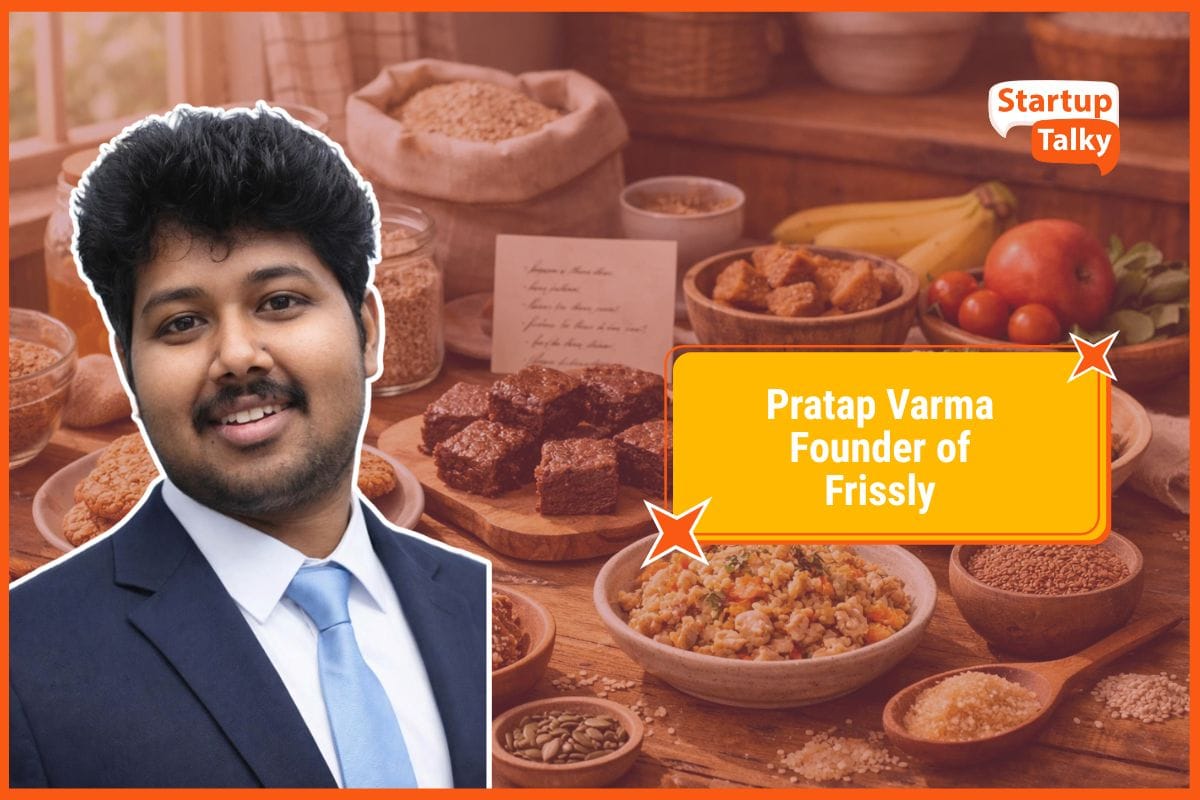
Pratap Varma of Frissly, on Building a Trust-First Clean Food Ecosystem for Everyday Families
📝Interviews
StartupTalky presents Recap'25, a series of exclusive interviews where we connect with founders and industry leaders to reflect on their journey in 2025 and discuss their vision for the future.
In this edition of Recap’25, StartupTalky speaks with Pratap Varma, Founder of Frissly, who reflects on a year of disciplined growth in India’s evolving clean-label food space. Varma shares how Frissly strengthened its position as a trust-first food brand by prioritizing freshness, ingredient integrity, and small-batch production over shortcuts typically associated with scale.
He discusses the operational realities of building a chemical-free, organic food ecosystem — from navigating certification challenges and ingredient sourcing constraints to designing delivery systems that support freshness instead of long shelf life. The conversation also highlights shifting consumer behaviour, with more families reading labels, seeking everyday clean food options, and driving growth through repeat purchases and word-of-mouth rather than promotional tactics.
StartupTalky: What products does Frissly sell? What was the motivation/ vision with which you started?
Pratap Varma: Frissly offers fresh, clean, chemical-free food products that are designed for everyday consumption. Our focus is on minimising processed food and focusing more on using clean ingredients, free from preservatives, additives and any form of harmful or adulterated ingredients without compromising on the taste. The motivation behind Frissly came from years of working on the ground as a farmer and building farm-to-consumer models. During this journey, I saw how India moved away from organic farming and traditional homemade foods toward chemical-based agriculture and highly processed packaged foods. Parents repeatedly told us they had no clean options for everyday snacks, especially for children.
Frissly was created to solve this gap by building a clean food ecosystem — making honest, organic, and freshly prepared food accessible and practical for modern Indian families.
StartupTalky: What other products/features have been added in the past year? What is/are the USP/s of your products?
Pratap Varma: Over the past year, we have expanded Frissly across both product range and formats. We added more clean-label packaged foods made with whole grains, improved taste profiles through deeper R&D, and introduced small-batch fresh products supported by our 100-minute delivery model in select cities. We also strengthened our digital platform to better manage freshness, availability, and customer experience.
The core USP of Frissly lies in how the food is made. Our products are built on four fundamentals: 100% organic certified ingredients, zero chemicals or additives, zero refined ingredients, and strong focus on taste. We don’t engineer food for shelf life — we design systems for freshness.
Another key differentiator is that we treat clean food as everyday food, not a niche or premium category. Whether packaged or freshly prepared, Frissly products are meant to be consumed regularly, with trust, transparency, and consistency at the centre.
StartupTalky: How has the industry you are in changed in recent years, and how has Frissly adapted to these changes?
Pratap Varma: In recent years, the food industry has seen a clear shift in consumer awareness. People are reading labels more carefully and questioning preservatives, artificial ingredients, and highly processed foods. At the same time, convenience and quick access have become non-negotiable, especially in urban lifestyles.
Frissly adapted to this change by staying rooted in clean food principles while redesigning the way food is produced and delivered. Instead of chasing long shelf life, we focused on clean-label, organic, freshly made food, supported by small-batch production and faster delivery models. By combining strong R&D, honest ingredients, and quick access, we aligned with evolving consumer expectations without compromising on food integrity.
StartupTalky: What key metrics do you track to check the Frissly's growth and performance?
Pratap Varma: We focus on metrics that reflect real usage and trust, not just topline numbers. The most important ones for us are repeat purchase rate, customer retention, and word-of-mouth growth, because they tell us whether families are genuinely adopting Frissly into their daily lives.
Operationally, we track small batch manufacturing cycles, batch-level wastage, consistency in taste, and on-time delivery, since clean, chemical-free food demands tight control. We also closely monitor R&D progress and new product success, ensuring that every addition meets our standards for taste and integrity.
For us, healthy growth is not just about scaling fast — it’s about building a system that customers come back to, again and again.
StartupTalky: What were the most significant challenges Frissly faced in the past year and how did you overcome them?
Pratap Varma: One of the significant challenges we faced in the past year was maintaining our standards while navigating the organic certification and availability ecosystem. Certain ingredients that meet our taste and nutrition benchmarks were simply not available in certified organic form during parts of the year. As a result, we consciously chose not to launch a few products, even though they performed very well in R&D.
Another challenge was the certification and compliance process itself. Organic certification, audits, and documentation took so much of time and discipline, and they often slow down launches. But for us, this is non-negotiable — we would rather delay a product than compromise on integrity.
We also faced challenges in scaling freshness alongside rising demand, which we addressed by refining our hybrid production and delivery model.
Overall, these challenges reinforced our core belief: growth should never come at the cost of trust. Every decision we made last year was guided by that principle.
StartupTalky: Repeat purchase is one of the most important parameters on which most e-commerce brands are betting. How do you keep your customers engaged to stop churn? Can you share specific customer retention initiatives or loyalty programs that have proven successful for your brand?
Pratap Varma: For us, repeat purchase doesn’t come from tactics — it comes from trust and habit.
The biggest driver of retention at Frissly is taste and consistency. When customers know that every order will be clean, chemical-free, and genuinely tasty, Frissly naturally becomes part of their regular routine. That reliability reduces churn more than any discount or campaign.
Instead of aggressive loyalty programs, our retention is largely driven by word-of-mouth and family networks. Mothers recommend us to other mothers, and children bring in other children. That organic advocacy has been far more powerful than traditional retention schemes.
Our bestsellers like almond cookies, Witch brownie, and jowar dosa speak for themselves, and with above 60% of our customers returning, it’s clear people love what we make. Freshness, quality, and simple, delicious food naturally keep our customers engaged.
At Frissly, retention is earned every day at the product level, not engineered through churn-control tactics.
StartupTalky: What are the different strategies you use for marketing? Tell us about any growth hack that you pulled off.
Pratap Varma: Our marketing has always been very simple and ground-driven. We don’t rely heavily on large campaigns or aggressive digital promotions. The strongest strategy for us has been direct community engagement and product sampling.
We actively go into residential communities, schools, and family-focused spaces and let people taste the food first. Sampling has been one of our most effective growth drivers. Once consumers taste the product, the first impression is created there itself. If they like it, trust begins immediately — far more effectively than any advertisement.
What we’ve consistently seen is that the more people taste our food, the more customers we gain. Clean-label food can’t be explained fully through words; it has to be experienced. Taste becomes the entry point, and clean ingredients ensure repeat purchases.
Once customers understand that the food is genuinely tasty and clean-label, repeat behaviour follows naturally. That repeat base — especially among families — is what fuels word-of-mouth. Mothers recommend us to other mothers, and children bring in more children.
We don’t believe in flashy growth hacks. Our growth comes from letting the product speak, building confidence through experience, and then earning loyalty through consistency. For us, marketing is not about creating noise — it’s about creating belief.
StartupTalky: What are the important tools and software you use to run your business smoothly?
Pratap Varma: We use technology mainly to bring discipline and visibility into our operations, not to overcomplicate things. Our core tools include a custom-built ordering and inventory system, which helps us align demand with small-batch production and manage freshness efficiently.
We also use standard tools for inventory tracking, quality checks, logistics coordination, and customer communication, ensuring that orders move smoothly from production to delivery. Internally, we rely on basic ERP, accounting, and reporting systems to maintain control as we scale.
For us, software is successful only when it runs quietly in the background and allows teams to focus on what really matters — making clean, tasty, and honest food consistently.
StartupTalky: What opportunities do you see for future growth in your industry in India and the world? What kind of difference in market behaviour have you seen within states in India?
Pratap Varma: The biggest opportunity for growth in India — and globally — lies in making clean, chemical-free food part of everyday consumption, not just a niche or premium choice. Consumers are moving beyond calorie counting and starting to question ingredients, processing methods, and long-term health impact. This shift creates strong potential across packaged foods, freshly prepared meals, beverages, and daily essentials.
Within India, we do see clear differences in market behaviour across states. Cities like Bengaluru and Hyderabad show higher awareness and faster adoption, with consumers actively reading labels and valuing clean ingredients. In some other regions, price sensitivity is higher, and education plays a bigger role — once people understand the difference and experience the taste, acceptance increases steadily.
StartupTalky: What lessons did your team learn in the past year, and how will these inform your future plans and strategies?
Pratap Varma: One of the biggest lessons we learned in the past year is that doing fewer things well is far more powerful than doing many things quickly. Clean food cannot be rushed. Every shortcut — in sourcing, processing, or people — eventually shows up in the product.
We also learned that taste is the strongest trust-builder. Clean-label alone is not enough; food has to be genuinely enjoyable.
Another key learning was around operations and scale. As demand grows, systems need to evolve without compromising values. This led us to refine our hybrid production and delivery model — balancing freshness with convenience more intelligently.
Finally, we learned the importance of patience. Building a clean-eating ecosystem takes time — with farmers, teams, and consumers. These lessons will guide our future strategy: steady expansion, strong fundamentals, and never compromising on integrity, even when growth opportunities look tempting.
For us, the past year reinforced one belief — if we stay honest to the food, the future will take care of itself.
StartupTalky: How do you plan to expand the customers, SKUs, and team base in the future?
Pratap Varma: Our expansion across customers, SKUs, and teams will be deliberate and phased, not aggressive.
We aim to serve more cities like Chennai, Pune, Vizag, and Mumbai, reaching new customers while expanding our product range to include sparkling waters, Protein Bars, Granola, Bars and ready-to-cook foods, with new categories coming soon.
Team expansion will follow the same philosophy. We invest in training from the ground up, especially for chefs and operations teams, so people grow with the culture. We prefer building small, aligned teams that understand clean food deeply, rather than scaling headcount quickly.
StartupTalky: With so much hype around D2C brands spending on ads, What will be your growth strategy, organic or inorganic? How to plan to work around SEO and content marketing?
Pratap Varma: We believe growth has to be earned, not bought. Clean food builds best through trust, taste, and repeat behaviour — not through excessive ad spending.
Our focus is on product-led growth: community sampling, strong word-of-mouth, and high repeat rates. When families genuinely like the food and feel confident serving it at home, growth happens naturally and sustainably.
That said, we do use digital tools thoughtfully. SEO and content marketing are important for us, but not as traffic hacks. We plan to invest in education-driven content — explaining clean-label food, ingredients, traditional eating habits, and transparency in food systems. This helps consumers make informed choices and builds long-term trust.
We avoid pushing content just to rank or sell. Instead, we aim to create meaningful, informative content that reflects our philosophy and answers real consumer questions. Over time, this builds credibility, organic reach, and steady discovery.
In short, our strategy is organic-first, supported by content and SEO that educate and build trust — not by burning money on ads.
StartupTalky: One tip that you would like to share with another D2C founder, based on your own experience
Pratap Varma: Don’t build for speed — build for truth.
It’s easy to get distracted by funding, ads, and quick scale, but if the product and the system behind it are not right, growth won’t last. Spend time on fundamentals: ingredients, processes, people, and trust. Especially in food, shortcuts show up sooner or later.
If you get the product right and stay patient, customers will do the marketing for you.
Explore more Recap'25 interviews here.
Must have tools for startups - Recommended by StartupTalky
- Convert Visitors into Leads- SeizeLead
- Website Builder SquareSpace
- Run your business Smoothly Systeme.io
- Stock Images Shutterstock