

Prateek Shukla of Masai School on Simulated Adaptive Learning, Vernacular AI Education, and Building Outcome-Driven Tech Talent Across Bharat
📰 News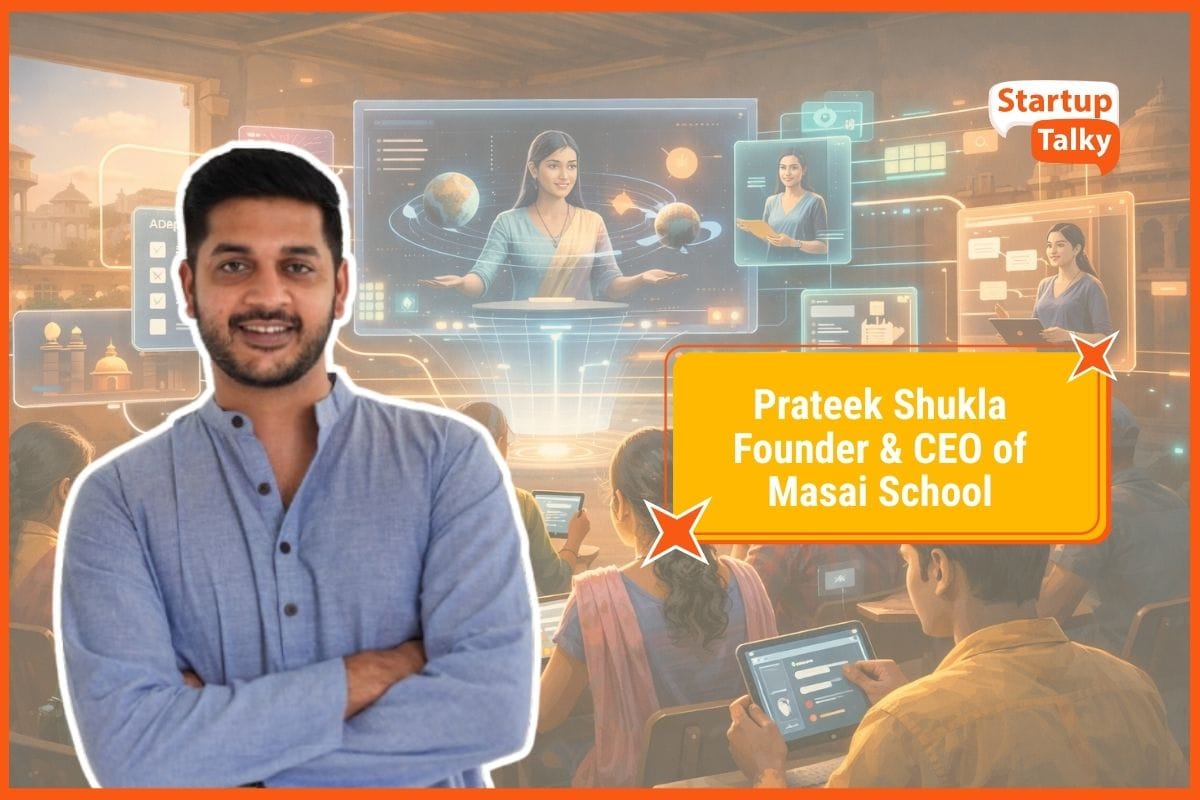
StartupTalky presents Recap'25, a series of exclusive interviews where we connect with founders and industry leaders to reflect on their journey in 2025 and discuss their vision for the future.
In this edition of Recap’25, StartupTalky speaks with Prateek Shukla, Founder & CEO of Masai School, who reflects on how 2025 marked a turning point in the evolution of outcome-driven, AI-powered education in India. As the EdTech ecosystem grappled with shifting learner expectations and rapid advances in artificial intelligence, Shukla shares how Masai moved beyond conventional online learning to build systems that deliver personalization at scale without compromising quality or accessibility.
He discusses the launch of Simulated Adaptive Learning (SAL) and Masai’s AI-powered Tutor and Interviewer, which together redefined how learners engage with content, receive support, and prepare for real-world roles. The conversation also explores the surge in AI and ML demand from Tier-2, Tier-3, and Tier-4 cities, the strategic importance of vernacular-first education, and why outcome accountability—placements, readiness, and skill validation—is fast replacing credential-led learning. Looking ahead to 2026, Shukla outlines how Masai School aims to scale adaptive learning, industry-specific AI programs, and accessible education models to serve the next wave of tech talent across Bharat.
StartupTalky: Looking back at 2025, what were the most significant milestones or improvements of Masai School achieved in platform features, content, or learner engagement?
Prateek Shukla: We launched two transformative platform innovations in 2025. First, Simulated Adaptive Learning (SAL)—a technology that turns traditional one-size-fits-all classes into live simulations where every student watches the same lesson, but quizzes and in-flow decisions continuously adapt the pace, depth, and difficulty. This ranges from a 60-minute fast track to a 120-minute support path, all while maintaining cohort synchronization. It combines the scalability of recorded content with the precision of personal tutoring, delivering consistent outcomes at scale.
Second, we integrated an AI Tutor—a multilingual tool that gets embedded within class content. Learners can ask contextual questions like "I'm confused with the topic discussed at the 14th minute, help me understand with an example," and the AI explains in their preferred language.
On the outcomes front, we graduated our first cohort of AI Engineers with an 80% placement rate within 30 days of graduation. Leading companies like Keka, NoBroker, Zoop, and MSG Global rapidly closed AI Engineering talent gaps through our program.
We also partnered with HDFC Life to run a comprehensive training program for their campus hires, validating our curriculum's industry relevance.
StartupTalky: How did learner behaviour and expectations evolve this year? Were there any notable trends in engagement, course selection, or skill demand?
Prateek Shukla: Two significant trends emerged in 2025. First, demand for AI and ML courses surged dramatically, particularly from Tier-2, Tier-3, and Tier-4 cities—what we call "Bharat." This shift in regional demand patterns revealed that learners outside metros are equally eager to upskill in emerging technologies, challenging the traditional metro-centric EdTech narrative.
Second, learners increasingly demanded accessibility in their native languages. To address this, we launched AI courses in vernacular languages including Hindi, Marathi, Telugu, and Tamil. This wasn't just a feature request—it was a fundamental shift in how learners expected to engage with premium content. Language should never be a barrier to capability.
These trends show learners prioritize outcome-focused, accessible, and locally-relevant content over traditional degree-heavy pathways.
StartupTalky: Technology and AI are increasingly shaping digital education. Which tools or innovations had the biggest impact on learning outcomes, personalisation, or operational efficiency in 2025?
Prateek Shukla: AI Tutor and AI Interviewer were our two most impactful innovations.
The AI Tutor delivers personalized support at scale. It understands context within lessons and explains concepts in learners' preferred languages, effectively democratizing access to individualized instruction. This addresses the core challenge of personalization—making it affordable and scalable.
The AI Interviewer transforms self-assessment. Learners can simulate interviews for specific companies and receive industry-level feedback on strengths and shortcomings within minutes. This bridges the gap between learning and real-world readiness, providing immediate, actionable insights that traditional assessments can't match.
However, we acknowledge challenges: the non-deterministic and hallucinatory nature of LLMs poses quality control concerns for AI tutoring consistency. We're actively working to mitigate this through validation frameworks.
StartupTalky: The EdTech sector saw shifts in enrolment patterns, regional adoption, and digital accessibility this year. What patterns stood out to you?
Prateek Shukla: The most striking pattern was the explosive demand for AI and ML courses from Tier-2, Tier-3, and Tier-4 cities—significantly outpacing metro adoption. This signals a fundamental shift: quality tech education is no longer a metro luxury. Learners across Bharat are actively seeking upskilling opportunities, but they expect content in their native languages.
This regional surge forced us to rethink localization strategy. Launching AI courses in Hindi, Marathi, Telugu, and Tamil wasn't optional—it was essential to serve this expanding learner base authentically.
StartupTalky: What challenges, whether in content delivery, learner engagement, or technology adoption, did your team face in 2025, and how were they addressed?
Prateek Shukla: Our primary challenge centered on AI quality assurance. The non-deterministic and hallucinatory nature of Large Language Models posed real risks for AI Tutor consistency. We couldn't simply deploy LLMs and hope for accuracy—learners depend on reliable explanations.
We addressed this through rigorous validation frameworks, continuous monitoring of AI outputs, and human-in-the-loop review processes. The goal is ensuring AI tutoring maintains the same standard as human instruction, not replacing one problem with another.
StartupTalky: Looking ahead to 2026, which learner segments, courses, or technologies do you see growing fastest, and why?
Prateek Shukla: AI and ML courses will continue accelerating, particularly in Tier-2, Tier-3, and Tier-4 cities. This isn't speculation—it's already happening. Learners in these regions recognize that AI skills directly translate to employment and earning potential, and they're willing to invest in quality outcomes over degrees.
We also anticipate rapid growth in industry-specific AI applications—how AI applies to maritime, logistics, healthcare, finance. As companies across sectors integrate AI into operations, they'll need talent fluent in both domain knowledge and AI capability.
Simulated Adaptive Learning will scale significantly as institutions recognize it solves a core problem: how to deliver personalized learning at scale without exploding operational costs.
StartupTalky: From your experience, what long-term changes do you anticipate in the EdTech landscape, particularly around AI, personalised learning, and global accessibility?
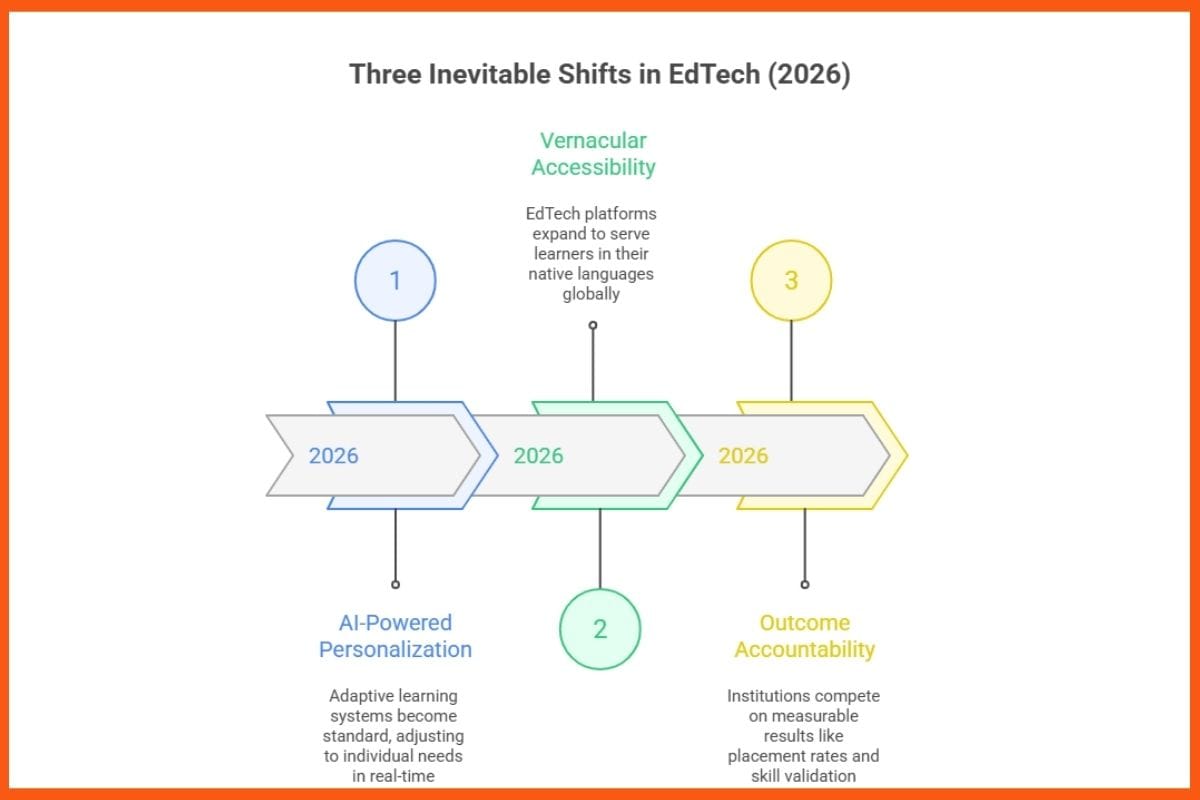
Prateek Shukla: Three structural shifts are inevitable:
First, AI-powered personalization will become table stakes. The future isn't one-size-fits-all content. It's adaptive systems that understand individual learning patterns and adjust in real-time. Simulated Adaptive Learning is just the beginning.
Second, vernacular accessibility will reshape EdTech geography. English-only platforms will become legacy. The real growth will come from serving learners in their native languages without compromising quality. This unlocks billions of learners globally.
Third, outcome accountability will replace credential obsession. Institutions will compete on measurable results—placement rates, salary progression, skill validation—not on brand reputation alone. This shift is already underway, but 2026 will accelerate it dramatically.
The EdTech landscape of 2026 won't be defined by technology alone. It will be defined by those who combine AI, accessibility, and accountability into coherent systems that actually change lives.
Explore more Recap'25 interviews here.