Ranjita Raman on Democratizing Higher Education: How Jaro Education is Bridging the Access Gap in India
📝InterviewsIn this StartupTalky International Women’s Day 2026 feature, Ranjita Raman, CEO of Jaro Education, discusses democratizing access to higher education, building a sustainable ed-tech business, and how women leaders are shaping the future of learning in India.
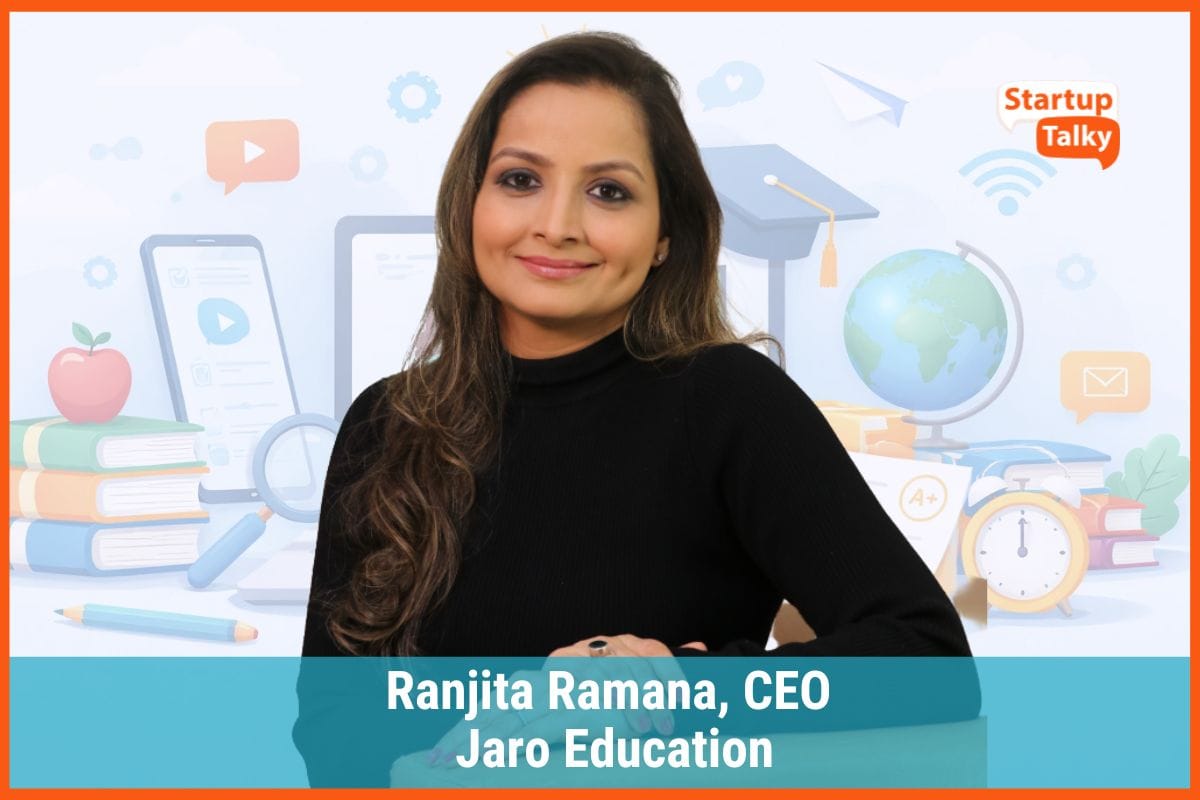
India’s ed-tech industry has witnessed rapid evolution, with the market projected to reach $10 billion+ in the coming years, driven by increasing demand for online higher education, executive programs, and upskilling solutions. As industries transform at an unprecedented pace, working professionals are actively seeking flexible, industry-relevant learning without disrupting their careers.
Amid this shift, platforms like Jaro Education are playing a crucial role in bridging the gap between aspiration and access by connecting learners with top-tier institutions through technology-enabled models.
As part of StartupTalky’s International Women’s Day 2026 special series, celebrating women leaders shaping the future of industries, we spoke with Ranjita Raman, CEO of Jaro Education, about her journey, leadership insights, and how the company is driving inclusive growth in education.
Bridging the Gap Between Aspiration and Access in Education
StartupTalky: Jaro Education has established itself as a leading ed-tech platform focused on online higher education and executive programs. As CEO Ranjita Raman, what inspired you to lead Jaro Education, and what gap did you see in India’s education landscape?
Ranjita Raman: India has world’s most respected academic institutions, but access to them has traditionally been extremely limited. Admission into premier institutions such as IITs, IIMs, and other leading universities is highly competitive, and only a small fraction of learners are able to benefit from that quality of education through conventional campus programmes.
At the same time, millions of working professionals aspire to learn from these institutions and upgrade their skills as industries evolve. However, stepping away from their careers or meeting traditional academic pathways is not always practical.
This is where a clear gap existed between aspiration and access to quality education.
At Jaro Education, we saw three important gaps in the ecosystem. The first was the access gap, where professionals outside major academic hubs struggled to reach top-tier institutions. The second was the quality gap, where learners were increasingly seeking credible university-led programmes rather than generic online courses. The third was the industry relevance gap, where learning needed to evolve alongside rapidly changing business and technology landscapes.
Jaro Education operates on a B2B2C model where we partner with leading universities and institutions to extend the reach of their programmes through technology-enabled and industry-aligned learning frameworks. In essence, we act as a bridge between academia, industry, and professionals, enabling universities to scale high-quality education while helping working professionals upskill without disrupting their careers.
In many ways, the goal is to democratize access to credible higher education so that learning from top institutions is no longer limited by geography, rigid formats, or traditional entry barriers.
From Startup to Public Company: Building for Long-Term Impact
StartupTalky: Jaro Education is one of the few publicly listed ed-tech companies in India. How has the journey from startup to a publicly listed company shaped your leadership and the company’s mission of inclusive growth?
Ranjita Raman: Moving from a startup to a publicly listed company fundamentally changes how you think about growth and responsibility.
Startups often prioritize speed and experimentation, while listed companies must focus on credibility, governance, and long-term sustainability. For me, this journey reinforced the importance of institution building rather than short-term expansion.
Our focus has been on strengthening the ecosystem we operate in by working closely with universities, aligning programs with industry needs, and building scalable learning models that serve professionals across geographies.
Being a publicly listed organization also strengthens our responsibility towards inclusive growth. It pushes us to build systems that expand access to quality higher education while maintaining academic rigor and transparency. In education, trust and credibility are long-term assets, and public markets reinforce that discipline.
Navigating Ed-Tech Challenges with Resilience and Credibility
StartupTalky: The ed-tech industry in India has seen significant turbulence in recent years. What unique challenges have you faced as a woman leader in this space, and how have you navigated them to build a sustainable business?
Ranjita Raman: The turbulence in the ed-tech sector has reinforced an important lesson. Education businesses must be built on credibility and long-term value rather than rapid scale.
At Jaro Education, we have focused on strengthening the ecosystem between academia, industry, and working professionals instead of operating purely as a consumer-driven ed-tech platform. Our B2B2C model allows universities to extend their reach while enabling professionals to access structured upskilling opportunities.
From a leadership perspective, resilience has been an important quality. Today, more than 50 percent of our workforce comprises women, and several key functions within the organization are led by women leaders.
In online higher education and executive learning, professionals often seek guidance before committing to programs. Counselling learners requires empathy, listening, and a deep understanding of career aspirations. Women professionals often bring these strengths naturally, which helps build trust with learners who are making important decisions about their careers.
In a sector that has experienced volatility, resilience, credibility, and disciplined growth ultimately define sustainability.
Women Leaders Shaping the Future of Ed-Tech
StartupTalky: As we celebrate International Women’s Day 2026, how do you see women leaders transforming the education and ed-tech sector in India, and what role does Jaro Education play in enabling this change?
Ranjita Raman: One defining characteristic of today’s women leaders is resilience. Women across industries are navigating challenges while continuing to create opportunities for others.
In the education and ed-tech sector, this resilience is shaping a more inclusive and learner-centric leadership approach. Women leaders often focus on expanding access to learning and building ecosystems that support lifelong education.
At Jaro Education, this belief is reflected in our own organization. Today, women make up more than 50 percent of our workforce, and several important functions are led by women professionals. This diversity influences how we design learning experiences and engage with professionals who are looking to grow in their careers.
Education and upskilling can be particularly empowering for women professionals because flexible executive programs allow them to continue developing their capabilities without stepping away from their professional or personal responsibilities.
When resilience is combined with access to education, it creates powerful pathways for leadership.
Driving Inclusive Growth Through Accessible Learning
StartupTalky: Inclusive growth is central to Jaro Education’s vision. How do you ensure that your programs reach underserved communities and working professionals who may not have access to traditional higher education?
Ranjita Raman: Inclusive growth in education requires more than simply putting courses online. It requires building scalable pathways that connect institutions, industry, and learners.
At Jaro Education, we focus on three key levers. The first is expanding institutional reach by partnering with universities to extend their programs beyond traditional campuses. This allows professionals across India, including those in emerging cities, to access quality higher education.
The second is flexible learning models. Working professionals require programs that integrate with their schedules, and executive and online formats allow learning without disrupting careers.
The third is industry-aligned learning. Upskilling must remain relevant to evolving workplace needs, which is why our programs emphasize practical knowledge that professionals can apply directly in their roles.
Our role is to act as an ecosystem enabler that helps universities scale their programs while enabling professionals to access meaningful career advancement opportunities.
Balancing Innovation, Profitability, and Purpose
StartupTalky: Building a publicly listed ed-tech company requires balancing innovation, profitability, and social impact. What has been the most rewarding and the most challenging aspect of this balancing act for you?
Ranjita Raman: Education businesses operate at the intersection of purpose and performance, so balancing innovation, profitability, and impact is essential.
The most rewarding aspect has been building a platform where universities can extend their reach, professionals can access high-quality learning, and industries benefit from a more skilled workforce.
The most challenging aspect is maintaining discipline in a rapidly evolving sector. The ed-tech industry has experienced phases of aggressive expansion followed by correction. Sustainable organizations are built by focusing on academic credibility, responsible growth, and long-term value creation.
Innovation in education must always be anchored in quality and trust.
Advice for Women Entrepreneurs in Ed-Tech
StartupTalky: What advice would you give to aspiring women entrepreneurs and leaders who want to build impactful businesses in the education and technology space?
Ranjita Raman: Education is one of the most meaningful sectors to build in, but it also requires patience, credibility, and a long-term perspective.
My advice would be threefold. First, understand the ecosystem deeply. Education involves institutions, learners, regulators, and industry expectations, so technology alone cannot solve every challenge.
Second, focus on building institutions rather than chasing quick scales. Trust is the most valuable currency in education, and it takes time to build.
Third, lead with empathy. Education and upskilling are deeply personal journeys for learners. Leaders who understand those human dimensions build stronger organizations and more sustainable businesses.
Diversity in leadership, especially women leaders, also brings more inclusive perspectives and stronger decision-making, which is essential in sectors that shape human potential.
 Muskaan Kapoor