

Roby John of SuperGaming on Building Global Games from India, Community-First Design, and the Future of Homegrown Gaming Ecosystems
📰 News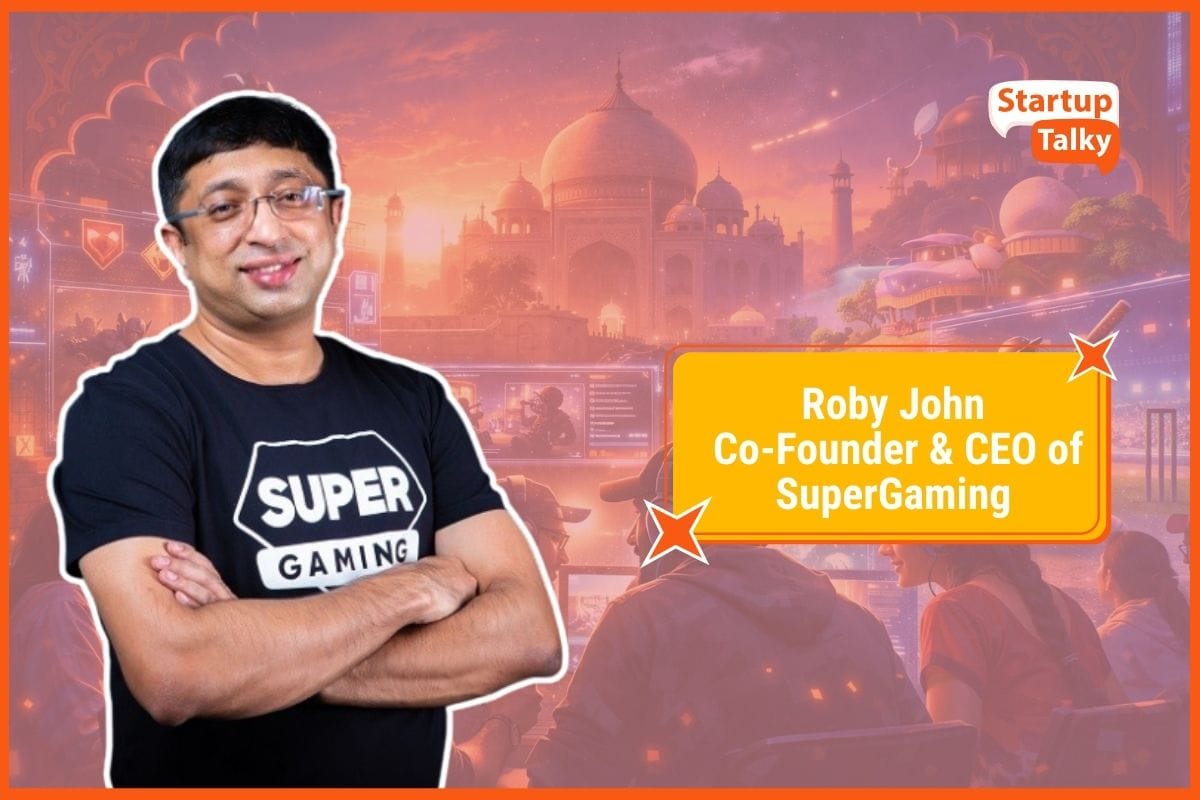
StartupTalky presents Recap'25, a series of exclusive interviews where we connect with founders and industry leaders to reflect on their journey in 2025 and discuss their vision for the future.
In this edition of Recap’25, StartupTalky speaks with Roby John, Co-Founder & CEO of SuperGaming, who reflects on a year of building globally competitive games from India while staying deeply rooted in community and culture. John shares how SuperGaming’s vision evolved from creating games they were proud to play to building a long-term gaming ecosystem—powered by homegrown technology, strong multiplayer infrastructure, and creator-led communities. He discusses the challenges of scaling high-quality gaming for India’s diverse market, the role of Indian art and identity in global game design, and how features like ranked progression, creator programs, and community-first mechanics are driving engagement across titles like Indus Battle Royale, MaskGun, and Silly Royale. Roby also highlights SuperGaming’s expansion into cricket fandom with ICC SuperTeam, the use of AI as a creative and operational accelerator, and the company’s focus on building future-ready gaming experiences from India for the world.
StartupTalky: What inspired you to start the SuperGaming, and how has your vision for gaming evolved since then?
Roby John: When we started SuperGaming, the inspiration was simple: make games in India that we were proud to play. Back then, most of the games we admired were made outside the country, and we kept asking ourselves, why not here? Why not us? We wanted to build games with deep communities, strong tech, and a sense of identity that felt truly our own.
But there was another layer to it. As lifelong gamers, we felt that in the global gaming ecosystem, Indian art, stories, and culture were underrepresented. The worlds we played in rarely reflected any of our Indian culture. That gap became a motivation: to build games with a sense of identity that felt authentic, modern but in a more futuristic way, and proudly Indian. One that shows our culture could stand shoulder-to-shoulder with the best in the world.
Over the years, that vision has grown. Today, gaming for us has become about building experiences that connect people, whether it’s millions playing MaskGun together, children laughing over Silly Royale characters, or players from across geographies competing in Indus Battle Royale and Prime Rush.
Our thinking has evolved from “can India build world-class games?” to “how can India build global gaming experiences that scale across cultures?”
We’ve become sharper about craft, more ambitious about technology, and deeply focused on community as the real engine behind everything we do. From custom room ecosystems to creator-driven programs, from scalable infrastructure to cross-border rollouts, our vision has shifted from just building games to building a long-term gaming ecosystem from India for the world.
But at the core, the inspiration remains unchanged: to create games that bring people together and to prove that some of the world’s best gaming stories can be written right here.
StartupTalky: What unique features set your platform apart, and how are you making gaming more accessible and enjoyable for a diverse audience?
Roby John: What sets SuperGaming apart is our belief that great gaming is a combination of technology, and a vibrant, interactive community. We’ve built our platform around these principles:
- A Homegrown, Scalable Tech Stack: Our in-house SuperPlatform powers everything from real-time multiplayer to matchmaking, custom rooms, anti-cheat, live-ops, and creator tools. Building this ourselves gives us the flexibility to optimize for low-end devices, unstable networks, and high concurrency, making high-quality gaming accessible to players.
- Games Designed for Community, Not Just Content: Across titles like MaskGun, Silly Royale, Indus Battle Royale, Prime Rush, and our upcoming cricket title ICC SuperTeam, the community has and will always be the core. Our games are built with social play in mind, custom rooms, spectator tools, team systems, and weekly events that encourage people to play together, not alone.
- Bringing Cultures to the Forefront: With Indus and Prime Rush, we’re proving that Indian and regional stories, art styles, can resonate globally. Cultural representation is a philosophy that guides our worldbuilding as showcased by our map Virlok and Maré, characters like Morni, Sirtaj, Pokhran for India whereas Rafael, Juliana, for Brazil, and design choices. Players see themselves and their cultures reflected meaningfully in our games, which is rare in global gaming.
StartupTalky: What gamified elements, such as scoring, highlights, or stats, help you boost player engagement?
Roby John: With Indus we introduced something unique with Cosmium clutches: A dual win condition with high-stakes end-game moments where a single decision made in the heat can change the outcome of the match. Players love sharing these clutches, and they’ve become a driver of highlight culture and repeat play. We also have a Grudge system, where past rivalries and repeat encounters add emotional stakes to gameplay.
We also give players visibility into their performance metrics that influence their playstyle: accuracy, survival time, headshots, ability efficiency, match history, team performance, and more. These stats create a mastery loop, helping players understand how they’re improving over time and giving them goals to chase.
Our ranked system is designed to give players a clear sense of progression while making every match meaningful. Players begin in Bronze, and as they perform well, they climb through Silver, Gold, Platinum, Diamond, Yodha, Maha Yodha, Cosmic. Each rank has three sub-tiers (Bronze III → Bronze II → Bronze I), so players experience a steady sense of advancement.
SuperGaming titles also run seasonal structures: battle passes, quests, and rotating challenges that reward consistency and creativity. Our leaderboard systems are designed to be competitive but fair, giving casual players room to grow while allowing competitive players to climb up the rungs.
A major differentiator for us is how creators directly drive engagement. Through Indus Prime Squad, creators host their own challenges, custom rooms, team scoring formats, and weekly missions, all tied to rewards and recognition.
We also host regular community scrims that allow competitive players to practice, form rivalries, experiment with strategies, and climb social reputation. This acts as a soft-esports layer: accessible to everyone, yet deep enough to retain serious players.
StartupTalky: How do you personalise the user experience and build a strong, active gaming community?
Roby John: We personalise the experience by designing systems that adapt to how players actually play. Skill-based matchmaking, diverse modes like TDM and Xtraction Royale, and a clear ranked progression path ensure every player finds the right challenge level and a sense of growth for our battle royale game Indus.
A big part of personalisation for us is also cultural. With Indus and Prime Rush, we’ve built worlds where Indian and regional identity aren’t an afterthought but they’re central to the experience with a futuristic touch to it. Players connect more deeply when the game reflects their stories, art, and environments in a modern, globally appealing way.
Community is where we truly differentiate. We maintain one of India’s most active gaming communities: 100K members on the Indus Discord alone, and over 200 million players across our titles. We speak with players, through Discord, livestreams, AMAs, and Test Labs. Their feedback shapes in-game changes that we make.
This combination of personalised gameplay, cultural relevance, and direct player relationships is what builds a community that helps us shape our games.
StartupTalky: What major challenges have you faced in the gaming space, and how have you stayed innovative and competitive?
Roby John: The biggest challenge has been building high-quality, scalable games for a market as diverse as India. Different devices, network conditions, and player expectations. To solve this, we invested early in our own tech stack and augmentation layer so we could optimise performance, matchmaking, and live-ops for players across segments.
The second challenge is that player behaviour and trends shift quickly. What works one season may not work the next. We stay ahead by experimenting constantly with new modes, new meta loops, new creator formats, and fast Test Lab iterations that let us adjust quickly.
Another challenge is creative differentiation. Globally, Indian stories haven’t been represented strongly in gaming. Rather than compete on sameness, we leaned into culture with Indus and Prime Rush, proving that culturally grounded games can feel modern, aspirational, and globally relevant.
Finally, scaling community trust is always hard. We overcame this by keeping communication direct and transparent with our players.
Our approach is simple: solve technical problems with innovation, solve creative problems with authenticity, and solve community problems with transparency. This keeps us competitive in a very fast-moving space.
StartupTalky: Looking ahead, how do you plan to expand your user base and introduce new games or features?
Roby John: Our next phase of growth is about widening the portfolio and deepening our presence in categories where India already has massive global influence. A big step in that direction is ICC SuperTeam, where we’re partnering with Fancraze, the ICC’s official partner for digital collectibles. We’re building a first-of-its-kind cricket fandom app built around official ICC-licensed Cricket Moments and interactive, social gameplay. It opens the door to a new audience segment, cricket fans who may not be traditional gamers but are highly engaged and emotionally invested in the sport. Pre-registrations are already underway, and the early traction indicates this category has huge potential.
At the same time, we’re laying the foundation for the future of player ownership. We’re building a unified layer where players can carry identity, achievements, and ownership across experiences. We aim to bring our existing player base on-chain in a seamless, entertainment-driven way, whilst tapping into newer audiences who want deeper connection, continuity, and value in the time they spend inside our games. This ensures that as our portfolio grows, players grow with it.
StartupTalky: How are you using AI, whether for game design, personalisation, matchmaking, or security, and what impact has it created for your users?
Roby John: We use AI primarily as a creative accelerator. A lot of our early character exploration and worldbuilding begins with AI-generated artistic mood boards that help our teams visualise tone, style, and direction much faster. To make it clear, it’s not about replacing artists here, it’s about giving them a wider range of inspiration in minutes instead of weeks.
On the gameplay side, we use AI-assisted systems to analyse match patterns, improve balancing, and refine matchmaking so players get fairer, more competitive sessions. It also helps us detect unusual behaviour patterns early, strengthening player safety.
The impact is faster creative iteration for our teams, smoother matches for players, and a more secure environment overall.
StartupTalky: What is one piece of advice you would share with new founders entering the gaming industry?
Roby John: Build for real players, not for presentations.It’s very easy to fall in love with ideas, genres, or tech trends. But games only survive when real players care about them. Put something playable in people’s hands as early as possible, listen aggressively, and be ready to throw away your favourite ideas if the data or players don’t support them.
The second thing is: invest in your foundation. Whether it’s your tech, your art direction, or your community DNA; the choices you make early will decide how far you can scale later. Shortcuts catch up with you very quickly in gaming.
And finally, remember: this industry rewards resilience more than brilliance. Games take time, iteration, and a lot of humility. If you can stay close to your players, stay curious, and keep progressing, you’ll find your space.
Explore more Recap'25 interviews here.