

What No One Tells First-Time SaaS Founders About Customer Churn Anxiety
✍️ Opinions
This article has been contributed by Sriram Kakarala, Chief Product Officer, Scalefusion
Imagine yourself at 2 a.m., glaring at your dashboard, monitoring your SaaS service. You have a cancellation, not of a Trial Customer but of a loyal Customer who has been with you for months. Your stomach starts to cramp as you are overwhelmed by a barrage of questions: Was it the pricing? Was it my failure to effectively onboard? Did I fail to see an issue that a customer mentioned during my last Technical Support Ticket closed out?
For first-time SaaS Founders, the number changing from Green to Red on their dashboard is more than just another number turning dark red; it is a moment of self-reflection. The weight carried in that instant creates doubt that is incredibly difficult to shake off (often resulting in a terrible amount of sleepless nights).
The Silent Tax of Unpredictability
Early-stage churn hurts disproportionately because the base is tiny and every customer feels personal. But the deeper wound is unpredictability. One week you’re celebrating cohort retention above 90%, the next week three power users cancel without warning, often before you even shipped the feature they asked for. That randomness creates a low-grade dread: no matter how hard you work, someone can still walk away tomorrow.
What compounds it is the illusion of control. In engineering or product development, effort usually equals outcome. In customer retention, effort and outcome are only loosely coupled. That disconnect is disorienting, especially when you’re the one who answered their late-night support ticket and still couldn’t save the account.
The Four Levers Everyone Misses
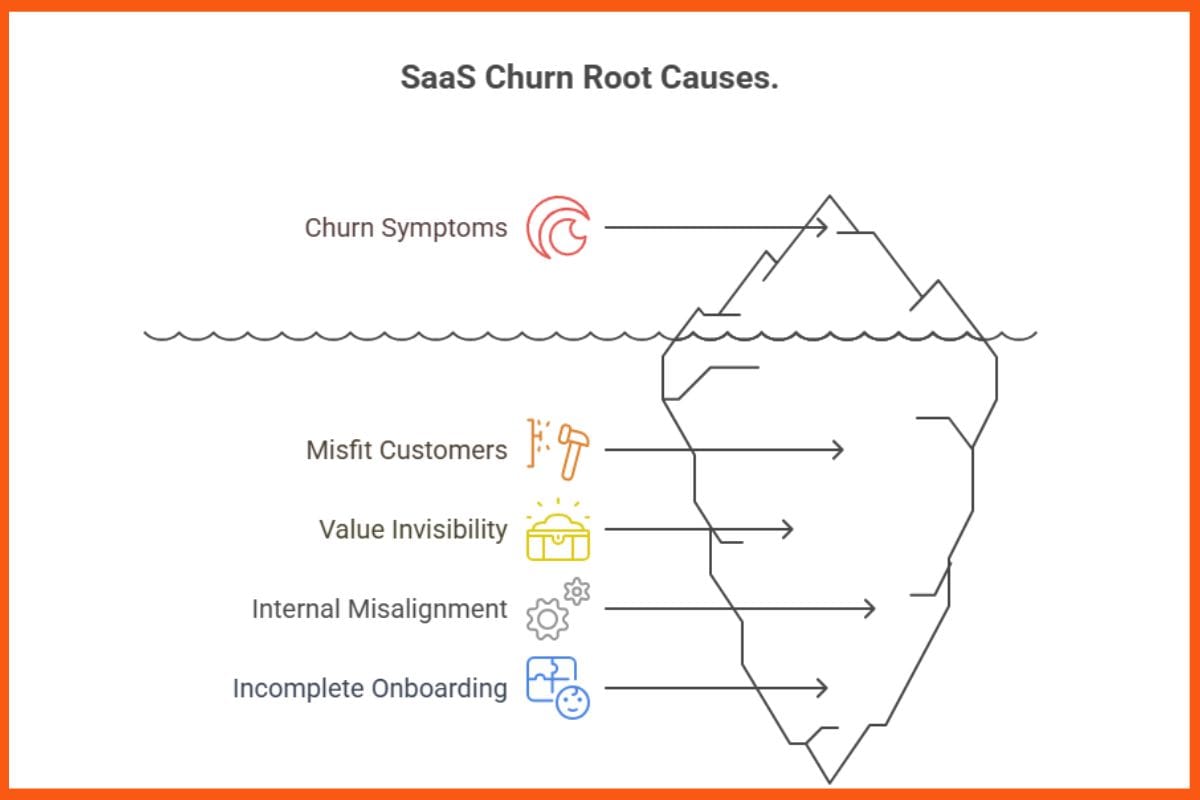
Most churn advice starts with “do better onboarding” or “add more integrations.” Those matter, but they’re symptoms. The root causes I’ve seen repeatedly in early SaaS companies are simpler and more structural:
- Selling to misfits: The customer who signs up because your landing page sounded perfect, yet never actually needed the core job-to-be-done.
- Value invisibility: Users forget or never fully discover the outcome they paid for, especially in tools used sporadically.
- Internal misalignment: Sales promises a customization that the product can’t deliver in the timeline given, and Customer Success pays the price six months later.
- Onboarding that ends at “account created”: Activation and aha-moment discovery are left to chance.
Fixing any one of these moves the needle far more than another discount or desperate retention email.
Why Acquisition Can’t Outrun the Feeling
A common reflex is to pour fuel into the top of the funnel. New logos hide the red in the churn column and temporarily quiet the anxiety. But in SaaS, short decision cycles mean customers constantly re-evaluate. You’re never more than 30 - 90 days away from the next judgment day. Acquisition becomes a treadmill where the speed keeps increasing just to stay in place.
I’ve watched founders burn cash (and themselves) chasing growth that masked 12-15% monthly churn. The numbers looked decent on a slide until the acquisition budget ran dry and reality crashed in.
Turning the Signal into an Edge
Here’s the part no one says out loud: churn anxiety, handled well, becomes unfair advantage.
Departing customers are the most honest source of truth you’ll ever get. A 10-minute exit call reveals misfits, missing jobs-to-be-done, and pricing friction faster than any survey or win-loss analysis. Treat every cancellation as a free consulting session.
Predictive signals exist months before the cancel button is clicked: drop in logins, specific features going dark, support tickets turning sharp. Spotting those early lets you intervene with the right message at the right moment, often saving accounts that felt lost.
Segment ruthlessly. Your best customers usually cluster around a specific company size, use case, or integration. Once you know who they are, double down on acquiring more of them and gently steer the misfits elsewhere before they churn (and drag your metrics down).
A Practical Playbook That Actually Calms the Mind
Run a weekly 15-minute churn autopsy with the entire leadership team, focusing on identifying patterns rather than assigning blame. Map the end-to-end customer journey and pinpoint the three moments where perceived value peaks; then reinforce those moments consistently using emails, in-app messages, and success check-ins.
Make onboarding non-negotiable: since activation rates below 70% in the first seven days correlate strongly with churn, prioritize fixing onboarding before building the next feature. Develop a retention roadmap that parallels the product roadmap, treating “customer must feel 10x value by day 60” with the same rigor as “ship version 2 by Q3.” Finally, accept that some churn is inevitable; even the best B2B SaaS companies live with 4-7% annual net revenue churn – zero churn is neither realistic nor healthy.
From Dread to Compass
Churn anxiety never fully disappears, but it can shift from a weight on your chest to a compass in your hand. When cancellations stop feeling like personal verdicts and start feeling like data points, something changes. You sleep a little better. You make bolder roadmap bets. You stop discounting out of fear and start pricing for the value you know you deliver.
The founders who scale aren’t the ones who magically eliminate churn. They’re the ones who learn to metabolize the anxiety, extract the signal, and keep shipping anyway. That’s the part no one tells you on day one. But it’s the part that decides whether you make it to year five.
 Sunita Singh