

Shashi Kumar of Akshayakalpa Organic on Building a Farmer-First, Trust-Led Organic Dairy Ecosystem
👨💻 StartupTalkers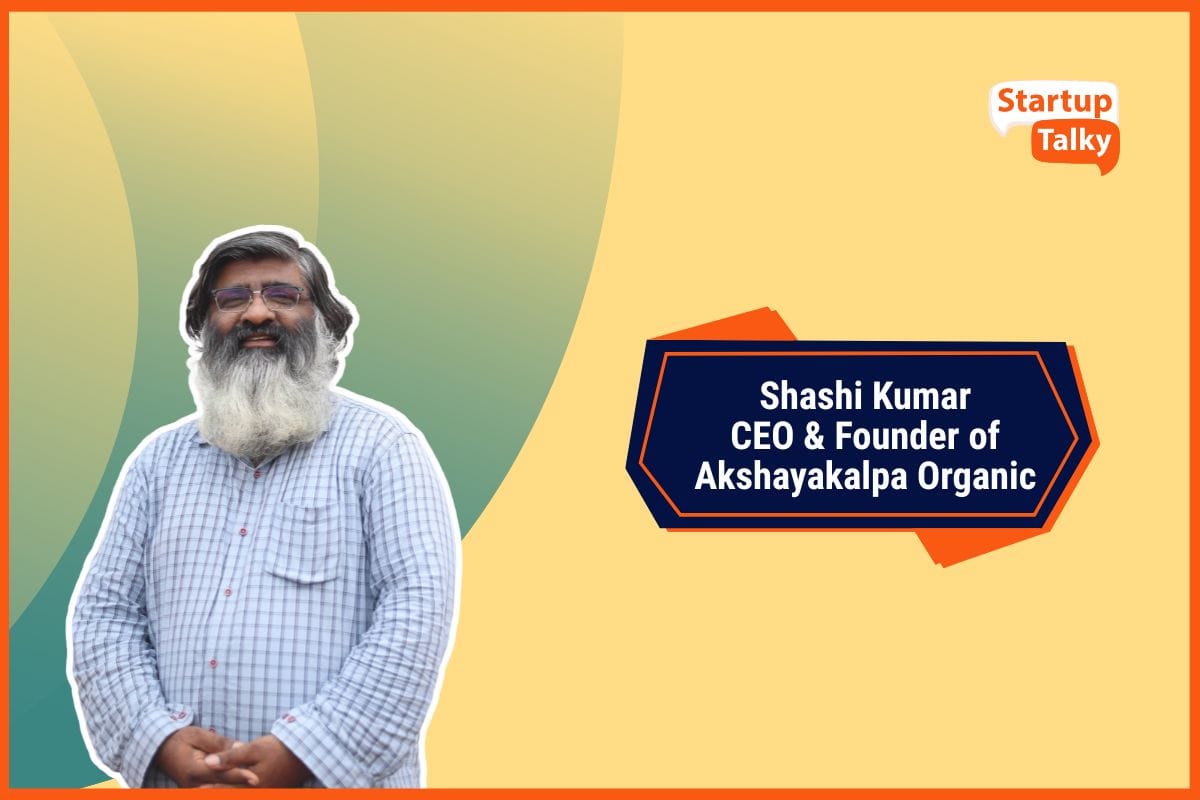
In this exclusive interaction with StartupTalky, held on the occasion of National Startup Day, Shashi Kumar, CEO & Founder of Akshayakalpa Organic, reflects on how purpose-led startups are reshaping India’s food and farming ecosystem from the ground up. Drawing from Akshayakalpa’s journey of building a farmer-first, organic dairy model, Kumar discusses why improving farmer livelihoods—not just expanding consumer choice—was the real problem to solve in Indian agriculture. He shares insights on reversing rural migration by making farming economically viable and aspirational for the next generation, maintaining organic integrity and traceability at scale, and building long-term trust across the farm-to-consumer value chain. As India’s startup landscape matures beyond urban, asset-light businesses, Kumar explains what meaningful scale looks like in agribusiness—one that balances growth with soil health, farmer dignity, and a fundamental shift in how India values food and farming.
StartupTalky: To begin with, what was the core gap you saw in India’s food and farming ecosystem when Akshayakalpa Organic started, and why did you believe a farmer-first, organic dairy model could solve it at scale?
Shashi Kumar: When we started Akshayakalpa in 2010, the real gap we saw was not in consumer choice but in farmer livelihoods. Most farmers faced unpredictable, seasonal incomes, rising input costs, and little pricing power, making agriculture financially unstable and unattractive for the next generation. At the same time, consumers were increasingly disconnected from how their food was produced, creating a trust deficit.
We believed that unless farming became economically viable, no food system could be sustainable. Organic farming, for us, was not a premium positioning but an economic solution—reducing dependence on chemical inputs, improving soil health, and stabilising costs. Dairy became the backbone because it ensured daily, assured cash flow for farmers while supporting organic farming through natural manure and soil regeneration. Our farmer-first model is built on long-term partnerships, fixed pricing, and intensive on-ground support, allowing us to scale through a replicable, cluster-based approach while keeping farmers at the centre of the ecosystem.
StartupTalky: You actively work on reversing migration by encouraging young people to return to farming. From a business perspective, how difficult is it to make farming financially aspirational for the next generation, and what incentives or systems have worked best so far?
Shashi Kumar: Making farming financially aspirational for the next generation is challenging because it has long been associated with volatility, soil degradation, and diminishing returns. At Akshayakalpa, our approach goes beyond dairy economics to reimagining the farm itself as a resilient, regenerative enterprise.
We work with young farmers on integrated organic farming systems by combining dairy with fodder, crops, trees, poultry, and allied activities so farms become biologically diverse, climate-resilient, and economically stable. By investing in soil health, water cycles, and on-farm inputs, land becomes more productive over time, not depleted. This fundamentally changes the risk profile of farming.
Equally important is the sense of purpose. Farmers are not treated as suppliers but as stewards of soil and food systems. Through training, peer networks, and exposure to consumers via farm visits, young farmers see the direct impact of their work on food quality and public health. For consumers, this translates into traceable, chemical-free food grown on rejuvenated land. When farming restores ecosystems, ensures dignified livelihoods, and delivers better food, it becomes a future-ready profession worth returning to.
StartupTalky: Your model depends heavily on deep farmer integration rather than just sourcing. How do you balance long-term farmer partnerships with the pressures of cost control, operational efficiency, and D2C growth?
Shashi Kumar: At Akshayakalpa, our model is built on deep, long-term partnerships with farmers rather than transactional sourcing. We work with 2800 farming families across 1,200+ farms on 5,000 acres, ensuring that their livelihoods grow alongside the business.
Balancing farmer welfare with cost control and D2C growth requires a systems-driven approach. Investments in training, technology, and modern farm infrastructure increase productivity and reduce wastage, driving efficiency without compromising farmer income. Transparent pricing and predictable procurement reinforce trust and quality.
On the D2C side, we deliver 80,000 direct orders daily to over 3,00,000 households we serv including e-com and Q-Com channels, optimizing operations at scale while sustaining healthy farmer margins. By viewing farmers as partners, not suppliers, we ensure that long-term relationships and business performance reinforce each other, making growth both sustainable and inclusive.
StartupTalky: Organic dairy demands strict processes, traceability, and discipline across the value chain. What have been the biggest learning curves in building consistency and trust from farm to consumer, especially as you expand into new cities?
Shashi Kumar: Building an organic dairy brand like Akshayakalpa demands rigorous processes, traceability, and discipline across the value chain. One of the biggest learning curves has been maintaining consistency while scaling—training farmers in strict organic protocols, ensuring farm-to-factory hygiene, and implementing robust quality checks. Traceability is non-negotiable; consumers must trust that products are genuinely organic and free from additives.
In the first nine years, we faced immense challenges, coming close to bankruptcy six times, which taught us the importance of financial discipline and operational rigor. Now, as we plan to enter Mumbai and Pune this financial year, these lessons guide us in scaling responsibly while maintaining trust and credibility with farmers and consumers alike.
StartupTalky: Indian consumers are still evolving in their understanding of clean, chemical-free food. How do you approach consumer education without making organic food feel elitist or inaccessible?
Shashi Kumar: Educating Indian consumers about clean, chemical-free food is central to Akshayakalpa’s mission, but we are careful to ensure that organic doesn’t feel elitist or inaccessible. One of our most powerful tools is farm visits, over 45,000 consumers have come to experience Akshayakalpa farms, seeing firsthand how food is grown, processed, and delivered. This transparency builds trust and curiosity, making organic tangible rather than abstract.
We complement this with label-reading workshops for kids and parents, helping families make informed choices. Our ‘Good Food’ initiatives in schools introduce children to farming, healthy eating, and sustainable food practices early on. We also host interactive events at the farm, like ‘Forgotten Foods’, celebrating heritage crops and encouraging hands-on learning.
By combining experiential learning, education, and community engagement, we make organic relatable and aspirational. The focus is on connecting people to the journey of food—from soil to table—so that choosing clean, chemical-free food becomes both understandable and enjoyable for all.
StartupTalky: As your product portfolio expands beyond core milk into value-added offerings, how do you decide what to build next — is it driven more by consumer demand, nutrition science, or long-term brand vision?
Shashi Kumar: When we think about expanding beyond core milk, our decisions are guided by three factors: consumer needs, nutrition science, and our long-term vision. We don’t just want to offer convenience; every product must genuinely add value to people’s health. That’s why we developed high-protein milk and high-protein paneer, addressing the growing need for protein-rich, clean dairy without compromising on purity or taste.
Consumer insights, combined with scientific guidance, shape every innovation, but we also ensure alignment with our mission: making organic, healthy dairy accessible to every household. Looking ahead, we’re excited to introduce buffalo milk in Hyderabad, bringing our traceable, high-quality dairy to new consumers while maintaining the same rigorous standards across the chain.
For us, portfolio growth is not about chasing trends, it’s about creating products that empower families to eat healthier, build trust, and reinforce what Akshayakalpa stands for: transparency, quality, and nutrition in every sip and bite.
StartupTalky: Can you share one key number that best captures Akshayakalpa’s impact so far — whether it’s farmers onboarded, litres delivered daily, or repeat consumer rate — and why that number matters to you?
Shashi Kumar: Growth, for us at Akshayakalpa Organic, has never been about chasing big numbers, it has been about building belief, litre by litre. What best captures this journey is how a modest beginning has scaled into a nationally relevant, farmer-first food business.
We started in 2012 by selling just 18 litres of milk, gradually earning consumer trust in a then-unfamiliar idea called organic milk. Today, Akshayakalpa operates with a total processing capacity of 2.8 lakh litres per day across Karnataka, Tamil Nadu and Telangana.
That journey now translates into a INR 600 crore annual business in FY26, with steady monthly sales of around INR 50 crore. This scale reflects the strength of the ecosystem we’ve built, one that delivers consistency, quality, and long-term sustainability. For me, this milestone reinforces a simple belief: when you build deeply, stay committed to farmers, and grow with integrity, scale becomes a natural outcome, not the objective, but the result.
StartupTalky: Looking ahead, what does meaningful scale look like for Akshayakalpa? Is success defined by geography, farmer participation, product range, or by changing how India thinks about food and farming?
Shashi Kumar: When I think about scale for Akshayakalpa, I don’t measure it only in litres, revenues, or city launches. For me, meaningful scale is about whether we are able to change the underlying system that governs food and farming in India.
Geographic expansion matters, and entering markets like Mumbai and Pune is an important step for us. These are mature, high-intent markets where consumers actively care about food quality, traceability, and trust. Taking our products to these cities allows us to extend the farmer-first model we have built over the years—but we are doing this patiently, backed by farmer networks that have been developed well before commercial sales begin.
Farmer participation remains at the heart of how I define success. Each farmer we work with is meant to become a role model in their village, showing that farming can be profitable, dignified, and future-ready. Product expansion and wider reach are outcomes of this approach, not the starting point. Ultimately, meaningful scale for me is when India begins to value food not just for price and convenience, but for its impact on farmers, soil health, and long-term sustainability.
 Muskaan Kapoor