

Shraddha Thuwal of Karni Publishing: Amplifying Women’s Voices and Supporting New Authors
📝Interviews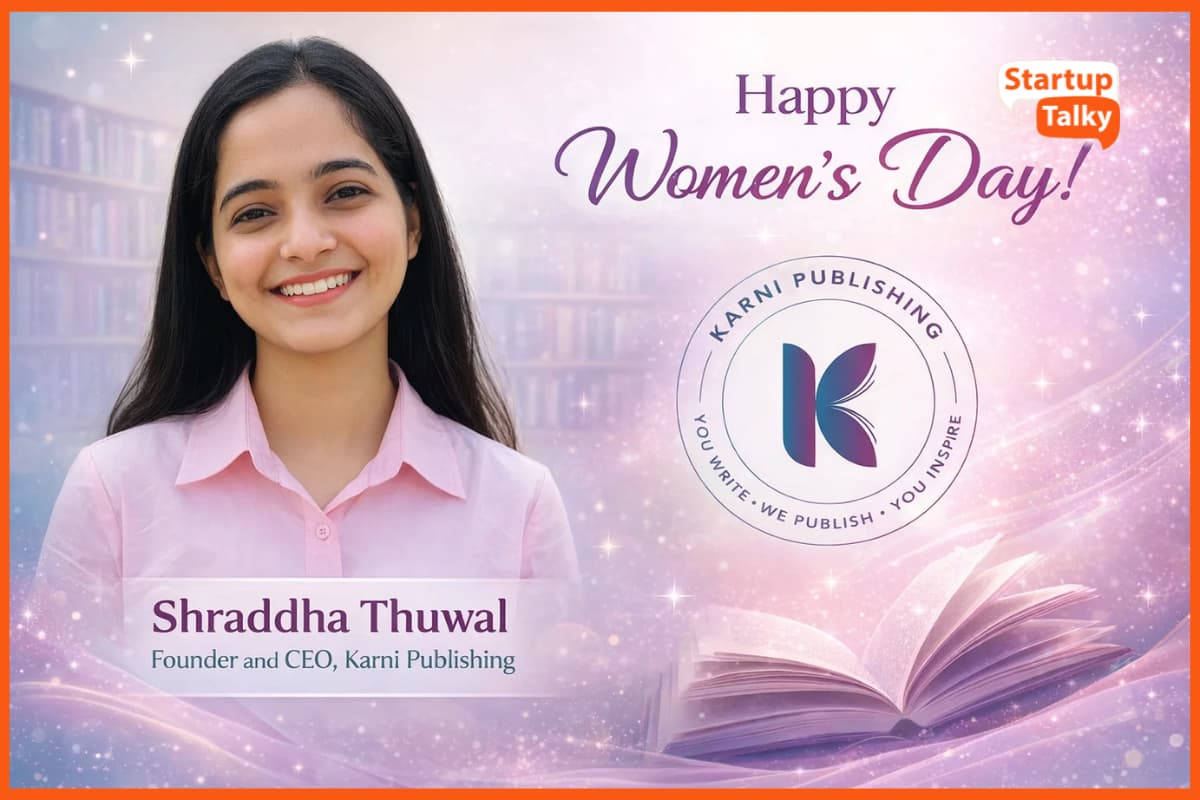
On the occasion of International Women's Day, we spoke with the founder and CEO of Karni Publishing, Shraddha Thuwal about building a publishing platform that supports aspiring authors and amplifies underrepresented voices.
In this conversation, she shares how Karni Publishing is creating a more inclusive and supportive space for women writers, mentoring first-time authors, and helping stories from smaller towns and regional language backgrounds reach a wider audience.
StartupTalky: In an industry where women authors have historically struggled to get published on their own terms, how does Karni Publishing actively work to amplify women's voices and stories?
Ms. Thuwal: Let me start with a truth that the publishing industry has quietly accepted for too long.
Virginia Woolf wrote in 1929 that a woman must have money and a room of her own if she is to write fiction. She was not just talking about space. She was talking about permission. The kind of permission that women have had to fight for, beg for, or bypass entirely for centuries.
History is full of women who disguised themselves just to be heard. The Bronte sisters published as Currer, Ellis, and Acton Bell. Mary Ann Evans wrote as George Eliot. Even in the 20th century, women were routinely told their stories were "too domestic," "too emotional," or "not commercially viable." Sylvia Plath's The Bell Jar was rejected by publishers who did not think a woman's breakdown was a story worth telling. We know how that turned out.
In India, the struggle has had its own texture. Women writing in regional languages, writing about their own bodies, their grief, their desires, their spiritual journeys, were either edited into silence or simply never given a shelf. The gatekeeping was not always loud. Sometimes it was just a quiet "this is not what our readers are looking for."
That history lives in me. And it is part of why KARNI exists. When I started KARNI Publishing, I did not build it around a genre or a market segment. I built it around a belief: that every story has worth, and no one should have to shrink themselves to get it out into the world. And when I look at the authors I have worked with so far, I see that women have naturally found their way to KARNI because this space does not ask them to justify their story before we begin.
Meenakshi Girish wrote about the freelancer's mindset at a time when not many people were writing about the messy, uncertain, deeply personal experience of building something on your own. Her book is practical but it is also deeply honest. Vaishali Chaudhary wrote Antardwand in Hindi, which means "inner conflict." That title alone tells you she was not writing to trend. She was writing to release something. Nirali Virani brought Smritipath, a collection of poetry rooted in memory and emotion.
None of these women needed me to validate their story. They needed someone to handle the rest so the story could actually reach people. That is what I do.
I personally sit with every author through the manuscript stage. I do not outsource the conversation. When a woman author tells me she is not sure if her story is "important enough," I do not rush past that moment. I sit in it with her. Because that doubt is not random. It has been planted over generations of being told that women's interiority is not literature.
KARNI amplifies women's voices not by running a special program for women or by making it a marketing angle. We do it by refusing to apply a filter of commercial viability before we listen. We do it by handling the logistics, the design, the printing, the distribution, so that the author can stay in her creative truth without having to negotiate it against a business model.
And honestly, the most radical thing I can do as a young woman founder in publishing is to keep the door open. To keep saying, yes, your story matters. Yes, we will find a way. Yes, your words deserve a stage.
Because the women who came before us did not get that. The least we can do is make sure the women who come after us do.
StartupTalky: What percentage of KARNI Publishing's catalogue features women authors, and is there a conscious editorial strategy to prioritize underrepresented women writers?
Ms. Thuwal: Right now, if you look at KARNI's catalogue, three out of six published authors are women. That is 50%. And when I say that number out loud, I feel two things simultaneously. Pride. And the awareness that I did not plan it that way.
That is actually the more important part of the answer.
There was no quota. There was no editorial mandate that said "we will prioritize women." There was no boardroom decision or diversity strategy document. What there was, is a space that felt safe enough for women to walk into and say "I have a story." And they did. In larger numbers than I initially expected.
I think that tells you something about the industry they were navigating before they found KARNI. When women writers come to a publishing house founded and run by a young woman who herself started writing at 16, who speaks about stories with emotional honesty rather than commercial calculation, they recognize something. They recognize that they will not have to defend the validity of their experience before the conversation even begins.
That is not a strategy. That is a culture. And culture, I have come to believe, is more powerful than strategy.
Now. Is there a conscious editorial direction? Yes. But it is not framed around gender alone.
KARNI was built for the underrepresented. Full stop. For the aspiring author whose manuscript was rejected. For the person who does not know where to start. For the writer sitting on a story they have been carrying for years because the traditional publishing world felt too distant, too gatekept, too expensive to even approach. That is our author. And when you build for that person, you will inevitably serve more women, more regional language writers, more first-time authors, more people whose stories do not fit the template of what mainstream publishing considers marketable.
What I want KARNI to become, as the catalogue grows, is a record of voices that might otherwise have gone undocumented. The women who wrote about heartbreak and called it philosophy. The women who wrote about business and refused to strip the personal out of it. The women who wrote in languages that do not have big distribution networks but have deep emotional roots.
If 60% of our catalogue today is women, I want that number to reflect not a policy but a pattern. A pattern that says: when you make publishing human, when you remove the intimidation and the gatekeeping and the commercial filter, women show up. They have always had stories. They just needed someone to stop asking them to prove it first.
So no, there is no formal editorial strategy to prioritize underrepresented women writers. But there is something I think matters more. There is an editorial instinct. And that instinct was shaped by the same history that kept women out of publishing for centuries. I carry that history. And I refuse to replicate it.
That is the most honest answer I can give you.
StartupTalky: Can you share a story of a woman author whose manuscript was rejected elsewhere but found a home at Karni Publish, and what made you believe in her work?
Ms. Thuwal: I want to tell you about Nirali Virani. Nirali did not come to me with fanfare. She came with hesitation. She told me she was not sure if the world needed her book. She was not ready to invest earlier. There was real uncertainty about whether this was the right time or even the right decision. The history of publishing has been particularly unkind to poetry, and doubly unkind to poetry in Indian regional languages. And I told her: if you want to do it, go for it.
That was it. No grand pitch. No editorial committee.
What made me believe in her work? Two things.
The first was the honesty of it. Nirali writes in simple language about complicated emotions. She does not reach for difficult words to make the poetry seem more serious. She reaches for the truest word. And that is actually the hardest thing to do. Anyone can complicate language. Very few people can write simply about something devastating and have it land like a blow to the chest.
The second was the subtitle she and I arrived at together. She had originally wanted to name the book something like "Real and candid expressions of the human condition." Which is accurate. But it is not a soul. When we spoke, I told her the title had to be the soul of the book, not a description of it. We arrived at Smritipath (the path of memory). And the subtitle: Vismaran ki khamosh raahein (the silent roads of forgetting).
That conversation told me everything I needed to know about why this book had to exist. Because Nirali was building a path back for every person who has felt something so deeply they could not say it out loud to anyone.
StartupTalky: Beyond just publishing books, does Karni Publishing invest in mentoring or nurturing first-time women writers through workshops, editorial guidance, or community programs?
Ms. Thuwal: Every single author who has come to KARNI has received something that most established publishing houses do not offer. My time. My full, undivided, personal attention. Not a template. Not a checklist handed off to an assistant. Me, sitting with their manuscript, their fears, their doubts, and their vision, for as long as it takes.
My author, Meenakshi Girish said something in her testimonial that I keep coming back to. She said she was made to feel like my only client, despite knowing I had ten other things on my plate. That is not an accident. That is a choice I make every single time. Because I remember what it felt like to have something to say and no one to say it to. I remember writing my first poem in 10th standard and having no idea what to do with that feeling. I do not take lightly the responsibility of being the person someone trusts with their story.
So what does mentoring look like at KARNI right now?
It looks like a conversation before the manuscript is even ready. Most of my authors did not walk in with a polished draft. They walked in with an idea, a fear, and a question: do you think this is worth writing? And my job at that stage is not to be an editor. It is to be the person who says yes, write it.
It looks like guiding a first-time author through every single step of the publishing process, manuscript preparation, editing, design, printing options, distribution, marketing, without making them feel like they are being processed.
StartupTalky: With self-publishing and digital platforms disrupting traditional publishing, how does Karni Publishing see its role evolving, particularly in making publishing more accessible to women from smaller towns and non-English backgrounds?
Ms. Thuwal: I am from Haldwani. I want to start there. Because when people talk about disruption in publishing, about digital platforms democratising access, about the future being more inclusive, they are usually talking from cities. From metros. From places that already have infrastructure, networks, literary festivals, writing communities, and publishing contacts.
Haldwani is not that place. And I say that not as a complaint but as a context. The fact that KARNI was built in a small town in Uttarakhand is not incidental to what KARNI believes. It is the whole point.
I know what it means to have a story and no system around you to support it. I know what it means to look at the traditional publishing world and feel like it was built for someone else, in a language you were told to adopt, in a format you were told to conform to, for an audience you were told to imagine as someone far away from where you actually live. That gap is real. And it has always been real.
Digital platforms have changed some of this. Amazon KDP means a woman in Bhopal can technically publish a book today without leaving her house.
But here is what digital platforms have not solved.
They have not solved the confidence gap. A woman from a small town who has written a poetry collection in Hindi still has to navigate cover design, ISBN registration, pricing, distribution logistics, marketing, and the entirely overwhelming question of whether any of this is worth doing. The tools exist. The knowledge of how to use them, and more importantly the belief that her story deserves to use them, often does not.
They have not solved the gatekeeping of legitimacy. There is still a perception, particularly among first-generation readers and writers from smaller towns, that a book is only real if a big publisher made it. That self-publishing is somehow lesser. I spend a significant amount of my time dismantling that belief in the authors I work with.
StartupTalky: This Women's Day, if you could put one book by a woman author into the hands of every young Indian girl, which book from your catalogue would it be and why?
Ms. Thuwal: Without a second thought. Antardwand by Vaishali Chaudhary.
We were students together. And from that first meeting, I knew she was someone whose mind worked differently. She did not just observe life. She held it. Turned it around. Looked at it from angles most people do not think to look from. She inspired me then. She inspires me now. And for eight years, that inspiration has only grown.
We worked on Antardwand for over a year. A year of conversations, of revisions, of sitting with the manuscript in all its layers. The trust she placed in me during that process is something I do not take lightly. It is the kind of trust that does not come easily, especially for a first-time author writing in Hindi, writing about the inner life, writing about things that do not have a market category but have everything to do with being human.
The opening lines of Antardwand say something I want every young Indian girl to read slowly.
जीवन की गहराइयों को समझने का प्रथम प्रयास स्वयं से प्रारंभ होता है।
Vaishali writes about the battlefield of life. Not in a dramatic, performative way. In a deeply honest way. She says our lives are no less than a battlefield where we fight not just social and worldly challenges but intensely personal ones. Helplessness. Fear. Disappointment. Failure. And the question she asks, quietly but persistently throughout the book, is not how do we win. It is how do we win meaningfully.
We live in a time that celebrates hustle. That equates achievement with worth. That tells young women to win, compete, prove, perform. Social media shows us highlight reels and we measure our interiors against someone else's exterior. The pressure on young Indian girls today, whether she is in a metro or a small town, whether she is preparing for JEE or managing expectations at home, is enormous. And almost none of the noise around her is asking her to stop and look inward first.
Antardwand does exactly that.
Hindi literature has a long tradition of women writing about the inner life. Mahadevi Varma, whose poetry is drenched in longing and introspection, was writing about the female interior in the 1930s when the world was barely ready for it. Meerabai was doing it centuries before that, using devotion as a language for a freedom she was otherwise denied. These women understood something that Vaishali understands too. That the inner world is not a retreat from the outer one. It is the preparation for it.
So yes. This Women's Day. Antardwand. By Vaishali Chaudhary, my friend, my author, and one of the most quietly powerful writers I have had the privilege of publishing.