

Susmita Chakravarty of Eastern Staple on Building Reliable Food Systems, Scaling Institutional Kitchens, and Human-Led Cafeteria Operations
👨💻 StartupTalkers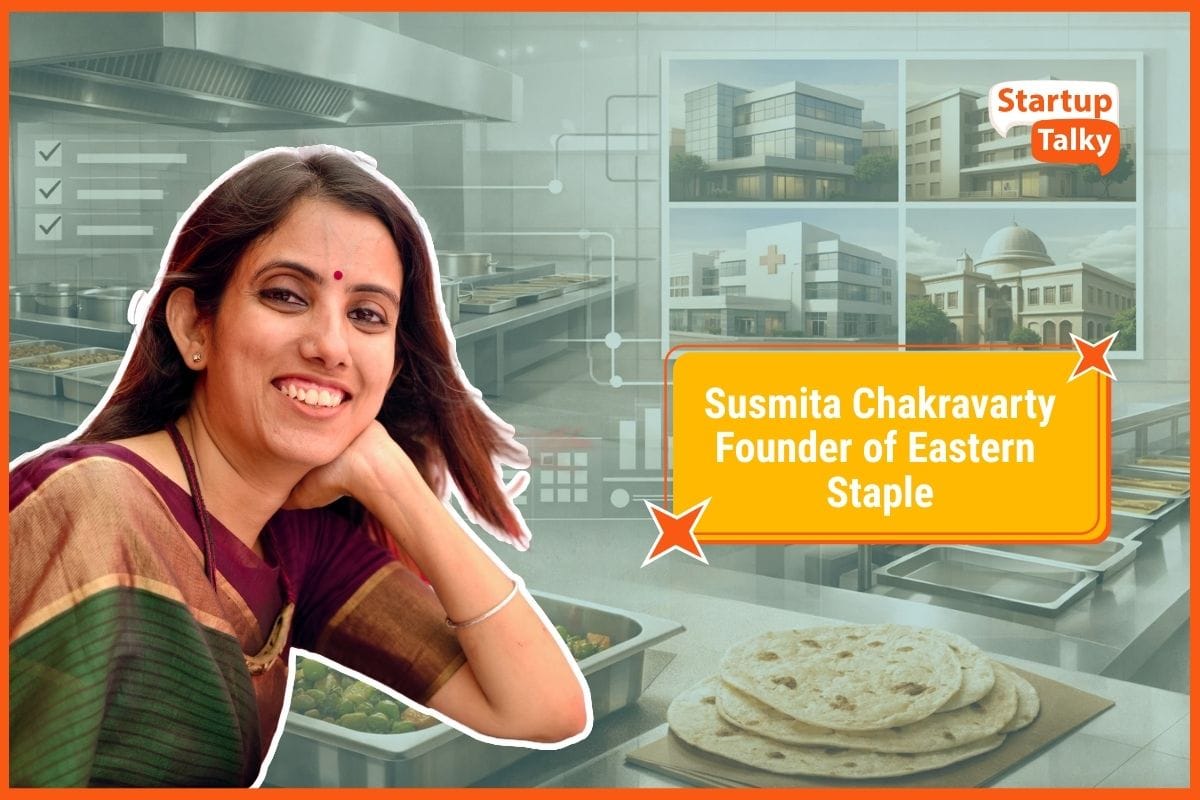
StartupTalky presents Recap'25, a series of exclusive interviews where we connect with founders and industry leaders to reflect on their journey in 2025 and discuss their vision for the future.
In this edition of Recap’25, StartupTalky speaks with Susmita Chakravarty, Founder of Eastern Staple, who reflects on her journey from cooking home-style meals during the pandemic to building a structured Cafeteria as a Service (CaaS) and institutional food operations company. What began as an act of care for students living away from home has evolved into an end-to-end food systems business managing cafeterias across corporates, hostels, hospitals, industrial plants, and large-scale events.
Chakravarty shares how Eastern Staple scaled in 2025 from serving 100 meals a day to nearly 2,000 daily meals across multiple locations, without losing consistency, hygiene, or trust. The conversation explores the transformation of India’s institutional food services industry, the shift toward process-driven and accountable operations, and why reliability, disciplined SOPs, and human-led quality control remain central to Eastern Staple’s growth philosophy. She also discusses the role of technology in forecasting and hygiene tracking, opportunities in India’s growing CaaS market, and why slow, system-first expansion is key to building sustainable service businesses.
StartupTalky: What service does Eastern Staple provide? What was the motivation or vision with which you started?
Susmita Chakravarty: Eastern Staple is a Cafeteria as a Service (CaaS) and institutional food operations company. We manage food systems end to end for corporates, hostels, hospitals, factories, campuses, and large events, from kitchen setup and staffing to menu planning, hygiene systems, and daily meal execution.
The company started very simply during the pandemic. I was a teacher then, and I began cooking meals for students living in a nearby PG. It was not a business idea, it was just about feeding people properly at a time when everything felt uncertain. One day, a student told me, “Didi, your food felt like home today.” That stayed with me.
It made me realise that everyday food is not just about nutrition, it is emotional. It reassures people, especially when they are far from home or under pressure. Eastern Staple was born from that belief, to make daily meals dependable, nourishing, and comforting for people who rely on them every single day.
StartupTalky: What new services have been added in the past year? What are the USPs of your service?
Susmita Chakravarty: Until 2024, Eastern Staple was largely focused on lunchbox style meal delivery for corporates and private parties. We were cooking for about 100 households a day, familiar names, known tastes, and a very hands on way of working.
In 2025, the scope of our work expanded significantly. Without changing our core philosophy, we moved into managing full scale institutional cafeterias. Today, we do not just cook and deliver food, we run kitchens end to end. This includes staffing, sourcing, daily production, hygiene compliance, and service execution across corporate cafeterias, institutional hostels, an industrial plant, and large events. By December 2025, we were serving close to 2,000 meals a day across multiple locations.
What differentiates Eastern Staple is not novelty, but reliability. We have built strong, repeatable systems so taste and hygiene do not fluctuate as volumes increase. Discipline around SOPs, audits, and daily checks is part of routine operations, not an occasional exercise. Each kitchen is led by trained on ground supervisors who take ownership of execution, while technology supports planning and monitoring. Final quality control always remains human led.
That balance between structure and accountability is what has allowed us to scale without losing control or character.
StartupTalky: How has the industry changed in recent years, and how has your Eastern Staple adapted?
Susmita Chakravarty: Institutional food services in India have changed significantly in recent years. There has been a clear shift away from informal catering towards more structured, accountable, and technology enabled food operations. Expectations around hygiene, transparency, consistency, and compliance have increased sharply, especially in corporate, healthcare, and campus dining.
At the same time, institutions no longer want just a food vendor. They want a partner who can manage complexity at scale.
We adapted by becoming deeply process driven early on. As volumes increased in 2025, we invested in strong SOPs, digital tracking for hygiene and forecasting, and clearer role ownership within teams. Importantly, we did not remove human checks. Tasting food, supervising kitchens, and listening to feedback remain central. That combination helped us grow from 100 meals to 2,000 plates a day without shortcuts or dilution.
StartupTalky: What key metrics do you track to measure growth and performance?
Susmita Chakravarty: We track both numbers and discipline. Key metrics include:
- Daily and monthly meal volumes across locations
- Food preferences across institutions, such as veg and non veg, rice, roti, snacks
- Client retention and contract renewals
- Hygiene audit scores and compliance records
- Forecast accuracy to minimise waste
- Delivery time tracking
- Team stability, training completion, and execution consistency
- Year on year revenue and operational efficiency
These metrics help us grow steadily without compromising food quality or team health.
StartupTalky: What were the biggest challenges in the past year, and how did you overcome them?
Susmita Chakravarty: The biggest challenge was scaling across multiple kitchens while keeping food consistent. Institutional food has no margin for error, people depend on these meals daily. Another challenge was managing multiple delivery and service fleets to ensure uninterrupted service.
We addressed this by tightening systems instead of improvising. SOPs became sharper, team training more structured, and on ground supervisors were given clear ownership. Structure became our safety net, allowing growth without chaos.
StartupTalky: What marketing strategies do you use? Any notable growth wins?
Susmita Chakravarty: Our growth has been largely organic. Most new clients come through referrals, repeat institutions, and word of mouth within professional networks.
Instead of aggressive marketing, we focus on doing the work well and sharing honest operational insights when relevant. Client case stories have been one of our strongest growth drivers, opening doors across sectors without heavy marketing spends. B2B sales and word of mouth have worked best for us.
StartupTalky: What tools or software help you run the business smoothly?
Susmita Chakravarty: We use digital tools for:
- Client preference tracking
- Pre ordering through apps in corporate cafeterias
- Demand forecasting and inventory planning
- Reporting and feedback dashboards
These tools bring predictability and transparency, while final decisions always involve human judgment.
StartupTalky: What future opportunities do you see in this industry? India vs global markets?
Susmita Chakravarty: Cafeteria as a Service has strong growth potential in India, especially across healthcare, education, industrial clusters, and managed campuses. Institutions are increasingly recognising food as a critical part of productivity and well being.
Globally, institutional food services are highly system driven. India is moving in the same direction, but with greater diversity in tastes and cultural expectations. That complexity creates space for adaptable, region sensitive food systems, which we are consciously building towards.
StartupTalky: How are you using AI or technology today?
Susmita Chakravarty: We currently use data driven tools for demand prediction, inventory planning, and operational tracking. This helps reduce waste, improve planning accuracy, and maintain hygiene standards across locations.
As we scale, we see scope for deeper analytics around menu planning, nutrition, and predictive quality control.
StartupTalky: How do you plan to expand customers, services, and teams?
Susmita Chakravarty: We are focused on slow, calculated growth. This includes expanding into new geographies, building strong mid level leadership for multi location operations, and introducing wellness and nutrition focused programs. Growth, for us, means doing more without losing what made us dependable in the first place.
StartupTalky: One piece of advice for other service business founders?
Susmita Chakravarty: Build systems early. Respect the process. Lead with empathy, but stay disciplined. In service businesses, consistency earns trust far more reliably than speed or visibility.
Explore more Recap'25 interviews here.