

The Future of Customer Engagement - How Omnichannel CePaaS is Redefining Brand-Consumer Interactions
News 📰
This article has been contributed by Praveen Singh, Co-Founder and CEO of Tubelight Communications
Customer engagement has quietly moved from being an operational need to a strategic advantage. In earlier years, businesses could grow through aggressive customer acquisition alone. Today, the companies that scale are the ones that learn how to hold on to the customers they already have, apart from adding new. The shift is not theoretical. What truly moves the needle now is the depth and continuity of the relationship a customer shares with a brand.
Engagement as a Growth Engine, Not a Support Function
Startups and small businesses usually face the challenge of limited resources. But in the current scenario, customer engagement is no longer a ‘nice to have’. It has emerged as the most dependable catalyst for recurring revenue and steady scale. The modern consumer expects instant support, regardless of the size of the business they interact with. They do not pause to consider whether a company is operating with a team of five or five thousand. Their benchmark is shaped by the best experience they have ever had, anywhere.
Retention, reactivation, and advocacy now decide the long-term winners. A business that engages its existing customers well, spends less on marketing and grows faster. But real engagement is not about sending more messages. It is about building a relationship that stays alive across the customer lifecycle: discovery, purchase, support, and beyond.
How CPaaS Entered the Picture
Communication Platform as a Service (CPaaS) is a cloud-based model that emerged to solve a fundamental problem of scale: the rise of A2P (Application-to-Person) communication. As businesses scaled automated messages like OTPs, alerts, and reminders, they struggled to ensure reliable global delivery because connecting with multiple carrier networks was technically complex, costly, and slow. CPaaS solved this by taking over the carrier integrations, redundancy through multi operator connectivity etc, and now communication has become even more efficient by optimising delivery, routing, and customer engagement with minimal effort from businesses. They built the stable, scalable software layer that sat between the business and the carrier infrastructure. Rather than building complex interfaces, businesses could use CPaaS’s ready APIs, making communication quick, simple, and economical and with AI added, it’s now smarter and more personalised too. CPaaS delivered the vital reach, speed, and efficiency necessary for the first wave of digital services, allowing brands to manage real-time communication across channels without needing immense in-house development.
Why CPaaS Was Not Enough
While CPaaS did solve the problem of scale, speed and channel delivery the limitation of CPaaS became clearer as customer expectations and the communication channels evolved. Customer conversations were not limited to voice calls only. With the proliferation of OTT Channels like Whatsapp, RCS, etc and the ability of these channels to support 2 way communication customers now had the choice of choosing the channel in which they would want to converse with the brand. Although this was possible with CPaaS, the gaps were not in delivery but in context. Every time a customer switched channels, the history vanished. For a business, this meant higher support effort and lower conversion potential. For a customer, it meant starting over again and again. Communication was functioning, yet engagement was broken.
The market needed something beyond multichannel communication. It needed a system that preserved intent, memory, tone, and purpose across every touchpoint.
 Muskaan Kapoor
The Rise of Omnichannel Engagement
The customer might first engage with a brand on social media, continue the conversation through chat, ask questions through email, and complete an order through voice support. In an omnichannel setup, each step is part of one continuous thread rather than four isolated interactions.
This shift was not driven by technology first. It was driven by customer behaviour. People expect brands to keep up , they navigate through various digital channels daily. Omnichannel is simply meeting the customer where they already are, without losing context.
The next natural step in this evolution is Omnichannel Customer Engagement Platform as a Service (CePaaS). If CPaaS focuses on the channels, CePaaS focuses on the customer. It brings messaging, voice, chatbots, support workflows, automation, and analytics into a single space so that every interaction builds on the previous one.
For startups and small businesses, this is a turning point. Instead of juggling different vendors for onboarding flows, reminders, abandoned cart recovery, support tickets, feedback loops, and loyalty initiatives, CePaaS provides these journeys pre-built. The business no longer works hard to connect tools. The system works hard to connect the customer journey. CePaaS elevates communication from transactional touchpoints to a unified experience that recognises intent, emotion, and continuity.
How Technology Enhances Modern Engagement
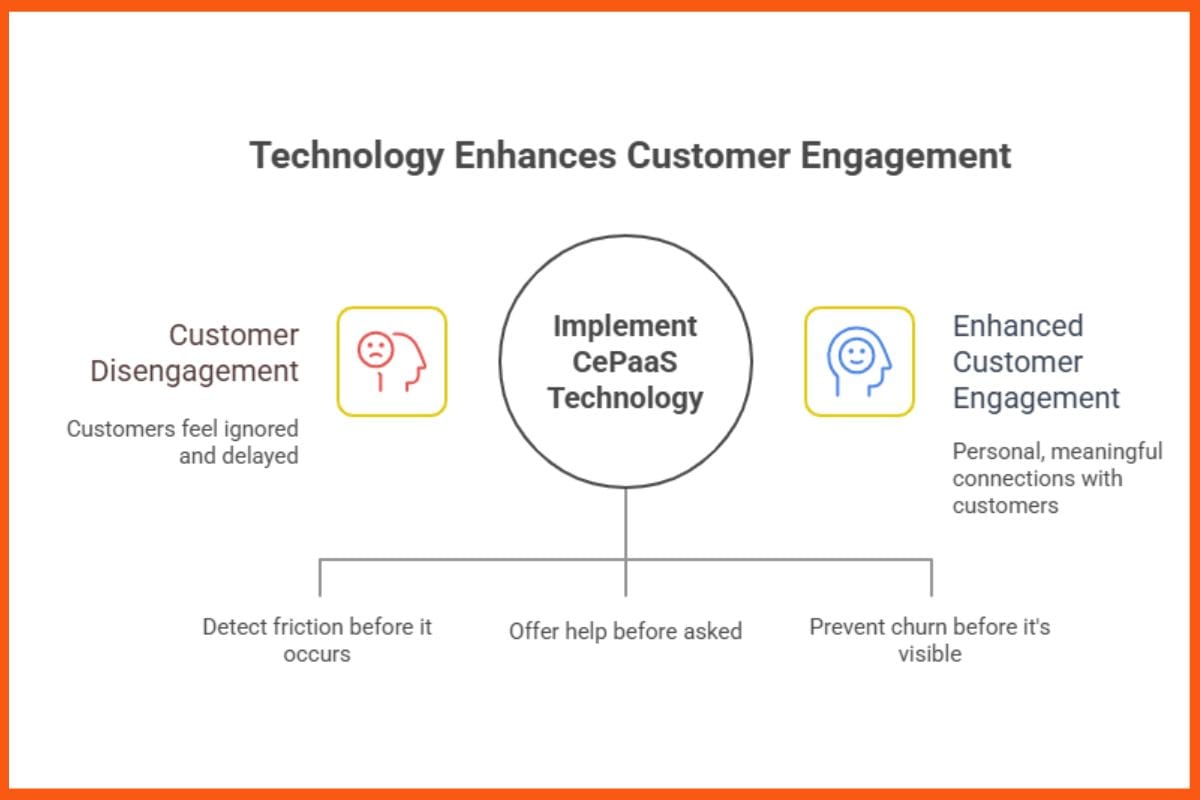
Modern technology amplifies the impact of CePaaS by helping brands connect with customers at the right moment, with the right message, in a way that feels personal and meaningful to each person. It enables brands to spot behavioural patterns early and take action before any friction occurs. It can detect when a customer needs support before the customer asks for it. It can initiate retention before churn becomes visible. It is to remove the delays that make customers feel ignored.
Why This Matters
Small organisations don't struggle because of a lack of ambition or ideas, they struggle because of bandwidth. Managing multiple tools, teams, and workflows creates hidden operational debt. With CePaaS, all of these aspects of customer engagement are managed through one unified system.
How the Customer–Brand Relationship Is Evolving
With omnichannel CePaaS, the journey moves beyond sending messages and enters the realm of meaningful customer connection. Rather than one-off interactions, engagement turns into an ongoing relationship. With time, this consistency builds familiarity and trust; the strongest drivers of loyalty. In the end, customers don’t count the number of messages they receive; they remember whether they felt understood.
Looking Ahead
Engagement will keep evolving toward more personal, more adaptive, and more seamless experiences. Voice and chat will function in complete sync as a single experience. Journeys will trigger themselves based on behaviour rather than schedules. Payments, fulfilment, support, and logistics will blend into customer engagement rather than sit outside it. And the technology edge once reserved for the largest enterprises will be available to the smallest businesses. The companies that grow fastest will be those that treat engagement not as a cost but as the foundation of their customer relationships.
Every technology wave comes with new tools. But the purpose remains unchanged. Customers want to feel recognised, valued, and remembered. Businesses that invest in continuity rather than communication volume will build the strongest relationships and the most resilient growth in the years ahead.
Abinaya Arangarajan