

SatLeo Labs’ Urmil Bakhai on Building Thermal Intelligence from Space, AI-Powered Heat Insights, and Climate-Ready Earth Observation
📝Interviews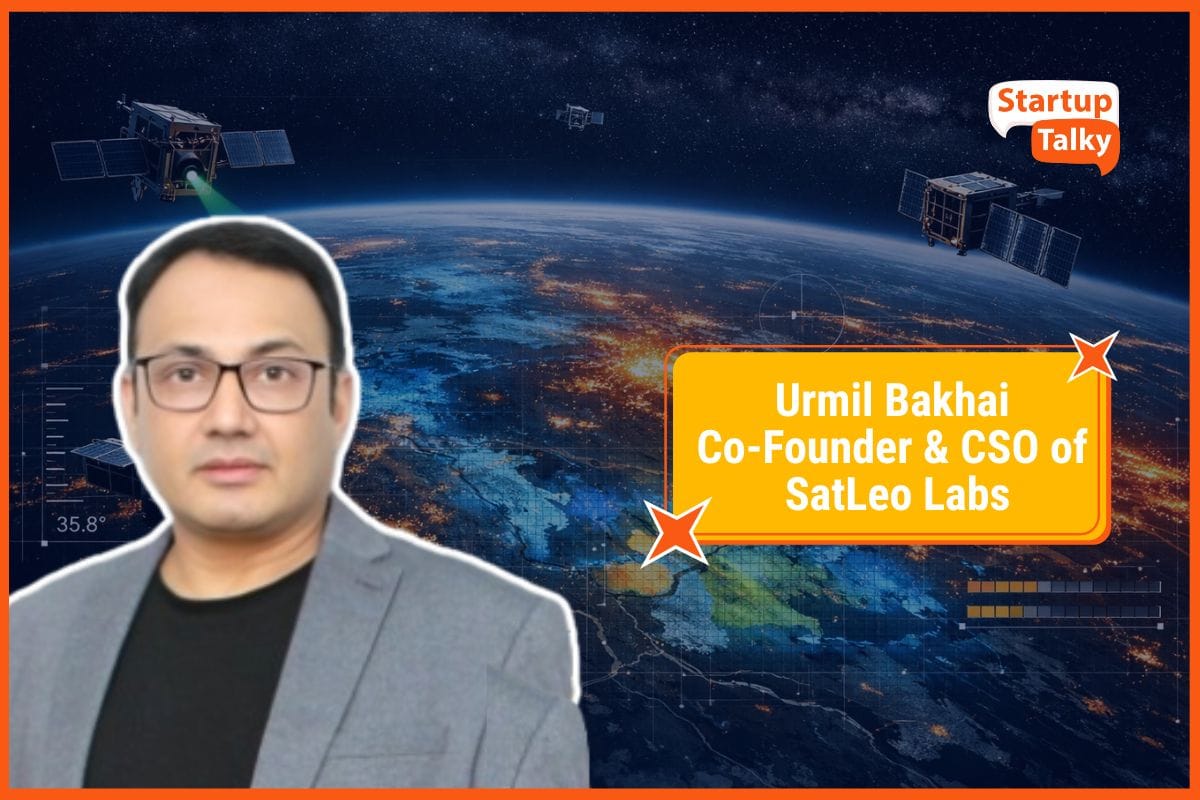
StartupTalky presents Recap'25, a series of exclusive interviews where we connect with founders and industry leaders to reflect on their journey in 2025 and discuss their vision for the future.
In this edition of Recap’25, StartupTalky speaks with Urmil Bakhai, Co-Founder & CSO of SatLeo Labs, who shares how the company is building a new climate intelligence layer by capturing high-resolution thermal data from space and converting it into actionable decision insights for governments, enterprises, and institutions. Bakhai explains why temperature should be treated as a critical “decision layer” influencing agriculture, urban livability, public health, and infrastructure resilience and how existing temperature datasets remain too delayed, generalized, or coarse to drive real-time action.
She goes on to discuss how SatLeo Labs is moving beyond visible Earth-observation imagery by developing satellites that deliver day-and-night thermal sensing, combined with onboard AI and analytics. The conversation explores the launch of new intelligence layers like Thermal Comfort, API-first integration for real-world platforms, and the company’s focus on shifting Earth observation from raw data availability to actionable intelligence. Bakhai also highlights key challenges of building deep-tech space hardware, securing early trust and funding, and SatLeo’s roadmap for constellation deployment and global expansion — positioning thermal intelligence as essential infrastructure for climate resilience.
StartupTalky: What service does Satleo Labs provide? What was the motivation/vision with which you started?
Urmil Bakhai: Satleo Labs provides thermal intelligence from space by building and operating a constellation of high-resolution thermal imaging satellites combined with AI-driven analytics. Our core service is converting precise temperature data from Earth’s surface into actionable insights that can be directly used by governments, enterprises, and institutions for better planning and risk management. Unlike traditional Earth-observation data, which largely relies on visible imagery, our thermal data works day and night and reveals hidden patterns such as heat stress, moisture variation, energy loss, and early indicators of environmental and infrastructure risks.
We deliver this intelligence through tailored datasets, analytics platforms, and APIs designed for real-world decision-making. The vision behind Satleo Labs emerged from a fundamental gap we observed in how temperature data is currently captured and used. Temperature influences agriculture, urban livability, climate resilience, public health, and resource efficiency, yet existing data is often coarse, delayed, or generalized, limiting its practical value.
We started Satleo with the belief that temperature should be treated as a critical decision layer, not just a background metric. Our motivation has been to build a dedicated thermal layer for the planet, one that enables early detection rather than reactive responses. By combining space-based thermal sensing with onboard computing and AI, we aim to make thermal intelligence timely, precise, and usable at scale. Ultimately, Satleo’s vision is to empower smarter, more resilient decisions by helping societies see and respond to the planet’s thermal signals before challenges escalate.
StartupTalky: What new services have been added in the past year? What is/are the USP/s of your service?
Urmil Bakhai: Over the past year, Satleo Labs has expanded its service offerings beyond foundational thermal imaging to deliver more advanced, user-ready thermal intelligence products. A key addition is our AI-driven “Thermal Comfort” layer, designed to translate raw thermal data into practical, human-centric insights. This layer quantifies heat stress and environmental comfort at street-level granularity and is made available through APIs that can be integrated directly into third-party platforms used by municipalities, logistics providers, urban planners, and weather-sensitive applications.
This capability empowers clients to assess and respond to localized heat conditions, for example, guiding outdoor workforce planning, optimizing urban green infrastructure, and informing daily route choices based on thermal comfort. Beyond this, we have continued refining our analytics suite to include industry-specific, AI-enhanced datasets and predictive models that help users anticipate heat-related trends rather than simply observe them. These services sit atop our expanding satellite data pipeline as we prepare for commercial constellation deployment. The USPs of Satleo’s services are:
- Sub-10-metre, high-cadence thermal data: Our satellites capture temperature variations with exceptional spatial and temporal resolution, revealing heat patterns that traditional datasets miss.
- AI and edge computing-native workflows: Onboard processing and machine learning convert raw thermal measurements into actionable, near-real-time insights, drastically reducing latency and data noise.
- Thermal Comfort intelligence: This innovative layer makes thermal information directly relevant to people’s daily choices and operational decisions, helping organizations integrate heat metrics into their existing decision systems.
- API-first integration: Our products are designed for seamless integration into client platforms, from smart city dashboards to agritech and logistics tools, ensuring that thermal intelligence drives real-world outcomes rather than sitting unused.
StartupTalky: How has the industry you are in changed in recent years and how has your company adapted to these changes?
Urmil Bakhai: The space and Earth-observation industry has rapidly shifted from being government-led to commercially driven, enabled by increased privatisation, supportive policy reforms, and a growing startup ecosystem. Private companies today can design, launch, and operate satellites with far greater speed and cost efficiency than before. This shift has been reinforced by the emergence of space incubation frameworks, which provide startups with access to testing facilities, regulatory guidance, and technical infrastructure that were previously out of reach.
At the same time, government support has evolved from ownership to enablement, with agencies encouraging private innovation and acting as partners and early adopters. This ecosystem has enabled us to build a cost-efficient and commercially scalable model. By leveraging private launch options, incubation support, and policy-backed access to space infrastructure, we are accelerating satellite development and deployment. We are now focused on delivering differentiated, AI-driven thermal intelligence solutions that address real-world needs—without the constraints of traditional, slow-moving space programs.
StartupTalky: What key metrics do you track to check the company's growth and performance?
Urmil Bakhai: At SatLeo Labs, we track metrics that reflect real-world impact, technical readiness, and commercial traction.
On the technology side, we closely monitor:
- Payload readiness levels (TRL progression)
- Data accuracy and validation benchmarks for thermal and optical outputs
- Time-to-insight - how quickly raw satellite data can be converted into actionable intelligence for urban stakeholders
On the business side, our focus is on:
- Number of active pilot engagements with municipalities, government bodies, and enterprises
- Conversion of pilots into long-term data or platform contracts
- Revenue visibility through LOIs and multi-year data demand
- Cost per square kilometer of usable thermal intelligence, which directly reflects scalability
We also track ecosystem signals, partnership depth, policy relevance, and repeat inbound interest—because in deeptech, sustainable growth is as much about trust and credibility as it is about speed.
StartupTalky: What were the most significant challenges your company faced in the past year and how did you overcome them?
Urmil Bakhai: One of the most significant challenges was building and validating highly specialised space hardware within a capital-intensive and regulation-heavy ecosystem. Thermal imaging payloads are technically complex, require precise thermal management, and depend on components that are not fully available domestically, creating supply-chain and customs-related delays. We addressed this by leveraging government-backed infrastructure and incubation support, particularly through IN-SPACe, which enabled access to advanced testing, assembly, and integration facilities without the need for heavy upfront infrastructure investment.
This significantly reduced development risk and timelines. Another key challenge was securing early-stage funding for deep-tech space hardware, where long development cycles often deter investors. We overcame this through sustained engagement with investors, demonstrating strong technical credibility, early pilot deployments with government bodies, and clear commercial demand for thermal intelligence.
StartupTalky: What are the different strategies you use for marketing? Tell us about any growth hack that you pulled off.
Urmil Bakhai: Our marketing philosophy is simple: demonstrate value before we promote it.
Instead of traditional marketing, we focus on:
- Problem-first storytelling — urban heat stress, waste-site emissions, and industrial thermal anomalies are urgent, visible problems
- Publishing city-scale thermal insights and sample intelligence that decision-makers can immediately relate to
- Speaking at and contributing to policy, geospatial, and climate-focused forums, where our users already are
One growth lever that worked particularly well was using hyperlocal thermal narratives. By mapping heat stress and emissions at street-level resolution and contextualizing it for specific cities, we sparked organic interest from municipal bodies, media, and ecosystem partners, without paid campaigns.
Media coverage and inbound interest followed because the data told a story that was impossible to ignore.
StartupTalky: What are the important tools and software you use to run your business smoothly?
Urmil Bakhai: We operate at the intersection of space engineering, data science, and urban intelligence, so our stack is built for collaboration and speed.
Key tools include:
- Geospatial and remote sensing platforms for data processing, validation, and analytics
- Cloud infrastructure for scalable data ingestion and analytics pipelines
- Design and simulation tools for payload development and testing
- Collaboration and project management tools to align hardware, software, and business teams
That said, our most important “tool” is our integrated workflow, where satellite data, analytics, and domain context come together to produce insights that city officials and enterprises can actually act on.
StartupTalky: What opportunities do you see for future growth in your industry in India and the world? What kind of difference in market behavior have you seen between India and the world?
Urmil Bakhai: The next phase of growth in the space and Earth Observation industry will be driven by a shift from data availability to actionable intelligence, creating strong opportunities for SatLeo Labs in both India and global markets. Globally, improved launch access, inter-satellite communication, and onboard AI will enable near-real-time thermal and climate intelligence at scale, unlocking use cases across urban heat monitoring, climate risk assessment, infrastructure planning, energy optimization, and disaster response. Thermal intelligence is rapidly becoming a core data layer, allowing SatLeo Labs to evolve from an imagery provider to a decision intelligence partner. In India, growth is closely aligned with national priorities such as climate resilience, agriculture productivity, urban governance, and infrastructure development. As climate volatility increases, space-based thermal intelligence will play a critical role in irrigation planning, crop stress monitoring, pollution tracking, and heat-risk mitigation, supported by strong policy momentum and rising government adoption.
Difference in market behavior: In India, adoption is largely problem-led and impact-driven. Government bodies and public institutions are often the earliest adopters, using satellite data to address systemic challenges such as agriculture resilience, urban heat stress, water management, and disaster preparedness. Decision cycles may be longer, but once validated, deployments tend to be large-scale and long-term. In global markets, especially in North America and Europe, adoption is more commercially driven and speed-focused. Enterprises in sectors like insurance, energy, EV infrastructure, logistics, and industrial monitoring increasingly view space-based intelligence as critical operational infrastructure. These markets prioritize faster data delivery, AI-driven insights, and integration into existing digital workflows, leading to quicker monetization and product scaling.
StartupTalky: How are you using AI, whether in service delivery, internal processes, or customer experience, and what impact has it created?
Urmil Bakhai: At SatLeo Labs, AI powers SatLeo Insight Hub, our thermal intelligence platform that transforms satellite data into decision-ready insights.Using AI and machine learning, we analyze thermal data to identify heat anomalies, greenhouse gas emission zones, and unauthorized waste sites. In our work with the Tumkur Municipal Corporation, this has enabled city-wide thermal profiling to detect heat islands, predict heatwave-prone zones, and monitor excess heat from solid waste decomposition—supporting proactive urban and climate planning.
We also apply AI at the edge-computing level, processing high-value data closer to the satellite to reduce latency for time-sensitive use cases. From a customer experience perspective, AI allows us to deliver customized, use-case-specific intelligence layers rather than raw datasets, ensuring seamless integration into existing workflows and driving higher adoption, operational efficiency, and measurable outcomes.
StartupTalky: How do you plan to expand the Customers, service offering, and team base in the future?
Urmil Bakhai: SatLeo Labs’ expansion strategy is built around close customer collaboration, differentiated service offerings, and a strong talent foundation.
From a go-to-market perspective, we have engaged with customers from day one to understand real-world problems and cost gaps in existing solutions. Many potential customers today rely on expensive alternatives such as ground-based IoT sensors for temperature and environmental monitoring. Our space-based thermal intelligence offers a more scalable and cost-effective approach, which has driven strong early interest and adoption. This is reflected in our ability to secure $27 million + LOIs , with nearly 40% coming from international markets across the Middle East, Europe, and Australia, and the rest from India. Strategic partnerships, including with one of the world’s largest satellite data aggregators, further strengthen our global reach.
In terms of service offerings, we plan to expand beyond raw datasets to more application-specific intelligence across agriculture, urban governance, climate risk, and industrial monitoring. Platforms like SatLeo Insight Hub will play a central role in delivering tailored, use-case-driven insights that integrate seamlessly into customer workflows.
On the team front, our growth is anchored in deep domain expertise combined with young engineering talent. With over 150 years of cumulative space heritage, including experienced scientists—many with ISRO backgrounds—and a strong cohort of early-career engineers, we have built a balanced, execution-focused team of 20+ members. Being based in Ahmedabad has enabled us to organically tap into India’s emerging space ecosystem, with access to ISRO, IN-SPACe incubation, and advanced testing and manufacturing facilities, accelerating our satellite development timelines.
StartupTalky: One tip that you would like to share with another Service company founder?
Urmil Bakhai: From day one at SatLeo Labs, we focused on deeply understanding the real problems our customers were trying to solve—even before the technology was fully ready. That early collaboration helped us design solutions that are not only technologically strong but also commercially viable and cost-effective. For any service company founder, staying close to customer pain points and validating assumptions early can significantly reduce risk and accelerate meaningful growth.
Explore more Recap'25 interviews here.