

Vatsal Kundalia of Advait Group on Scaling EPC Execution, Grid Resilience, and India’s Energy Transition
📰 News
StartupTalky presents Recap'25, a series of exclusive interviews where we connect with founders and industry leaders to reflect on their journey in 2025 and discuss their vision for the future
In this edition of Recap’25, StartupTalky speaks with Vatsal Kundalia, Director – Operations & CP&P at Advait Group of Companies, to understand how on-ground infrastructure execution is shaping India’s renewable energy ambitions. As India rapidly scales renewable capacity, the focus is shifting from headline targets to grid readiness, execution discipline, and long-term reliability.
Kundalia reflects on Advait Greenergy’s evolving role across EPC execution, indigenous grid technologies, and infrastructure innovation, sharing key learnings from executing large-scale green energy and grid modernisation projects in 2025. He also discusses why early-stage planning, local manufacturing, and technology-led execution are critical to building resilient, future-ready energy infrastructure for India.
StartupTalky: Advait Greenergy operates across EPC execution, grid technologies, and infrastructure innovation. Could you briefly explain AGPL’s role in India’s energy transition and how it has evolved in recent years?
Vatsal Kundalia: India’s energy transition ultimately depends on whether infrastructure on the ground can keep pace with ambition on paper. Advait Greenergy’s role sits at the intersection of EPC execution, grid readiness, and infrastructure reliability, ensuring that renewable capacity can be absorbed and stabilised by the system. Over the past few years, we have evolved from being primarily execution-focused to building systems that are resilient, scalable, and future-ready. As renewable penetration increases, integration, flexibility, and grid stability have become just as critical as capacity addition. Our work supports the transition by strengthening the physical backbone that enables renewables to perform reliably over the long term.
StartupTalky: Looking back at 2025, what were the most defining developments or learnings for AGPL while executing green energy and grid modernisation projects on the ground?
Vatsal Kundalia: One of the strongest learnings from 2025 was that scale exposes execution gaps very quickly. As project sizes increase, even small weaknesses in planning, coordination, or decision-making get amplified across timelines and costs. Large projects demand tight coordination between engineering, logistics, grid authorities, contractors, and on-ground realities, and weak planning is immediately reflected at scale.
Beyond technical and regulatory complexity, we also navigated practical site-level challenges that are often underestimated, such as accommodation, food logistics for large workforces, extreme weather conditions, and operating in remote terrain. These factors directly affect productivity, safety, and morale. Having consistently dealt with such challenges across sites, our on-ground teams are now far more seasoned and resilient.
Early-stage planning proved critical in reducing downstream risk, particularly in difficult terrain, while flexibility in execution models became essential as regulatory and site conditions continued to evolve. Regular management presence on site helped accelerate decision-making, resolve issues in real time, and maintain team alignment. Today, these experiences define how we operate, execution is no longer reactive, but deliberate, disciplined, and built to hold at scale.
StartupTalky: Indigenous grid technologies are increasingly being discussed in India’s power ecosystem. From your experience, where do locally developed solutions create the most value compared to imported technologies?
Vatsal Kundalia: Locally developed grid technologies create the greatest value when projects are exposed to Indian operating realities such as terrain diversity, climate extremes, and logistical constraints. Imported solutions are often optimised for different environments, whereas indigenous technologies allow faster customisation, easier serviceability, and quicker response during execution. This becomes especially important when projects face unforeseen site conditions or tight commissioning timelines.
From an EPC perspective, local manufacturing also improves coordination between design and field execution. Shorter supply chains reduce uncertainty, while closer collaboration between engineering and manufacturing improves quality and reliability. Over the long term, this results in lower lifecycle risk for utilities and developers, making indigenous solutions not just cost-effective, but operationally superior.
StartupTalky: EPC execution in the energy sector comes with operational, regulatory, and terrain-related challenges. What were the toughest execution challenges you faced this year, and how did your teams address them?
Vatsal Kundalia: The toughest execution challenges arose from aligning project schedules with regulatory approvals and evolving site conditions. In difficult terrain, even minor logistical delays can cascade into larger schedule impacts. Managing workforce safety, accommodation, and mobility in remote locations added another layer of complexity.
Our teams addressed these challenges through detailed pre-execution planning, modular construction strategies, and continuous coordination with authorities and contractors. Strong site leadership and experienced execution teams ensured consistency across locations. Regular management engagement on site helped maintain accountability and enabled faster resolution of issues. This combination of planning discipline and field experience allowed us to maintain momentum despite external constraints.
StartupTalky: How is technology, whether automation, data-led planning, or digital monitoring, reshaping how AGPL designs, executes, and manages large-scale energy infrastructure projects?
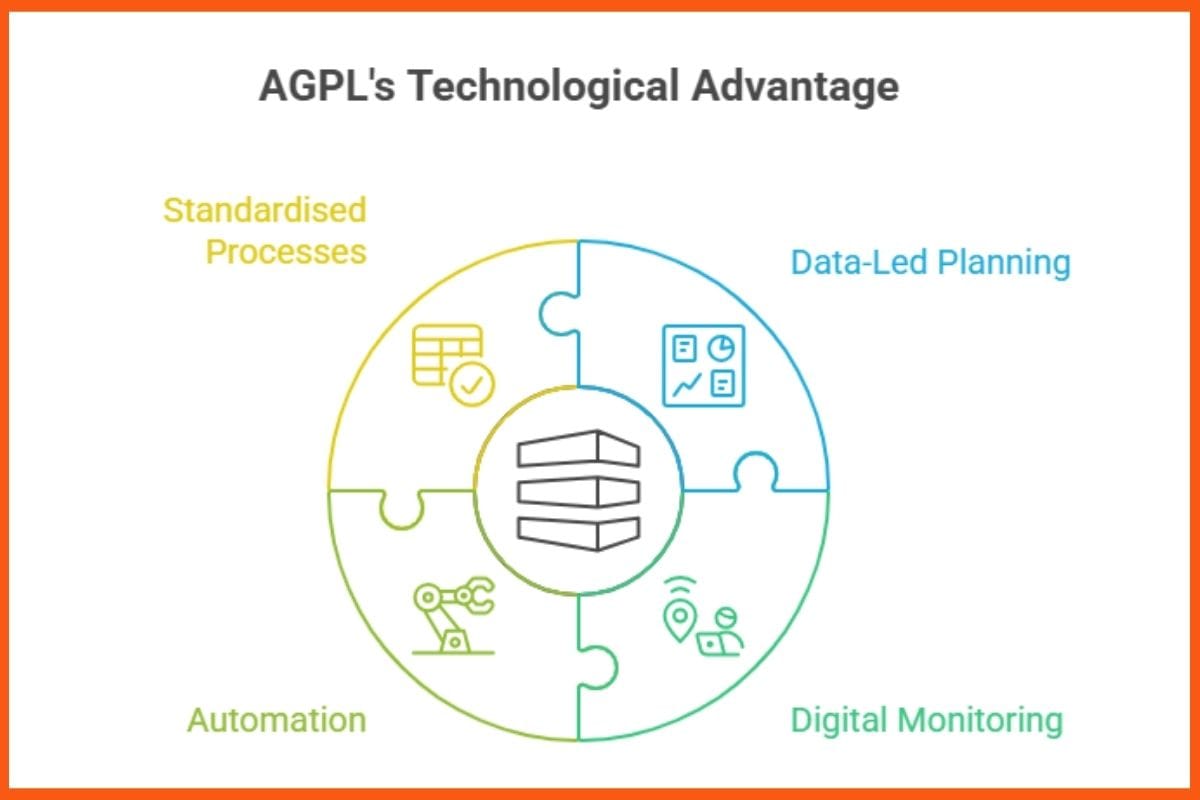
Vatsal Kundalia: At AGPL, technology is a practical enabler rather than a buzzword. Its value lies in improving decision-making on the ground. Data-led planning allows us to identify risks early, optimise layouts, and simulate execution scenarios before construction begins. This reduces uncertainty and improves predictability.
Digital monitoring systems provide real-time visibility across geographically dispersed sites, enabling faster intervention and better coordination. Automation and standardised processes have also strengthened quality control and repeatability across projects. Together, these tools help us deliver large-scale infrastructure with greater consistency, safety, and efficiency.
StartupTalky: As renewable capacity scales rapidly, what gaps do you see today in India’s transmission and grid infrastructure, and how critical is manufacturing-led innovation in addressing them?
Vatsal Kundalia: India is adding renewable generation capacity faster than it is upgrading grid flexibility and resilience. Transmission infrastructure must now support not just higher capacity, but also variability and rapid load balancing. Strengthening the grid for these demands is critical to sustaining renewable growth.
Manufacturing-led innovation plays a key role by enabling faster deployment, better alignment between design and execution, and improved serviceability. Locally manufactured solutions allow quicker upgrades, easier maintenance, and reduced dependence on long supply chains. Without this foundation, scaling renewable energy becomes increasingly complex and vulnerable to delays.
StartupTalky: Looking ahead to 2026 and beyond, what opportunities and priorities do you see for AGPL in building future-ready, resilient, and sustainable energy infrastructure in India?
Vatsal Kundalia: The coming years present strong opportunities in integrated energy infrastructure that combines generation, storage, and grid readiness. Our priority will be to maintain execution quality while adapting to evolving technologies, regulatory frameworks, and market expectations. Building resilience into infrastructure will be as important as adding capacity.
We also see significant value in deeper collaboration across the energy ecosystem, between developers, manufacturers, utilities, and policymakers, to reduce execution bottlenecks. For AGPL, the focus remains clear: translating ambition into infrastructure that performs reliably on the ground and supports India’s energy transition over the long term.
Explore more Recap'25 interviews here.