

What Entrepreneurs Learn About Themselves When Scaling Their Business
✍️ Opinions
This article has been contributed by Tarun Dua, Founder and Managing Director of E2E Networks
Scaling a company is an endeavor deeply rooted in leadership rather than in business mechanics alone. The individual who passionately ignites the venture is fundamentally not the same person who must steward it to maturity. This path from a raw startup to an established enterprise is not a linear progression of tasks but a demanding series of personal metamorphoses. Each stage requires the founder to embrace a new and often uncomfortable identity to meet the escalating demands of the organization.
The journey of scaling a business is universally segmented into distinct phases: from zero to one, one to ten, and ten to one hundred. These are more than just numerical milestones; they represent fundamental shifts in the company's very nature. However, although far less discussed are the corresponding, non-negotiable transformations in the founder's identity, focus, and core capabilities. Failure to evolve at these critical inflection points is the silent killer of potential, a far more common cause of stagnation than any external market failure. It is the internal ceiling that the founder cannot break through that ultimately limits the organization.
Metamorphosis I: From Master Doer to Visionary Catalyst (0→1)
At the very inception, the company is a pure projection of the founder's will. There is no distinction between the idea and its execution. The founder is not just the leader but the primary production engine, operating at a velocity that seems unsustainable because, at this stage, it absolutely must be. Every line of code, every sales call, and every customer support ticket is a direct extension of their hands. This phase is less about managing and more about manifesting something from nothing.
The founder’s focus here evolves from merely holding the vision to physically embodying it. This intense, hands-on immersion forges a deep, almost intuitive understanding of the customer, the product's core value, and the market's unspoken needs. It is during this time that the company's authentic culture is born, not from a document but from action. It is rooted in the founder's demonstrated pace, their relentless problem-solving, and their palpable sense of purpose. This is where the company's soul is formed.
The critical pivot in this first metamorphosis is the subtle but profound shift in mindset from ‘proving I can do it’ to ‘proving this can be done.’ This is the moment the founder realizes that their personal bandwidth is the company's primary bottleneck. It marks the first conscious investment in people and systems, an effort to create a framework where other talented individuals can be empowered. The initial culture is cemented not by a list of values on a wall, but by the founder's demonstrated tolerance for risk, their grace under pressure, their response to failure, and the ethical lines they will not cross when everything is on the line. This phase forges the foundational conviction—in the idea, in the market, and in oneself—that will be tested repeatedly in the years to come.
Metamorphosis II: From Player to Coach and Architect (1→10)
A significant and often painful leap occurs when the founder's direct contribution becomes a limiting factor. Their ability to inspire, organize, and elevate others must become more valuable than their ability to execute tasks alone. This is the essential shift from personal achievement to collective achievement. Where the founder once was the star player, they must now learn to become the coach and the general manager, building a team that can win without them on the field.
The core realization here is one of leverage. The founder’s impact expands exponentially not by working harder, but by learning to multiply talent. They move from being the chief problem-solver to becoming the chief problem-framer. Their role is to provide the context, the resources, and the clear boundaries within which their team can operate effectively and autonomously. They are no longer building a product; they are building an engine of capability that can operate beyond their direct reach. It is a profound identity shift; the founder moves from being the lead problem-solver, the person with all the answers, to becoming the clarifier of context and the builder of cohesive teams.
The critical pivot is a two-step process: first from ‘doing’ to ‘delegating’, and then, more importantly, from ‘delegating’ to ‘designing’. It is no longer enough to hand off tasks. Communication must be intentionally redesigned, shifting from the informal and implicit to the structured and explicit. The collective intuition of the founding team must be codified into clear processes and socialized across the expanding ranks. In this transition, the founder sheds the skin of a hands-on manager and steps into the role of a cultural and strategic architect. Their primary function is no longer to dictate tasks but to design the underlying systems that ensure alignment and cohesion, guiding the organization from a tribal unit to a unified enterprise with a single, compelling purpose.
Metamorphosis III: From Architect to Strategist and Systems Thinker (10→100)
At this final threshold, complexity compounds in ways that are difficult to anticipate. The organization is no longer a collection of people but a system of interconnected teams, departments, and business units, each with its own goals, dynamics, and sub-cultures. The founder can no longer have visibility into all decisions, nor should they seek to. Attempting to do so would create chaos and strangle innovation.
The core realization at this stage is that leadership is no longer about directing activity or even managing people directly. It is about designing and continuously tuning the organizational system itself. The primary levers of leadership are no longer the individuals, but the principles, processes, cultural norms, and grand strategies that guide them. The founder must shift from focusing on operational efficiency to focusing on strategic adaptability.
The identity shift here is from being the manager to becoming the steward of the entire system. The founder is now the guardian of the company's long-term health and its evolutionary potential. The critical pivot is the transition from being the primary source of answers to being the curator of the most important questions. The focus ascends to the highest levels of strategic intent, capital allocation, and ecosystem positioning. The key task is to build a senior leadership team not of followers, but of true peers who are capable of autonomous execution and strategic thought in their own domains. The founder’s most crucial skill becomes synthesis: the ability to integrate complex market data, nuanced customer insights, and deep operational capacity into a clear, compelling, and forward-looking path for the entire enterprise. They must build a company that can not only execute the current strategy with excellence but also sense, interpret, and adapt to the next major market shift on the horizon.
The Through Line: The Elasticity of Leadership
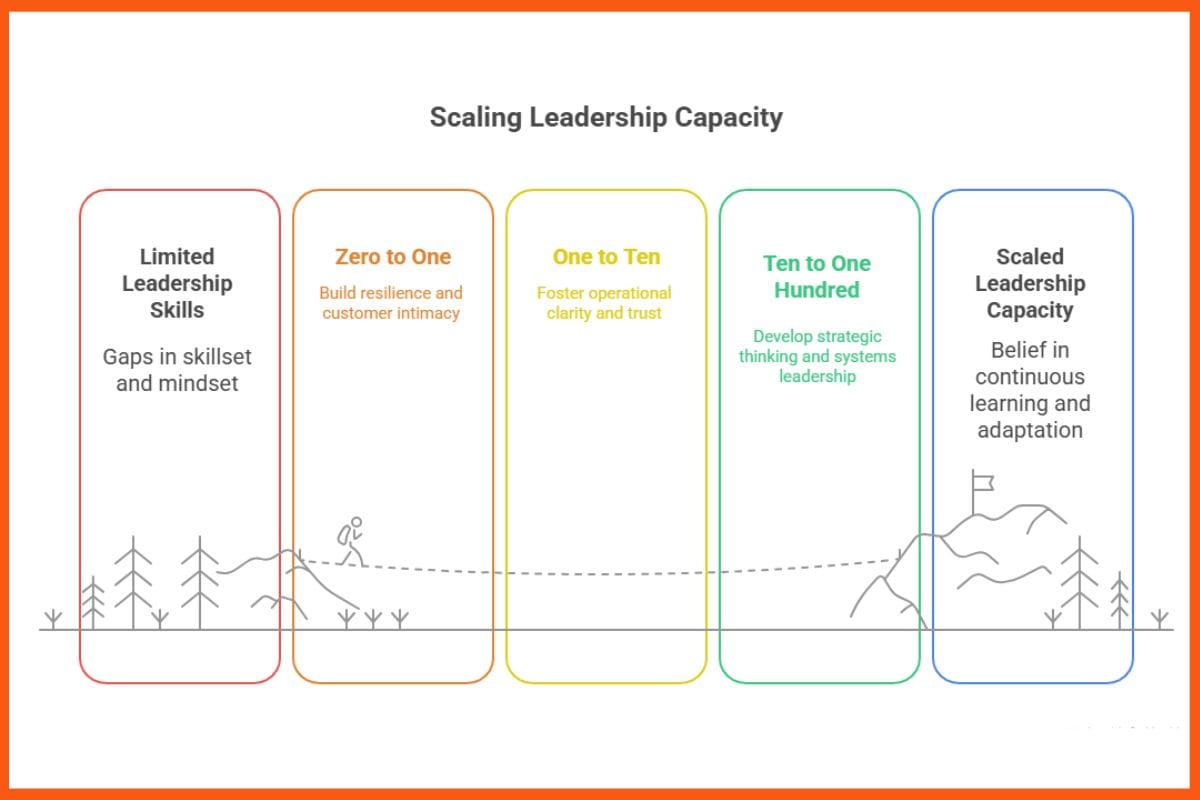
These metamorphoses are not neat, sequential boxes to be checked. They are cumulative layers of capability and consciousness that build upon one another. The resilience, grit, and customer intimacy forged at the zero-to-one stage become the bedrock for the difficult delegation and trust-building choices required at the one-to-ten stage. Likewise, the operational clarity and cultural coherence built during the one-to-ten phase are the absolute prerequisites for the sophisticated strategic thinking and systems leadership required at the ten-to-one hundred threshold.
The ultimate lesson for any founder is that human capacity is not fixed. The journey of scaling a business is the most intense and unforgiving personal development program imaginable. It relentlessly exposes gaps in your skillset, your mindset, and your emotional framework, and it demands that you close them. The founders who ultimately succeed are not those who begin with all the answers. They are those who possess a deep, unwavering belief in their own capacity to learn, adapt, and grow into the leader the next stage demands. They understand a fundamental truth: that before the company can scale, its leader must. The work on the business begins with the most challenging work of all: the work on oneself.
 Singh Neeraj Shekhawat