The Real Cost of Cloud Dependence: Why Digital Sovereignty Should Be a National Priority
✍️ Opinions
This article has been contributed by Mr. Manoj Dhanda, Founder and CEO, Utho Cloud
As the world accelerates toward a digital-first future, cloud infrastructure has already been established as a crucial factor in driving economic growth, governance, security, and innovation in the tech sector. Governments, large corporations, and small companies have all been utilizing cloud services primarily for data storage, software execution, and operational scaling. However, this exceptional reliance on cloud services, mainly on a few global hyperscalers, has turned digital sovereignty into a serious issue.
Digital sovereignty signifies the power of a nation to completely regulate its digital assets, prevent them from leaving its territory, and carry out their storage and protection without relying heavily on overseas providers. The countries that are heavily investing in cloud technologies are beginning to see the hidden costs attached to cloud dependence very clearly. These disadvantages are not only financial but also connected to the risks of national security, economic resilience, data independence, and the future prospects of innovation.
Foreign Cloud Dependence as a Strategic Vulnerability
When sensitive national data is stored on servers owned by foreign entities, countries risk losing control over their most valuable digital resources. Foreign cloud companies are governed by the regulations of their home nations, which may allow external authorities or agencies to request access to data even if that data is stored outside their borders. As a result, critical government information, defense systems, and citizen databases can remain vulnerable to external influence without any breach or cyberattack. In a world increasingly shaped by shifting geopolitical tensions, relying on foreign cloud infrastructure creates long-term exposure and limits a nation’s ability to safeguard its digital infrastructure independently.
The Hidden Financial Burden and Lock-In Problem
At first glance, global cloud platforms appear affordable and convenient, but deeper usage reveals hidden financial traps. High egress fees, premium support costs, and complex pricing structures often result in rapidly escalating cloud bills. Many organizations get locked into proprietary tools and architectures that make migrating away extremely difficult and costly. This vendor lock-in weakens operational flexibility and channels billions of dollars out of the domestic economy to foreign technology players. Over time, such dependency limits a country’s strategic digital autonomy and slows the development of its local cloud and innovation ecosystem, highlights Mr. Dhanda from Utho Cloud
Risks to Critical Infrastructure and Public Services
More and more, cloud platforms are taking over the role of a nation’s critical infrastructure, covering energy grids, healthcare systems, transportation networks, public utilities, and emergency services. The country becomes vulnerable to problems beyond its control when it uses foreign cloud ecosystems. Geopolitical disputes, lawsuits from foreign countries, or even significant outages might result in public services being interrupted. The governments that do not have complete power over the digital infrastructure lose the ability to continue their operations during emergencies. Digital sovereignty is an assurance to the nations that their infrastructures will still be powerful, secure, and unguarded by external influences.
Effect on Innovation and Independence in Technology
Being too dependent on foreign hyperscalers can be a major obstacle that lasts for years in the path of the growth of local technology capabilities. The local cloud providers might find it very difficult to grow because of the global players’ power, which is just too overwhelming. Consequently, lack of domestic innovation, less investment in local R&D, and fewer chances for homegrown cloud solutions to mature are the results of such a scenario. Besides, a workforce trained mainly on proprietary foreign cloud tools may not have the requisite exposure to open and scalable technologies that support the self-reliance of the nation. The lack of active development of local cloud ecosystems might put the nation at risk of being a passive consumer rather than a leader in technological innovation.
Data Governance, Citizen Privacy, and National Control
Data has become the world’s most valuable natural resource, powering digital identity systems, public policymaking, artificial intelligence models, and national growth strategies. When data of citizens is stored under the jurisdiction of a foreign entity, the data can be accessed by the foreign government. Concern arises about the possible surveillance, transferring across borders, and decisions made outside the country’s legal sphere. But with digital sovereignty, the government can impose stringent data localization regulations, monitor trails, and keep citizen information confidential under national privacy laws. It also ensures that data contributes to national advancement rather than enriching external corporations or being accessed under foreign policies.
Economic Advantages of Building Local Cloud Ecosystems
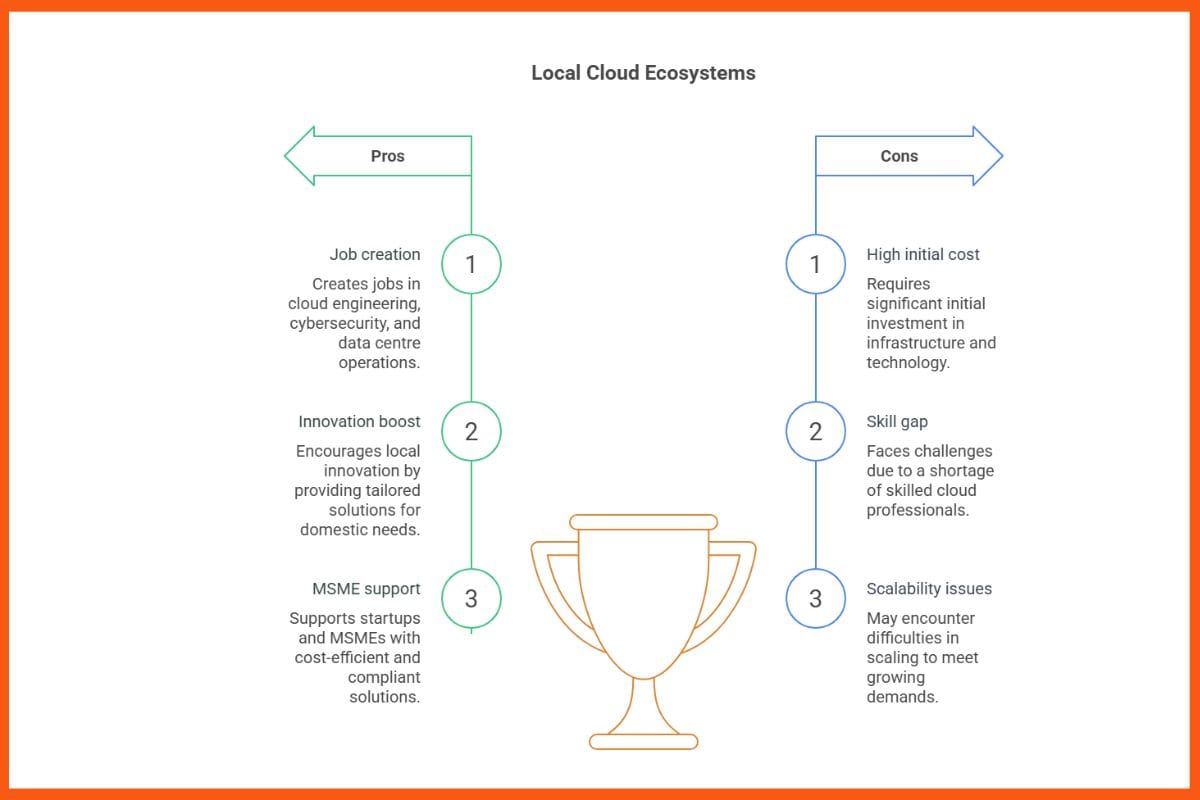
In the long run, investing in sovereign cloud infrastructure provides economic benefits. The strong local cloud ecosystem creates jobs in cloud engineering, cybersecurity, and data centre operations while at the same time encouraging local innovation. It also supports startups, little and medium-sized enterprises (MSMEs), and big companies by providing cost-efficient and compliant solutions specifically designed for domestic needs. Moreover, reducing dependence on foreign technology providers prevents major capital outflow and strengthens the national digital economy. Building sovereign cloud capabilities is not just an infrastructural decision, as it is a strategic economic investment.
Steps That Made Digital Sovereignty A National Priority
The real digital sovereignty can be achieved via policy coordination, investment making, and collaboration, along with steps. Local cloud providers, national data centre infrastructure, and regulations about data governance and security would be some of the aspects that the governments would develop to speed up the transition. A balanced solution is the one that promotes the use of domestic cloud; the critical workloads would be on sovereign clouds, while the non-sensitive workloads would be using global clouds. It is through public-private partnerships and specific incentives that the digital infrastructure would be in line with the national objectives, as well as being beneficial to innovation support.
The actual price of being dependent on the cloud goes much further than just the cost of storage or computing. It involves the very essence of national security, economic independence, and the digital rights of citizens. Countries that do not take into account the long-term approach of using foreign cloud infrastructure will ultimately lose their digital power. Digital sovereignty, like data, must be regarded as a national priority because the latter is the defining asset of the 21st century. When countries invest in sovereign cloud ecosystems and limit their dependency on external platforms, they not only protect their citizens but also strengthen their economies and, thereby, create a digital future that is secure, autonomous, and innovative.
 Muskaan Kapoor