

AI-Powered E-Commerce Audit Tools: The Complete 2026 Guide
Collections 🗒️

AI is transforming eCommerce auditing processes. What used to require several days now needs only a few minutes. The system operates continuously to identify problems that people tend to overlook. It evaluates website performance by measuring speed and design elements, content, and search engine accessibility. The system detects all lost traffic, declining sales, and decreasing revenue streams. The system identifies all dangerous customer experience issues, which include untested user paths, nonfunctioning links, and inadequate security defense. The system analyzes how users interact with the system while observing sales patterns.
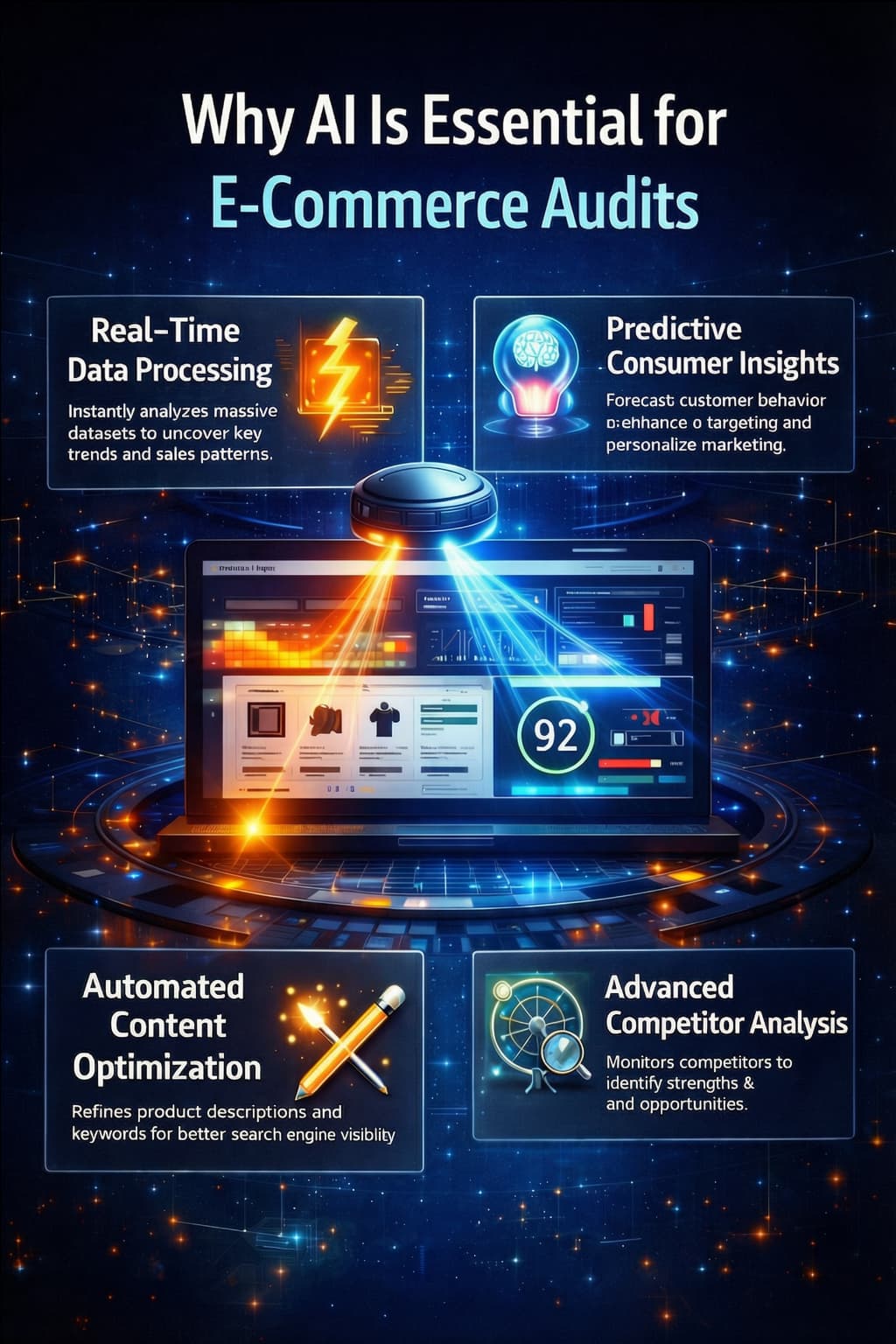
Why AI Is Now Essential for E-Commerce Audits
AI-powered audits are no longer optional. They:
- Detect traffic, UX, and conversion issues early
- Run continuously without fatigue or bias
- Turn complex data into clear actions
- Reduce costs and protect profit margins
Brands using AI audit tools move faster, test smarter, and scale with confidence.
Best AI Audit Tool by Use Case
Use the table below to quickly find the best AI audit tool for your specific eCommerce needs.
| Use Case | Best Tool | Why It’s Best |
|---|---|---|
| Product Content Quality | Describely.ai | Audits product descriptions, grammar, accuracy, and brand compliance at scale |
| SEO Optimization | Surfer SEO | Uses real SERP data to find keyword gaps and on-page SEO issues |
| Content Strategy & Topic Coverage | MarketMuse | Advanced topic modeling and intent-based content audits |
| Brand Voice & Compliance | Acrolinx | Ensures consistent brand tone, legal compliance, and readability |
| Revenue & Profit Visibility | Triple Whale | Unifies profit, ad performance, and attribution into one dashboard |
| Financial & Attribution Analysis | Polar Analytics | Identifies ROAS, LTV, and profit gaps across channels |
| Customer Retention & LTV | Peel Insights | Strong cohort, retention, and lifetime value analysis |
| Marketing Efficiency & Growth | Heybooster | Finds wasted ad spend and highlights fast revenue opportunities |
| UX Behavior & Funnel Issues | Hotjar | Visual heatmaps and session recordings reveal user friction points |
| UX + CRO with On-Page SEO | Plerdy | Combines UX tracking, funnel analysis, and SEO error detection |
Describely.ai
Describely.ai helps eCommerce brands audit and improve product descriptions at scale.
The platform scans your entire catalog to detect:
- Grammar and spelling errors
- Weak or unclear product messaging
- Non-brand-compliant text
- Inaccurate or misleading content
It suggests edits that users can approve or reject with one click. Brands can set content rules and sync with Shopify to keep SKUs consistent.
Pros
- Mass auditing procedures for extensive product databases save a lot of time
- The one-click approval system maintains human control over all decision-making processes.
- The system enables users to work more efficiently by connecting with Shopify
Cons
- Steep learning curve for some users.
- Lacks technical SEO audits
Pricing
- Pay as you go: $0.75 per product
- High volume: Custom pricing
Surfer SEO
Surfer SEO helps online stores rank higher by auditing content against top-ranking SERP competitors.
It identifies:
- Missing keywords and content gaps
- Weak internal linking
- On-page SEO errors
Surfer SEO converts complex SEO work into clear, data-backed action steps.
Pros
- Audit tasks that have specific impacts and allow for straightforward implementation.
- A powerful combination of AI and data, which has been optimized to assess actual SERP competition.
- The system operates effectively for online shops that have extensive product and category page content.
Cons
- Cost arises when more content is added
- The user needs to have preliminary knowledge of SEO
Pricing
- Standard: $119/month
- Pro: $219/month
- Business: $359/month
 Vivek Dev Jacob
MarketMuse
MarketMuse helps eCommerce teams improve content depth and topical authority. It evaluates:
- Topic strength of each page
- Keyword and question coverage
- Internal linking and content clusters
Pros
- Effective topic modeling capabilities enable users to conduct thorough intent-based audits.
- Continuous content inventory management, including automatic content evaluation and scoring.
- Forecast content performance improvements
Cons
- The pricing structure proves expensive for small retailers
- The credit system restricts extensive catalog usage
Pricing
Request for pricing (RFP)
Acrolinx
Acrolinx ensures every word matches brand, legal, and readability standards. It audits:
- Tone and voice consistency
- SEO terms and key phrases
- Compliance and industry rules
Writers get real-time guidance inside their writing tools.
Pros
- Ability to maintain a single brand voice throughout extensive content libraries.
- Complete control over all industry-specific rules and organizational vocabulary
- The solution enables international teams to create difficult product content at large scale
Cons
- Requires advanced setup procedures together with specific system adjustments
- Performance issues reported by users
Pricing
Request for pricing (RFP)
Muskaan Kapoor
Triple Whale
Triple Whale gives brands a single source of truth for performance and profitability. It tracks:
- Profit margins and ad performance
- Attribution errors and margin leaks
- Weak creatives and risky customer segments
Pros
- An accurate source that unifies information from Shopify and advertising platforms
- The system uses pixel-based attribution together with server-side tracking
- AI functions that extract insights about anomalies and cohort trends
Cons
- The system works best with Shopify, while other platforms provide diminished benefits.
- The native dashboards display data discrepancies that some users need to investigate.
Pricing
- Starter: $149/month
- Advanced: $219/month
Polar Analytics
Polar Analytics unifies data from 45+ sources into one dashboard. It helps teams find:
- Profit gaps and ROAS issues
- LTV and conversion problems
- Channel-level tracking errors
Pros
- Built to match the operational requirements of eCommerce businesses via metrics and views
- Complete visibility of all channels throughout different regions and stores
- The first-party pixel and CAPI enhancer help recover lost attribution
Cons
- Payment is based on GMV or order volume, which creates high expenses for brands
- The system performs daily backfill operations, which create problems for users
Pricing
Request for pricing (RFP)
Vivek Dev Jacob
Peel Insights
Peel Insights turns raw data into easy-to-understand business stories. It covers:
- Revenue trends and retention
- LTV and cohort analysis
- Product and customer performance
Pros
- Provides excellent retention and cohort analysis together with eCommerce LTV data
- Enables users to create unlimited custom dashboards and segments
- Complete integration capabilities with Shopify plus all major marketing solutions.
Cons
- Only restricted to Amazon and Shopify
- The system lacks a mobile application that users could use to monitor their data.
Pricing
- Core: $199/month
- Essentials: $499/month
- Accelerate: $899/month
Heybooster
Heybooster acts like a virtual analyst for marketers and agencies. It identifies:
- Wasted ad spend
- Underperforming products
- Funnel and CRO issues
Pros
- Solutions are unique to their target users, who are eCommerce marketers and agencies.
- The system provides daily important insights that function like a virtual analyst.
- Offers a no-code installation process that delivers quick value
Cons
- Expensive for extremely small retail businesses.
- Training restricts users from conducting in-depth technical search engine optimization
Pricing
- Starter: $294.71/month
- Premium & Enterprise: Contact sales
Hotjar
Hotjar helps teams see how users actually behave on their site.
Features include:
- Heatmaps and session recordings
- Funnel drop-off reports
- AI-generated surveys
Pros
- Easy installation process and straightforward visual reports that anybody can understand.
- Detects user experience problems that users would not see through regular analytical methods.
- AI technology to reduce the time required to develop and evaluate surveys.
Cons
- Does not include any tools for search engine optimization or performance testing.
- The system presents potential privacy and compliance issues
Pricing
- Growth: $49/month
- Pro & Enterprise: Contact sales
Plerdy
Plerdy combines UX tracking, funnel analysis, and SEO checks.
It offers:
- Heatmaps and session replays
- Funnel and revenue tracking
- Instant on-page SEO error detection
Pros
- Excellent combination of user experience design and conversion rate optimization
- Affordable plans provide users with free trials and high pageview allowances
- The export functionality of data supports two primary formats, which are PDF and CSV.
Cons
- The system experiences performance problems
- The software provides excessive features that will exceed the requirements of small teams
Pricing
- Startup: $32/month
- Scale: $64/month
- Thrive: $108/month
Best AI E-Commerce Audit Tools – Comparison Table
| Tool | Best For | Core Audit Focus | Main Limitation |
|---|---|---|---|
| Describely.ai | Product content audits | Product descriptions, grammar, brand compliance | No technical SEO audits |
| Surfer SEO | SEO audits | On-page SEO, keywords, SERP gaps | Requires SEO knowledge |
| MarketMuse | Content strategy audits | Topic depth, intent coverage, internal linking | Expensive for small retailers |
| Acrolinx | Brand & compliance audits | Tone, readability, legal and brand rules | Complex setup and configuration |
| Triple Whale | Profit & performance audits | Margins, ads, attribution, cohort analysis | Works best with Shopify |
| Polar Analytics | Financial & attribution audits | ROAS, LTV, profit gaps, channel tracking | Pricing scales with GMV |
| Peel Insights | Retention & LTV audits | Cohort analysis, revenue trends, product performance | Limited to Shopify and Amazon |
| Heybooster | Growth & marketing audits | Ad spend efficiency, CRO, revenue leaks | Not ideal for very small brands |
| Hotjar | UX audits | Heatmaps, session recordings, funnel drop-offs | No SEO or performance audits |
| Plerdy | UX + SEO audits | Heatmaps, funnels, on-page SEO | Too many features for small teams |
Conclusion
The process of conducting eCommerce audits now requires AI technology as its essential component. The technology functions as the main driving force for intelligent expansion. The system detects traffic, user experience, and conversion funnel problems before they cause financial damage. The software converts disorganized information into understandable instructions that your team can start using immediately. The system performs automated testing throughout the day without experiencing fatigue or producing biased results. The system enables you to quickly evaluate concepts while minimizing unnecessary expenses and protecting your profit margins. The brands that implement the system experience increased operational speed.
FAQs
What is an AI e-commerce audit tool?
An AI e-commerce audit tool automatically checks your website, content, SEO, UX, and performance to find issues that affect traffic, conversions, and revenue.
Do AI audit tools replace manual audits?
No. AI tools speed up audits and catch hidden issues, but human review is still needed for final decisions and strategy.
Which AI audit tool is best for Shopify stores?
Tools like Triple Whale, Peel Insights, Polar Analytics, and Describely.ai work especially well with Shopify-based e-commerce stores.
Can small e-commerce businesses use AI audit tools?
Yes. Tools like Plerdy, Hotjar, and Describely.ai offer affordable options, while enterprise tools may be better for large catalogs and teams.