

Aman Dhall of CommsCredible on Comms-Tech, Founder-Led Storytelling, and Turning Credibility Into Capital
👨💻 StartupTalkers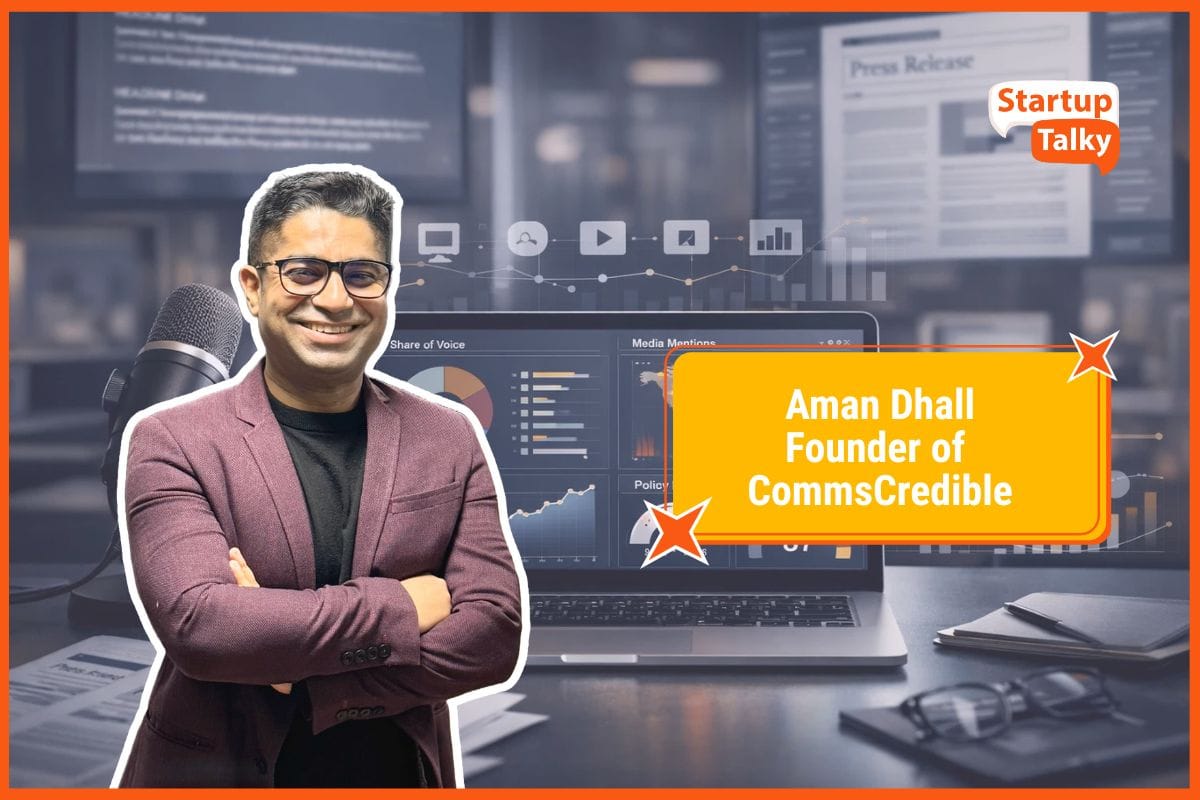
StartupTalky presents Recap'25, a series of exclusive interviews where we connect with founders and industry leaders to reflect on their journey in 2025 and discuss their vision for the future.
In this edition of Recap’25, StartupTalky speaks with Aman Dhall, Founder of CommsCredible and CEO of CommsCredible Venture Fund, who shares insights on how communication has evolved from a support function into a core business capability in an AI-led, digital-first world. Drawing from his background in journalism and strategic communications, Dhall reflects on how many startups and new-age organisations innovate rapidly but communicate reactively—often chasing coverage instead of building long-term credibility and narrative ownership.
Dhall explains how CommsCredible operates at the intersection of PR, content, media strategy, and technology to help founders and institutions build visibility that compounds into trust, influence, and search-led brand value. The conversation explores the rise of fragmented discovery across platforms like LinkedIn, WhatsApp, and AI summaries, CommsCredible’s shift from PR-first execution to narrative intelligence through its AI-powered CommsStack, and the growing importance of policy advocacy, founder visibility, and proof-based storytelling. He also shares key learnings from 2025 and the company’s roadmap for scaling across India, Southeast Asia, and the Middle East—alongside expanding the CommsCredible Venture Fund built on the belief that credibility itself is a form of capital.
StartupTalky: What service does CommsCredible provide? What was the motivation/vision with which you started?
Aman Dhall: CommsCredible is an India-headquartered global PR & Comms Tech venture that helps emerging businesses, founders, and institutions build visibility, credibility, and influence in a noisy digital-first world. We work at the intersection of PR, content, media strategy, and technology, enabling brands to shape narratives that travel across markets and matter to the audiences that influence growth, from investors and policymakers to consumers and talent.
The motivation to start CommsCredible at the peak of pandemic in 2020 came from a clear gap I observed firsthand as a journalist and communications professional. Startups and new-age organisations were innovating at speed but communicating reactively, fragmented across agencies, platforms, and dashboards, often chasing coverage instead of building credibility. Great stories were getting lost, not because they lacked substance, but because they lacked narrative clarity and ownership.
CommsCredible was built with a simple but powerful vision: stories should not just create visibility, they should create trust, momentum, and long-term search & brand value. We blend editorial thinking with modern distribution, data insights, and founder-led storytelling to turn communication into a strategic growth lever.
Aligned with India’s Digital India, AI Mission, and Viksit Bharat 2047 ambitions, CommsCredible has, in just five years, partnered with over 50+ ventures across fintech, proptech, sports, education, sustainability, and impact sectors — helping them raise capital, influence policy conversations, win global recognition, and scale across borders.
At its core, CommsCredible exists to turn credibility into capital and stories into scale, building narratives that endure, not just headlines that disappear.
StartupTalky: What new services have been added in the past year? What is/are the USP/s of your service?
Aman Dhall: Over the past year, CommsCredible has expanded from being a PR-first integrated communications-first firm into a comms-tech and narrative intelligence partner, adding services that reflect how influence is now built in an AI-led, multi-platform world.
The most significant addition has been our fast developing AI-powered CommsStack, which integrates PR, digital content, LinkedIn growth, and analytics into a single, unified system. This allows founders and leadership teams to track not just coverage, but credibility outcomes, share of voice, narrative ownership, policy influence, and reputation momentum in real time.
We have also deepened our LinkedIn Editorial & Founder Visibility practice, helping CXOs and founders build category leadership through opinion-led storytelling, and platform-native content. This is complemented by policy advocacy and public affairs communications, where we design campaigns that influence regulators, industry bodies, and national conversations, particularly in fintech, housing, sustainability, and sport sectors.
Another key addition is visual and video-led storytelling, including short-form video series, documentaries, and explainers designed for digital-first consumption and search-led discovery.
Our core USP lies in three things. First, editorial DNA. The firm is led by former journalists and editors who think like newsrooms, not agencies. Second, ownership-led storytelling. We don’t chase coverage, we build narratives founders can own over time. Third, tech-enabled credibility. We combine human storytelling with data, distribution intelligence, and AI to ensure stories are discoverable, trusted, and enduring.
What truly sets us apart is the CommsCredible Venture Fund, through which we support select early-stage and emerging businesses. The fund is built on a simple belief, credibility is a form of capital. Beyond strategic financial backing, portfolio companies gain access to narrative strategy, media relationships, and storytelling infrastructure that helps them build trust, influence markets, and scale reputation alongside growth.
StartupTalky: How has the industry you are in changed in recent years and how has CommsCredible adapted to these changes?
Aman Dhall: The communications industry has changed more in the last few years than it did in the decade before. Earlier, success was about visibility. A front page story, a prime time TV mention, or a logo in a marquee publication was considered the finish line. Today, that finish line has moved.
Discovery is fragmented. People now find stories through LinkedIn feeds, WhatsApp forwards, Google summaries, podcasts, and peer conversations. According to industry studies, more than 50% of online searches today are zero click. People get their answers without visiting a website at all. At the same time, LinkedIn has emerged as a primary platform for senior decision makers, with a majority of CXOs using it to form opinions on companies, leaders, and sectors.
We adapted by changing what we optimise for. Instead of chasing coverage, we focused on narrative clarity. Helping founders and brands say fewer things, more consistently, across platforms where their stakeholders already spend time. We brought PR, digital content, leadership visibility, and policy conversations into one integrated system so stories do not live in silos.
We also leaned into founder led storytelling. Data from the Edelman Trust Barometer shows people trust subject matter experts and leaders significantly more than corporate messaging. We have seen this play out repeatedly when founders speak with honesty and context, credibility compounds naturally.
Most importantly, we stopped treating communication as a campaign and started treating it as a long term discipline. Our role today is to help brands show up clearly, repeatedly, and credibly so that wherever someone encounters them, the story feels familiar and trustworthy.
That shift from visibility to credibility is how CommsCredible has evolved alongside the industry.
StartupTalky: What key metrics do you track to check the CommsCredible's growth and performance?
Aman Dhall: Key metrics include:
- Annual recurring revenue (ARR) growth
- Client retention and longevity
- Impact on partner outcomes, such as fundraising success and market expansion
- Reputation equity of founders and brands across platforms
- Portfolio performance through the Venture Fund
StartupTalky: What were the most significant challenges your company faced in the past year and how did you overcome them?
Aman Dhall: The most significant challenge we faced over the past year was navigating a period of rapid change on multiple fronts at once. Client expectations were evolving quickly, platforms were changing how discovery works, and budgets across industries were becoming more outcome driven rather than activity driven. Many companies were asking harder questions. What does credibility really deliver? How do we measure impact beyond coverage? Where should we focus our attention?
At the same time, we were scaling geographically and expanding our service mix, which meant building systems without losing the editorial soul that defines CommsCredible. Growth can dilute thinking if you are not careful.
We addressed this by slowing down before speeding up. We invested time in sharpening our core narrative and being very clear about what we will and will not do. Instead of adding fragmented services, we integrated our offerings into a single operating approach, which became our CommsStack. This helped us bring clarity internally and confidence externally.
Another challenge was helping clients stay relevant in a crowded, fast moving information environment. With more than half of online searches now resulting in zero clicks and senior decision makers relying heavily on platforms like LinkedIn for insight, the old playbook was not enough. We doubled down on founder led storytelling, opinion driven content, and consistency across platforms rather than chasing volume.
Internally, we focused on people. We invested in training, editorial thinking, and ownership mindset so the team could adapt with confidence rather than fear. The result was not just resilience, but momentum.
The year reinforced one belief for us. In times of change, clarity beats speed. And credibility, when built patiently, becomes the strongest advantage you can have.
StartupTalky: What are the different strategies you use for marketing? Tell us about any growth hack that you pulled off.
Aman Dhall: Our approach to marketing has always mirrored the advice we give our clients. We do not believe in loud marketing. We believe in visible thinking.
The primary strategy we use is thought leadership as distribution. Instead of marketing services, we market perspective. My own writings on LinkedIn, media platforms, and industry forums consistently address where communications, credibility, AI, policy, and storytelling are heading. This has helped CommsCredible attract founders, CXOs, and investors organically, without traditional outbound sales.
We also use earned media as a marketing engine. When our clients win, raise capital, or influence policy, CommsCredible’s role is naturally part of that story. Over time, this has positioned us as a behind-the-scenes credibility partner rather than a vendor pitching services.
One growth hack that worked exceptionally well was turning LinkedIn into our primary acquisition channel. Instead of posting generic agency updates, we treated LinkedIn like an editorial platform. Every post was written as if it were a column, not a caption. This led to consistent visibility in LinkedIn News, strong inbound interest, and a compounding follower base made up largely of decision makers.
Another effective lever was network-led amplification. We encouraged founders, journalists, and ecosystem partners to share narratives they genuinely believed in, rather than pushing paid amplification. This made our content travel organically across WhatsApp groups, founder circles, and investor networks.
Finally, we practised what we call proof-based marketing. We spoke less about what we offer and more about what our clients achieved. Growth, recognition, influence, and trust became our strongest marketing assets.
In short, our growth did not come from hacks alone. It came from consistency, credibility, and showing up with a point of view when others were only showing up with promotions.
StartupTalky: What opportunities do you see for future growth in your industry in India and the world? What kind of difference in market behavior have you seen between India and the world?
Aman Dhall: The biggest opportunity ahead for our industry is that communication has stopped being a support function. It is now a core business capability. When technology lowers entry barriers and markets get crowded, products alone no longer win.
In India, this opportunity feels especially urgent. The country has 1.6 lakh+ startups, but only a handful can confidently explain who they are, what they stand for, and why they deserve attention. As India moves forward with Digital India, the AI Mission, and the vision of Viksit Bharat 2047, communication will need to do much more than generate publicity. It will have to build investor confidence, shape policy conversations, and earn public trust. This is where founder-led storytelling, public affairs communication, and purpose-driven brand building will see sustained demand.
Globally, the landscape is different but equally telling. Markets such as Singapore, the Middle East, Europe, and the US are more mature when it comes to communication spends. Yet they are also experiencing saturation and trust fatigue. Audiences there are no longer impressed by noise or frequency. They are drawn to clarity, consistency, and authenticity. This opens space for firms that think like editors and partners, not campaign factories.
We have also noticed a behavioural difference. In India, founders are increasingly comfortable stepping forward and becoming the voice of their company, especially on platforms like LinkedIn. In many global markets, storytelling tends to be more institution-led, with a sharper focus on governance, reputation risk, and long-term brand equity.
Across geographies, one shift is common. Discovery is no longer linear. Brands are found through AI summaries, social feeds, conversations, and recommendations. This creates a powerful opportunity for communication firms that can help brands remain credible and relevant everywhere, not just visible somewhere.
For us, the future lies in building that credibility infrastructure thoughtfully, across borders, sectors, and platforms.
StartupTalky: How are you using AI, whether in service delivery, internal processes, or customer experience, and what impact has it created?
Aman Dhall: AI is deeply embedded in how we work today, but always as an enabler, not a replacement for thinking or judgement.
On the service delivery side, we use AI to power our CommsStack, which helps integrate media monitoring, content intelligence, narrative tracking, and performance analytics into one workflow. Internally, AI supports research, media landscape mapping, trend analysis, and early signal detection. That said, we are very deliberate in how we use AI. We do not automate judgment, relationships, or storytelling voice. Editorial instinct, cultural understanding, and human trust still sit at the core of our work.
StartupTalky: How do you plan to expand the Customers, service offering, and team base in the future?
Aman Dhall: Expansion plans include:
- Working with select high-growth purpose-led founders, startups and institutions globally
- Scaling the CommsCredible Venture Fund in fintech, sports tech, and Viksit Bharat-aligned sectors
- Building a lean, high-quality team of strategists rather than scale-heavy operations
- Deepening cross-border presence in India, Southeast Asia, and the Middle East
StartupTalky: One tip that you would like to share with another Service company founder?
Aman Dhall: One lesson I’ve learned the hard way is this. In a service business, your credibility is your product long before your service is.
Founders often rush to scale offerings, hire fast, or chase visibility. My advice would be to slow down and first build trust, with clients, with your team, and with the ecosystem you operate in. Say no more often. Choose clients you can genuinely create impact for. Deliver consistently, even when no one is watching.
Also, don’t outsource your thinking. Tools, frameworks, and even AI can make you faster, but clarity of judgment still has to come from the founder. If you are deeply involved in the craft in the early years, your culture, quality bar, and reputation will compound over time.
In the long run, service businesses don’t win because they do more. They win because they are believed.
Explore more Recap'25 interviews here.