Abhay Group’s Apurv Modi on AI-Led Marketing, Hyper-Personalisation, and Why Brand Trust Will Outperform Noise
📝Interviews
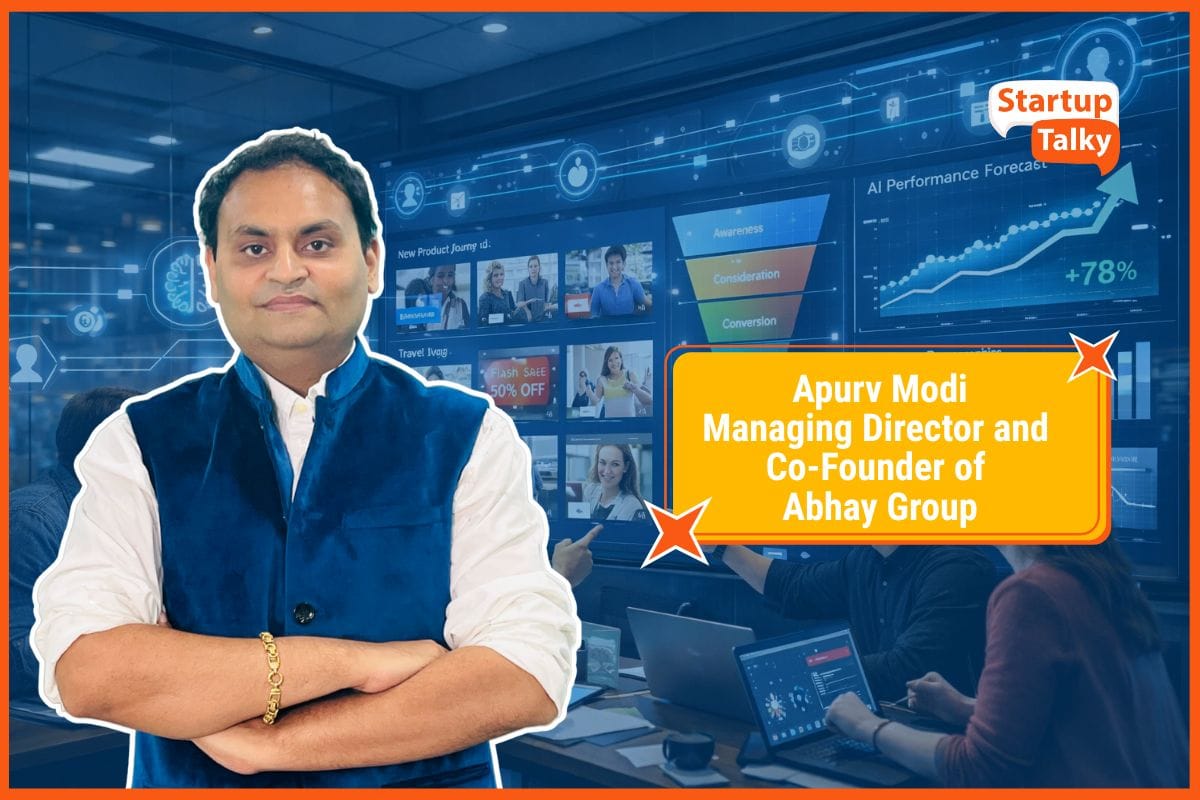
StartupTalky presents Recap'25, a series of exclusive interviews where we connect with founders and industry leaders to reflect on their journey in 2025 and discuss their vision for the future.
In this edition of Recap’25, StartupTalky speaks with Apurv Modi, Managing Director and Co-Founder of Abhay Group, who reflects on how digital marketing evolved from mass messaging to deeply personalised, data-driven engagement in 2025. He discusses how brands moved beyond traditional demographics to behaviour-led communication, using AI and analytics to create more intuitive, human-centric campaigns that prioritise long-term relationships over short-term noise.
Modi also shares how AI has reshaped agency workflows, automating repetitive tasks while elevating strategic thinking, creativity, and performance optimisation. The conversation explores the growing importance of customer lifetime value, loyalty ecosystems, and community-driven brand building, along with Abhay Group’s vision for 2026 — where interactive content, ethical AI-powered media, and trust-first marketing will define sustainable brand growth.
StartupTalky: How would you describe the biggest shifts in digital marketing in 2025? What stood out most in consumer behaviour, content formats, or brand expectations?
Apurv Modi: Hyper-personalized communication was the defining theme of 2025 as customers started finding themselves overwhelmed with brands sending out the same type of information. Instead, they wished for more individually tailored communications that focused on building rapport with their customers. Creativity and data were the keys to this interaction, allowing brands to reach customers on many levels beyond age, gender, and geography. Brands used insights gained from customer behaviour patterns, preferences, and contextual information to communicate with customers.
The result was the emergence of more human, intuitive campaigns, which didn't appear generic or mass-produced. In addition to longer engagement through video, brands used existing formats and developed programmes to include customer interaction through engagement via productive and fun methods in their stories. Customers became collaborators rather than frequenting videos or stories as passive observers. By the end of 2025, it was evident that storytelling was insufficient for brands as a tactic to connect with customers; brands must act and interact with customers on all fronts.
StartupTalky: AI adoption grew across the industry in 2025. How has AI changed the way your agency works, across creative, media planning, performance, or client servicing?
Apurv Modi: The advent of AI technology has revolutionised the way we think about and develop solutions. AI replaced repetitive tasks like data cleansing and segmentation, as well as rule-based optimisations, and allowed teams to focus on high-level strategic thinking and creative solutions. In addition to enabling teams to concentrate on their strategic vision and relationships with clients, AI improved virtually every aspect of how content is created and targeted and how performance is predicted and optimised.
A decade ago, teams were dependent on historical reports for determining customer behaviour; today, AI provides an opportunity to predict customer behaviour, create personalised experiences along the pathway, and optimise performance at the speed of light. In simple terms, AI did not take people’s jobs; it gave people power and opportunities to become strategic thinkers rather than simply performing operational duties.
StartupTalky: As a full-service digital agency, what were the toughest challenges you faced this year, and how did you tackle them?
Apurv Modi: Our teams' ability to maintain our focus on people and the speed of growth and change caused by the technology boom was our top priority. The implementation of Artificial Intelligence across our entire workflow presented both exciting opportunities to achieve greater creativity and productivity, as well as overwhelming challenges for many of our teams. As such, we have focused heavily on building our training and skills within our teams and forming deeper partnerships with AI technology and software providers to keep us ahead of this changing world, using technology to support and elevate human ingenuity and creativity, not replace it.
StartupTalky: What metrics matter most to you today when evaluating the success of a campaign or a long-term brand engagement?
Apurv Modi: More than the current focus being placed on short-term sales to drive 'sales spikes', we are seeing a shift to the lifetime value of the customer base with regard to 'brand sentiment'. Performance campaigns are still measured by the same methods as in the past; i.e., conversion rate, ROI, etc.; however, we have moved towards loyalty and engagement over time (as well as through multiple channels). In long-term engagement with your brand, we review overall adoption by customers, customer retention, and revenue impact. 'A campaign is a success' if and only if it positively impacts your business metrics, vs. being 'noise'.
StartupTalky: Which sectors or client categories showed maximum growth momentum this year? Any category that behaved differently from expectations?
Apurv Modi: As engagement and loyalty solutions have continued to gain traction in the fast-moving consumer goods (FMCG), automotive, home solution, and building materials sectors, FMCG brands leveraged their distribution networks for growth; automakers engaged in influencer marketing to promote their products; and home solution companies required additional support from dealers and retailers in order to meet increasing customer demands. Conversely, quick commerce, once thought to be an emerging segment, did not achieve its expected growth due to the need for loyalty-related economics within this segment to stabilize. Because of their reliance on extensive networks and large numbers of offline customers, many companies in these industries began to consider loyalty a strategic asset rather than simply being a part of their marketing toolkit.
StartupTalky: What tools have become essential for your team in 2025? Are there any AI tools or platforms that now play a major role in your workflow?
Apurv Modi: In 2025, technology has transitioned from being an overtly visible component of the creative process to becoming an understated yet significant enabler. Technology is there, but it's not about technology; in fact, the technology is simply a facilitator to allow creatives time to focus more on generating creative ideas and executing them. Thus, while technology can reduce time spent on repetitive tasks, it is ultimately the human intelligence behind those technologies and the skilled judgement of the teams that will drive innovation and growth through creative storytelling. Achieving the balance between technology and human talent has elevated the company's workflow in 2025 and beyond.
StartupTalky: Looking ahead to 2026, what trends in content, paid media, or tech-led marketing do you think will shape brand strategy?
Apurv Modi: By 2026, one area that will see growth over the next few years will be Interactive Content (e.g., AR/VR). As both mobile devices and AR eyewear are increasingly affordable and available, companies are likely to use these technologies to provide users with more immersive, experiential interfaces. This trend especially applies to the areas of fashion, retail, and wellness, where users will increasingly expect the opportunity to create customized experiences.\
In the area of Paid Media, we can expect to see growth in AI-driven programmatic advertising and an emphasis on ethical and transparent processes.
When it comes to retail and influencer-based advocacy, we can expect to see this trend grow significantly (people tend to trust people rather than platforms). Brands that focus on creating these communities will greatly benefit from their investment.
StartupTalky: What is your long-term vision for your agency, and what strategic moves are planned for the next phase of growth?
Apurv Modi: To achieve the next level of business success through a channel-focused approach by building a comprehensive framework that allows you to leverage AI to turn consumer behaviour into predictable revenue. We will develop our Channelverse™ platform into a global engaged community of distributed brands that leverage increasing amounts of data, emerging technologies, and modern user experiences.
Moving beyond traditional loyalty, our goal is to transform the way brands think about, support, and develop their distribution partners and retail networks.
StartupTalky: What key advice would you give to brands planning their 2026 marketing strategies?
Apurv Modi: I have one piece of advice: trust over noise. The brands that consistently communicate, personalize their conversations, and remain authentic are rewarded by both consumers and their distribution partners. Brands should spend more money on developing behaviours (i.e., Loyal and retaining customers, creating communities, and providing education) than on building up awareness. Brands should not chase after every trend that comes around; instead, they should focus on what creates equity in the long term. The most critical part is to maintain a close relationship with those who support your business - consumers, retailers, influencers, and distributors - because without their support, trust will not happen, and therefore growth will not occur.
Explore more Recap'25 interviews here.
Must have tools for startups - Recommended by StartupTalky
- Convert Visitors into Leads- SeizeLead
- Website Builder SquareSpace
- Run your business Smoothly Systeme.io
- Stock Images Shutterstock