

Avinash Godkhindi of Zaggle on Building a Unified Spend Management Platform, AI-Led Finance Automation, and Scaling B2B FinTech-SaaS in India
📝Interviews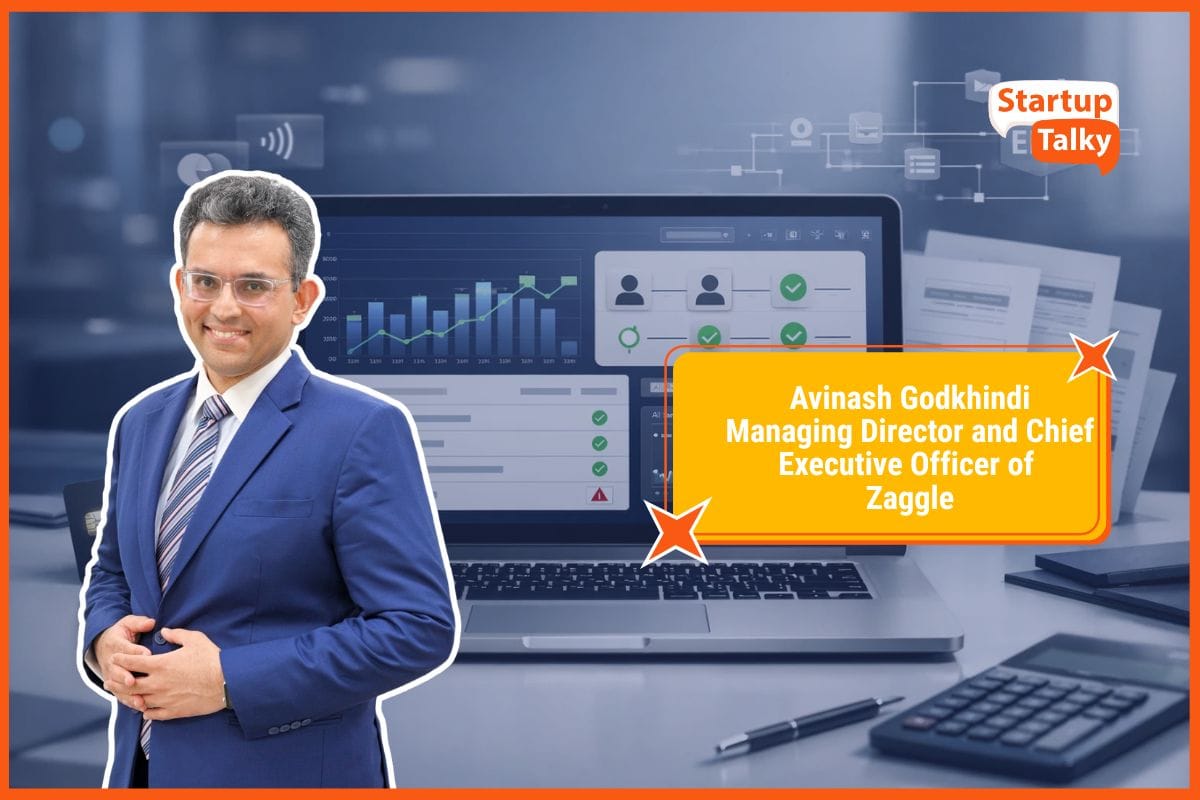
StartupTalky presents Recap'25, a series of exclusive interviews where we connect with founders and industry leaders to reflect on their journey in 2025 and discuss their vision for the future.
In this edition of Recap’25, StartupTalky speaks with Avinash Godkhindi, Managing Director and Chief Executive Officer of Zaggle, who shares insights on how the company’s B2B2C positioning at the intersection of FinTech and SaaS is shaping enterprise spend management in India. He reflects on how finance teams are moving beyond fragmented expense tools toward integrated platforms that enable real-time visibility, stronger compliance, and intelligence-led decision-making—especially in an environment of decentralized spending and rising regulatory complexity.
Godkhindi explains how Zaggle has evolved into an end-to-end spend management and payments ecosystem, integrating employee benefits, rewards and incentives, travel and fuel spends, expense management, and vendor payments on a unified platform. The conversation explores how automation, analytics, and AI-driven insights are helping CFOs detect leakage, enforce policies, improve governance, and shift from transactional oversight to strategic planning. He also shares Zaggle’s growth drivers across key enterprise use cases, sector-wise spending patterns, and the company’s roadmap for scale—through acquisitions, deeper product integration, and international expansion initiatives across GIFT City, MENA, and the US.
StartupTalky: Zaggle operates at the intersection of fintech and SaaS in a B2B2C model. How has this positioning shaped your growth strategy and product priorities over the past year?
Avinash Godkhindi: Zaggle’s positioning at the intersection of FinTech and SaaS, delivered through a B2B2C model, has been very deliberate and central to how we have built the company. Over the past year, this positioning has sharpened both our growth strategy and product priorities.
At one level, it allows us to solve for enterprises by offering control, compliance and visibility over spends. At another, it ensures a seamless, consumer-grade experience for employees, vendors and channel partners. This dual focus has guided our move away from point solutions towards building a unified, end-to-end spend management and payments platform.
Our product priorities have therefore centered on deeper integration across employee benefits, rewards, travel, fuel, expense management and vendor payments, enabling organizations to digitize, track and optimize spends on a single platform. We have also invested significantly in automation, data intelligence and AI-driven insights to help CFOs and finance leaders move from transaction oversight to strategic decision-making.
From a growth perspective, the FinTech-SaaS combination has allowed us to scale sustainably. It has strengthened enterprise relationships; improved wallet share through cross-selling and increased platform stickiness. Strategic acquisitions over the past year have further expanded our capabilities and accelerated our roadmap.
Importantly, this model gives us a strong foundation for global expansion. We are building a platform that is scalable, configurable and ready for international markets. In that sense, the B2B2C FinTech-SaaS approach continues to be the guiding force behind Zaggle’s evolution into a full-stack, profitable and globally relevant spend management and payments platform.
StartupTalky: With over 50 million prepaid cards issued and 3,400+ enterprise clients, what key use cases are driving the strongest adoption of Zaggle’s spend management solutions today?
Avinash Godkhindi: With over 50 million prepaid cards issued and more than 3,600 enterprise clients, adoption of Zaggle’s platform is being driven by use cases that directly address the core priorities of today’s finance teams i.e. cost control, compliance, visibility and operational efficiency.
Employee expense and benefits management continues to be one of the strongest adoption drivers. Enterprises are steadily moving away from manual reimbursements and cash-heavy processes to digital, prepaid-led solutions that offer policy-based controls, real-time visibility and simplified compliance. This shift not only improves governance but also significantly enhances the employee experience.
Fuel and transportation expense management is another high-growth use case, especially for logistics, mobility and field-force driven organizations. Zaggle’s solutions enable tighter control over fuel spends, reduce leakages and provide actionable analytics to optimize costs across large, distributed operations.
We are also seeing strong momentum in rewards, incentives and loyalty programs. Enterprises are increasingly using Zaggle’s flexible and compliant prepaid solutions to engage employees, channel partners and customers at scale, supporting productivity, retention and performance-led outcomes. Zaggle’s Rewards Platform enables enterprises to manage the entire rewards lifecycle, from attribution and program design to issuance, tracking and redemption, on a single, integrated platform. This end-to-end capability ensures transparency, governance and real-time visibility, while allowing organizations to run large-scale, outcome-linked incentive programs with speed, flexibility, and full regulatory compliance.
In addition, vendor payments and payables automation is emerging as a key adoption area. Finance teams are looking to consolidate payments, reporting and controls on a single platform to improve efficiency and oversight across the supplier ecosystem.
Collectively, these use cases reflect a broader shift among enterprises, from using fragmented tools to adopting an integrated, end-to-end spend management platform. That is precisely where Zaggle is positioned: as a comprehensive ecosystem aligned with the evolving needs of modern CFOs and Finance Leaders.
StartupTalky: The spend management space is becoming increasingly competitive. What differentiates Zaggle’s platform when enterprises evaluate it against traditional expense tools and newer fintech entrants?
Avinash Godkhindi: Zaggle differentiates itself in an increasingly competitive spend management landscape through a unified, SaaS-led platform that brings together payments, controls, analytics and automation in a seamless manner. Unlike traditional expense tools and newer FinTech or SaaS entrants that typically address only narrow use cases, Zaggle has been built as an end-to-end operating system for enterprise spends.
Our platform covers the full spectrum of spend categories, including employee expenses, vendor payments, branch petty cash management, rewards and incentives, fuel and travel, utility bill payments and rental payments. Solutions such as Zaggle Save for employee expense management, Zoyer for accounts payable automation and Propel for employee and channel incentives are deeply integrated and delivered on a single, cloud-based platform. This enables enterprises to achieve real-time visibility, stronger policy enforcement, reduced fraud and faster reconciliation across all spend types.
A key differentiator is our technology-first approach, focused on digitizing every enterprise spend while embedding compliance and governance by design. Advanced analytics and AI-driven insights allow finance leaders to move from reactive reporting to proactive planning and decision-making, supported by seamless ERP integrations.
While newer FinTech and SaaS entrants may offer point solutions, Zaggle stands apart through the breadth and maturity of its platform. With over 50 million prepaid cards issued, strong bank partnerships and a diversified portfolio spanning rewards, international payments, fleet and fuel management, branch spends and recurring payments, we are able to scale with large enterprises and complex use cases. This integrated and scalable model also underpins our global expansion ambitions and positions Zaggle as a long-term partner rather than a transactional vendor.
StartupTalky: How have enterprise expectations around spend visibility, compliance, and control evolved in 2025, and how has Zaggle adapted its offerings to meet these changing demands?
Avinash Godkhindi: In 2025, enterprise expectations around spend visibility, compliance and control have evolved decisively toward real-time transparency, proactive governance and intelligence-led decision-making. As spending becomes more decentralized and regulatory requirements grow more complex, CFOs are increasingly looking for platforms that go beyond reporting to enable continuous monitoring, predictive insights and automated controls. Manual reconciliations and siloed systems are no longer sufficient in an environment that demands speed, accuracy and resilience amid economic volatility.
Enterprises today expect deeply integrated platforms that connect seamlessly with ERPs, provide organization-wide visibility across departments and flag anomalies in real time. There is also a strong shift toward automation, with finance teams prioritizing policy enforcement, approval workflows and audit readiness by design rather than as after-the-fact processes.
Zaggle has adapted to these evolving expectations by strengthening its unified FinTech SaaS platform with real-time spend visibility, advanced analytics and AI-driven insights across all spend categories. We have focused on consolidating employee expenses, vendor payments, rewards and partner spends into a single operating framework, supported by seamless ERP integrations and configurable controls.
On the compliance and control front, Zaggle embeds automated audit trails, multi-level approval workflows, receipt capture and matching and configurable card and spend limits directly into the platform. This ensures governance at scale while significantly reducing manual intervention and leakage. Strategic investments and acquisitions in areas such as spend automation, travel and expense management and rewards have further enhanced our ability to meet enterprise demands.
Overall, our approach has been to move enterprises from reactive oversight to real-time, intelligent spend management, enabling finance leaders to operate with greater confidence, control and strategic clarity.
StartupTalky: Data and automation play a critical role in financial decision-making. How is Zaggle leveraging analytics or AI-driven insights to help enterprises manage spending more intelligently?
Avinash Godkhindi: At Zaggle, data and automation are central to helping enterprises make smarter financial decisions. Our spend management platform aggregates transactional data across employee expenses, benefits, rewards, and supplier payments, enabling organizations to move from reactive reporting to proactive spend control.
Advanced analytics provide CFOs and finance teams with real-time visibility into spending patterns, compliance adherence and budget allocation. This empowers enterprises to detect leakage, optimize spends in specific categories and take timely corrective actions. Automation further enhances efficiency and governance, with features such as auto-approval workflows, rule-based spend policies and seamless ERP integration, reducing manual intervention while ensuring compliance by design.
Building on this foundation, we are increasingly leveraging AI to deliver predictive and prescriptive insights. Enterprises can now benefit from anomaly detection, forecasted trend analysis and data-driven policy recommendations, helping them not only manage spending but optimize it strategically as they scale. By combining analytics, automation and AI, Zaggle enables finance leaders to make faster, more informed decisions while maintaining control and transparency across all enterprise spend.
StartupTalky: Zaggle serves clients across diverse industries such as BFSI, FMCG, healthcare, and manufacturing. What differences do you observe in spending behaviour across sectors, and how do you customise solutions accordingly?
Avinash Godkhindi: Zaggle observes distinct spending behaviors across BFSI, FMCG, healthcare and manufacturing and tailors its solutions, Zaggle Save for expenses, Zoyer for accounts payable and Propel for incentives, accordingly.
In BFSI, high-volume, compliance-heavy transactions are managed with real-time tracking, automated reconciliations and ERP-integrated anomaly alerts. FMCG and retail focus on petty cash and vendor payments, optimized through multi-approval workflows, BBPS utility payments and centralized dashboards. Healthcare requires precise reimbursements and inventory-linked spends, addressed through receipt matching and policy enforcement. Manufacturing prioritizes T&E and channel incentives, supported by Propel analytics and credit card integrations for visibility.
AI-driven insights across sectors detect patterns, reduce leakages and optimize budgets, improving efficiency and control for over 3,600 clients.
StartupTalky: Looking ahead, what are the biggest opportunities you see in India’s enterprise spend management and fintech ecosystem, and how is Zaggle preparing for its next phase of scale?
Avinash Godkhindi: India’s enterprise spend management and FinTech ecosystem offers enormous opportunities, with B2B spending projected to reach $15 trillion by 2030. Growth is being driven by digital transformation, AI adoption and regulatory tailwinds like GST enhancements. Key areas include real-time visibility across decentralized spends, ESG-linked platforms, cloud-connected ERP solutions and mobile-first tools for a Gen Z-dominated workforce. Globally, the spend management market is expanding at 12-13% CAGR, with rising demand for anomaly detection, blockchain-based fraud prevention and sustainability analytics.
Zaggle is preparing for its next phase of scale through focused acquisitions, product innovation and international expansion. We are building a presence in GIFT City to enable seamless cross-border access, entering MENA via the UAE and targeting the US market. Our goal is $1 billion in revenues by 2032. This positions Zaggle to capture India’s trillion-dollar corporate spend opportunity with resilient, AI-driven SaaS FinTech solutions.
Explore more Recap'25 interviews here.