Gaurav Verma Shares the Business Priorities Driving PharmEasy’s Expansion Beyond Online Pharmacy
📰 News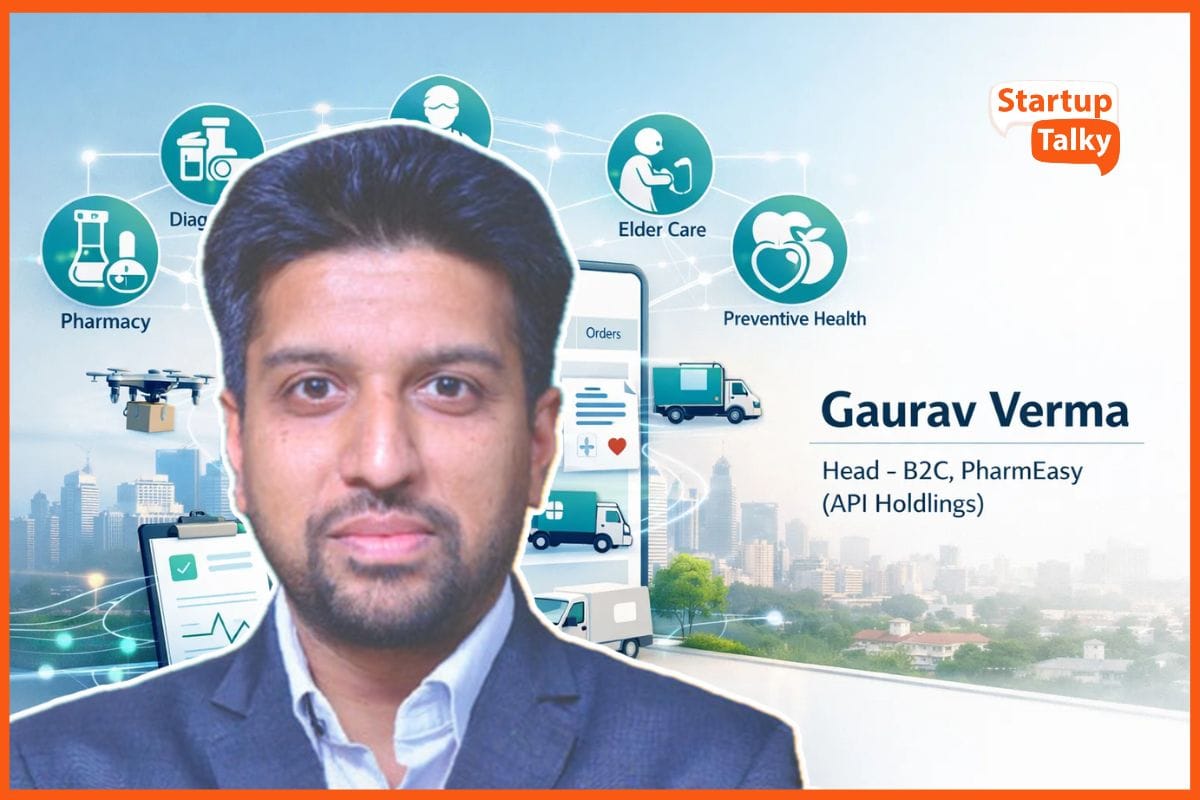
In this exclusive interaction with StartupTalky, Gaurav Verma, Head - B2C at PharmEasy (API Holdings), shares insights on how the company is evolving from an online pharmacy into a full-stack healthcare platform. He discusses his focus on sustainable growth, operational efficiency, and customer trust while operating in India’s price-sensitive and highly regulated healthcare market.
Verma highlights the key verticals driving revenue, from medicines and diagnostics to consultations and care services, and explains how data, technology, and a loyalty-led approach are shaping decisions and improving margins. He also outlines PharmEasy’s long-term vision of creating a trusted, integrated healthcare ecosystem accessible across India.
StartupTalky: To start with, could you briefly share your role as Chief Business Officer at PharmEasy and the key business priorities you focus on today?
Mr. Gaurav Verma: As Chief Business Officer at PharmEasy, my role is to drive sustainable growth while staying true to our purpose of making healthcare more affordable and accessible across India. I oversee business strategy across key verticals, with a strong focus on execution, partnerships, and ensuring growth is backed by solid operational and financial discipline.
Over the past year, we’ve strengthened our operating model by introducing sharper review mechanisms and a more data-led approach to execution. This has helped us shift from a phase of rapid expansion to one of more disciplined, scalable growth.
Today, our priorities are centred around deepening our core healthcare offerings, improving efficiency across the value chain, and expanding access beyond metros. At the heart of this is a simple goal: building a healthcare platform people can genuinely rely on, for convenience as well as for long-term health management.
StartupTalky: As Chief Business Officer, how do you balance growth, profitability, and customer trust in a sector where price sensitivity and regulatory scrutiny are both high?
Mr. Gaurav Verma: In healthcare, growth and trust cannot be viewed independently. While price sensitivity is a reality in India, trust is what ultimately sustains a business in the long run.
Profitability comes from building strong supply chains, improving operational processes, and using technology to reduce friction, not from compromising on quality or compliance. We work closely with regulatory frameworks and ensure transparency in pricing, sourcing, and service delivery.
Most importantly, we prioritise customer trust by being consistent and reliable. When people order medicines or book a diagnostic test, they are placing their health in our hands. That responsibility shapes every decision we make as a business.
StartupTalky: PharmEasy has evolved from an online pharmacy into a full-stack healthcare platform. From a business perspective, which verticals- medicines, diagnostics, consultations, or care services are currently driving sustainable revenue growth?
Mr. Gaurav Verma: PharmEasy today operates as a 360-degree healthcare platform, and each vertical plays a distinct role in driving sustainable growth. Medicines continue to be a strong pillar due to consistent demand and repeat usage, especially among chronic patients.
Diagnostics has emerged as a key growth driver, supported by increasing awareness around preventive health and early detection. We have launched a bunch of new services - doctor consultation, at-home vaccination, elder care service and physiotherapy, all of which help us move beyond one-time transactions to more continuous, long-term healthcare engagement.
What’s important is that these verticals complement each other. Together, they allow us to build a more resilient business model while offering users a seamless healthcare experience under one roof.
StartupTalky: India’s digital health market is becoming increasingly competitive with quick-commerce players, hospital chains, and D2C brands entering the space. What differentiates PharmEasy’s business model today, beyond discounts and delivery speed?
Mr. Gaurav Verma: While convenience and speed matter, they are no longer true differentiators in digital healthcare. What sets PharmEasy apart is the depth of our healthcare ecosystem and the trust we have built over time. Our key differentiator is deep healthcare integration, seamlessly connecting prescription management, diagnostics, teleconsultations and other healthcare services to deliver end-to-end care rather than isolated services. This enables us to support users from early detection to long-term management, with a strong focus on reliability through genuine medicines, accurate diagnostics, and consistent service quality. And we will continue to expand and strengthen our healthcare services on the platform.
Additionally, our scale, technology infrastructure, and strong partner network enable us to deliver healthcare services efficiently, even in complex or underserved markets. Ultimately, it’s this combination of trust, integration, and execution that differentiates us.
StartupTalky: How does data and consumer behaviour insight translate into commercial decisions at PharmEasy, whether in pricing, partnerships, or product expansion, while still maintaining user privacy?
Mr. Gaurav Verma: Data plays a crucial role in helping us understand health trends, user behaviour, and service gaps. These insights enable us to refine our pricing approach and design more relevant healthcare offerings. They also help us engage with consumers through more timely and contextual communication, ensuring they receive the right information and timely support.
However, privacy and data security are fundamental to everything we do. All data is handled with strict safeguards, and insights are used in aggregated, anonymised formats. Our intent is not to track individuals, but to understand broader patterns that can help improve healthcare access and outcomes.
Used responsibly, data becomes a powerful tool to deliver better care while maintaining user trust.
StartupTalky: Healthcare platforms often struggle with unit economics due to logistics and compliance costs. What levers have been most effective in improving operational efficiency and margins for PharmEasy?
Mr. Gaurav Verma: Currently, our focus is on increasing repeat usage through our loyalty ecosystem, led by PharmEasy Plus Membership, which encourages sustained engagement and long-term relationships with customers. By rewarding loyalty and repeat usage, we’re able to improve customer lifetime value while meaningfully reducing acquisition costs. Today, nearly 36% of our users are part of the PharmEasy Plus loyalty program.
At the same time, technology-led efficiencies across logistics, diagnostics, and customer support have played a key role in strengthening margins. From smarter supply chain planning to more streamlined service delivery, these efficiencies allow us to scale responsibly while maintaining a high-quality experience for our users.
StartupTalky: With API Holdings housing multiple healthcare offerings, how do you approach cross-selling and ecosystem monetisation without overwhelming the user experience?
Mr. Gaurav Verma: Our approach to cross-selling is rooted in relevance and timing. The focus is on understanding where a user is in their healthcare journey and offering support that genuinely adds value.
For instance, someone booking a diagnostic test may benefit from a follow-up consultation, while a chronic patient may need medication reminders or repeat testing. These recommendations are designed to be contextual and helpful, not intrusive. This has helped us build a strong engagement-led model. Today, a significant share of our users naturally engages with more than one service on the platform.
New services like doc consult, at-home vaccination, elder care, and our expanding private label portfolio, which is growing at over 25%, are playing an important role in strengthening unit economics.
Overall, the focus is on creating a seamless, end-to-end healthcare experience where cross-selling happens organically, driven by relevance and trust rather than volume.
StartupTalky: Looking ahead, what does long-term value creation look like for PharmEasy as a healthcare business, and what milestones will define the company’s next phase of growth?
Mr. Gaurav Verma: For us, long-term value creation means becoming one of India’s most trusted healthcare platforms. This involves expanding access, improving affordability, and enabling early detection and continuous care. Long-term value creation at PharmEasy is very clearly defined: it’s about building a business that is both sustainable and deeply impactful. We’ve moved from –16% to –4%, and while we are not EBITDA positive yet, the direction is strong, disciplined, and encouraging.
First, deepening profitability: ensuring that profitability becomes a consistent outcome driven by strong unit economics and operational discipline.
Second, operational excellence across all verticals. Whether it’s pharmacy, diagnostics, or consultations, every business line must operate with efficiency and predictability.
Third, building a future-ready healthcare ecosystem. Our vision is to connect detection, diagnosis, treatment, and ongoing care on one platform, using technology to make healthcare more proactive, accessible, and personalised to one and all.
 Muskaan Kapoor