The $6.5 Billion Bet: How Global Firms are Quietly Building India’s Next Tech Capitals
✍️ Opinions
This article has been contributed by Nanda Padmaraju – Chief Revenue Officer, EMEA, APAC & ANZ at Covasant Technologies
The Back Office That Built the World
For several decades, India served as the world’s most dependable outsourcing destination. From customer support desks and banking back offices to complex technology projects, global corporations have long looked to India for its ability to deliver at scale, quickly, efficiently, and cost-effectively. For years, the country powered the world’s operations, quietly becoming the “delivery capital” that kept global businesses running round the clock with minimal to no downtime. The focus then was clear, to get things done right, on time, and at scale. Today, that legacy of trust is translating into a fresh wave of investment. Global corporations are collectively placing an estimated $6.5 billion bet on expanding and strengthening their capability centers across India, quietly reshaping the country’s technology map.
Behind the rhythm of structured execution, a quiet change was stirring. Indian technologists were beginning to view their work as an opportunity to think, to reimagine, and to create, rather than just following a set of instructions or templates. They wanted to question the status quo and rewrite them from scratch when needed. What began as a service mindset gradually evolved into one of innovation and ownership. The goal was to shape global strategies and lead them.
From Outsourcing to In-House Innovation
As global enterprises grew more sophisticated, their needs changed too. Efficiency and cost advantage had served their purpose, but the conversation had moved on. The new priority was innovation ownership, which called for building the capability to design, decide, and deliver from within the enterprise, where insight and execution meet.
This shift gave rise to the GCC model which unlike traditional outsourcing represents a key realignment. GCCs are essentially in-house hubs where delivery and design both come together.
They bring together digital engineering, data science, and product innovation within a unified ecosystem directly aligned to enterprise strategy. India, with its strong technology infrastructure, deep engineering base, and entrepreneurial ecosystem, has slowly become the preferred location to set up a global capability center for most enterprises worldwide. Today, most global firms are conceiving, piloting, and scaling innovation from their GCCs here.
 Sanvi Barjatya
India’s Emergence as a Capability Powerhouse
The scale of this transition is striking. Not long ago, India’s technology centers were largely seen as the world’s back offices. Today, that image couldn’t be further from reality. India now hosts 1,700+ GCCs, about two million professionals, and generating an estimated $64.6 billion in annual revenue (FY 2024, NASSCOM–Zinnov Report) and that’s only the start. What used to be “back office” is fast becoming the creative innovation engine behind global products, platforms, and data strategies.
The AI Imperative
The rapid rise of AI has given this transformation great momentum. What once started as process-oriented delivery centers are now turning into AI-powered innovation labs, building industry-specific solutions that weave together data, analytics, and automation.
- In the pharmaceuticals sector, Indian GCCs are using AI-driven discovery models to cut down the time needed for clinical trials.
- In the automotive industry, they are designing autonomous and connected-vehicle software.
- In the banking, financial services, and insurance (BFSI) sector, GCCs are advancing predictive fraud detection and cyber security systems.
- In the retail and logistics industries, they are constructing data-driven supply-chain optimization platforms.
This moment signals a real change in character and approach, doing things faster with an altogether different thought process. The conversation has moved from automation to intelligence creation. India’s role today isn’t defined by how much work it can deliver, but by the quality of ideas and the depth of insight it brings to the table. What was once a story of labor efficiency is now one of intellectual power.
A New Geography of Innovation
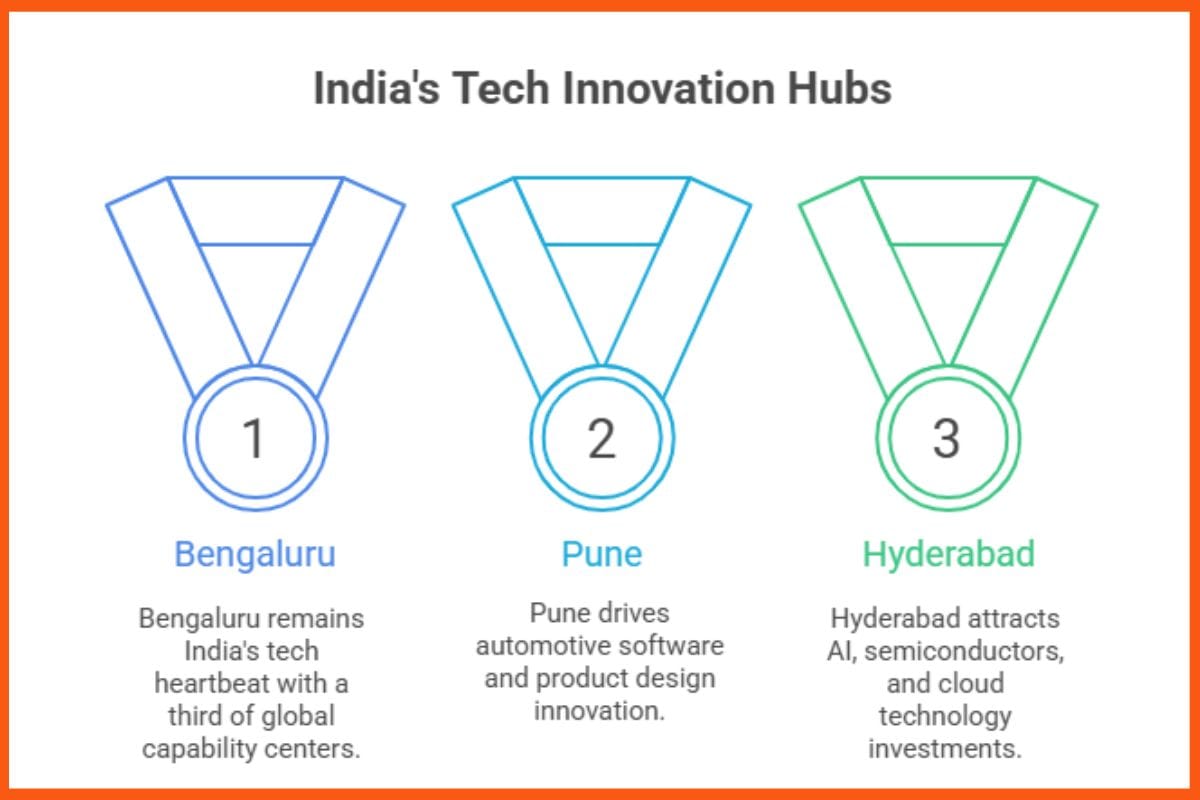
For many years, Bengaluru has been the heartbeat of India’s technology world, and it still holds that position, housing nearly a third of all global capability centers. But the energy is spreading outward. Pune has long been a quiet workhorse in India’s tech story. Its engineers now drive some of the most interesting work in automotive software and product design. Down south, Hyderabad has turned into a magnet for AI, semiconductors, and cloud technology. Chennai has grown into a place where the worlds of manufacturing and fintech naturally overlap, a mix that feels both practical and inventive. Then there are cities that you might not have expected to see on this list, such as Vizag, Coimbatore, Indore, and Kochi. They don’t make headlines every week, but they’re steadily winning attention from global firms that want stability, lower churn, and access to new talent pools.
Put together, these cities are redrawing India’s innovation map, creating opportunities and forming a more even, more grounded network of growth. For global companies, this means more options in terms of easy access to different types of talent, different cost models, and less risk in one place. For India, it’s the chance to build several strong corridors of high-skill work rather than relying on a handful of big hubs.
Policies and the Institutional Ecosystem
None of this has happened by chance. It’s been nudged along by clear intent and competitive policies that state governments are designing to attract global companies, offering tax breaks, state-of-the-art infrastructure, and innovation-friendly regulations. Karnataka continues to lead with its established ecosystem, but states like Telangana and Andhra Pradesh are making bold moves as well, placing early bets on AI and quantum computing as the next engines of growth. Similarly, Gujarat’s GIFT City has evolved into a fintech and financial-services innovation zone. All this is being done to accelerate the proliferation of GCCs in their territories. And while these are all simultaneously wooing foreign investors, a pathway for a richer, diverse, and collaborative ecosystem is being paved. GCCs, IT service providers, start-ups, and academia are increasingly forming strong partnerships to create a strong collaborative innovation ecosystem to fuel research and innovation.
Building The AI-First FutureAs global enterprises institutionalize AI into their strategic core, GCCs are undergoing another phase of transformation, transitioning from being centers of delivery to AI-First Centers of Excellence.
These centers are gradually becoming the thinking core of global companies, the places where data, technology, and decision-making come together to run systems efficiently. Global Capability Centers today are making AI work responsibly, at scale, and in ways people can trust. The focus has moved beyond building digital tools to cultivating digital judgment by bringing together human insight with machine intelligence.
The goal is to leverage technology to set the stage for a future where businesses aren’t simply automated, but genuinely autonomous. In this new order, India’s capability centers are set to play a dual role: the steady execution engines that keep businesses running, and the innovation architects who will help define what the next industrial era looks like.
The New Map of InnovationIndia’s trajectory from the world’s back office to its AI-enabled innovation backbone represents one of the most significant structural shifts in the contemporary global business landscape. Each new GCC established in India adds another node to the world’s digital infrastructure. Each emerging technology city extends the frontiers of innovation. And each AI-led breakthrough developed here reinforces India’s position as a strategic command center for enterprise transformation. That $6.5 billion bet is already paying off in the way India is redefining where and how the world innovates.
The world once turned to India for efficiency. Today, it turns to India for intelligence, capability, and creation.
Sanvi Barjatya