

How Real Estate Mandate Companies Help Developers Maximise ROI
✍️ Opinions
This article has been contributed by Satya Sobhan Mahapatra, Chief Marketing Officer, JUSTO REALFINTECH LIMITED
India’s real estate sector across metros and emerging cities has been undergoing a transformation. Developers are operating in an environment where timelines are tighter, funding is cautious and buyer expectations are higher. In this fast-evolving landscape, a new kind of partnership has emerged as a key growth enabler: the real estate mandate company.
This model is about restructuring how real estate businesses operate. Mandate firms bring together structure, technology and strategy to create order in a space that often struggles with scattered efforts, delayed monetisation and inconsistent messaging.
For many small and mid-sized developers across India, from MMR and Pune to Bengaluru, Hyderabad and beyond, this can mean the difference between managing a project and scaling a business sustainably.
Bridging the Cash Flow Gap
For most developers, the biggest challenge today is liquidity. Projects stall because sales velocity doesn’t match construction cycles. That’s where mandate companies make an impact. By combining data-driven market intelligence with integrated sales and marketing execution, mandate partners accelerate inventory absorption, leading to faster inflows and stronger financial stability.
In fast-growing residential markets and redevelopment zones, where funding often depends on milestone-based progress, mandate firms ensure steady, predictable cash flow, reducing reliance on expensive borrowing and improving project-level profitability. Many mandate firms also bring in institutional relationships with banks, NBFCs and private equity players, that help developers access financing and bridge short-term funding gaps. This blend of sales momentum and capital access helps sustain healthy ROI throughout the project lifecycle.
How Mandate Partnerships Maximise ROI
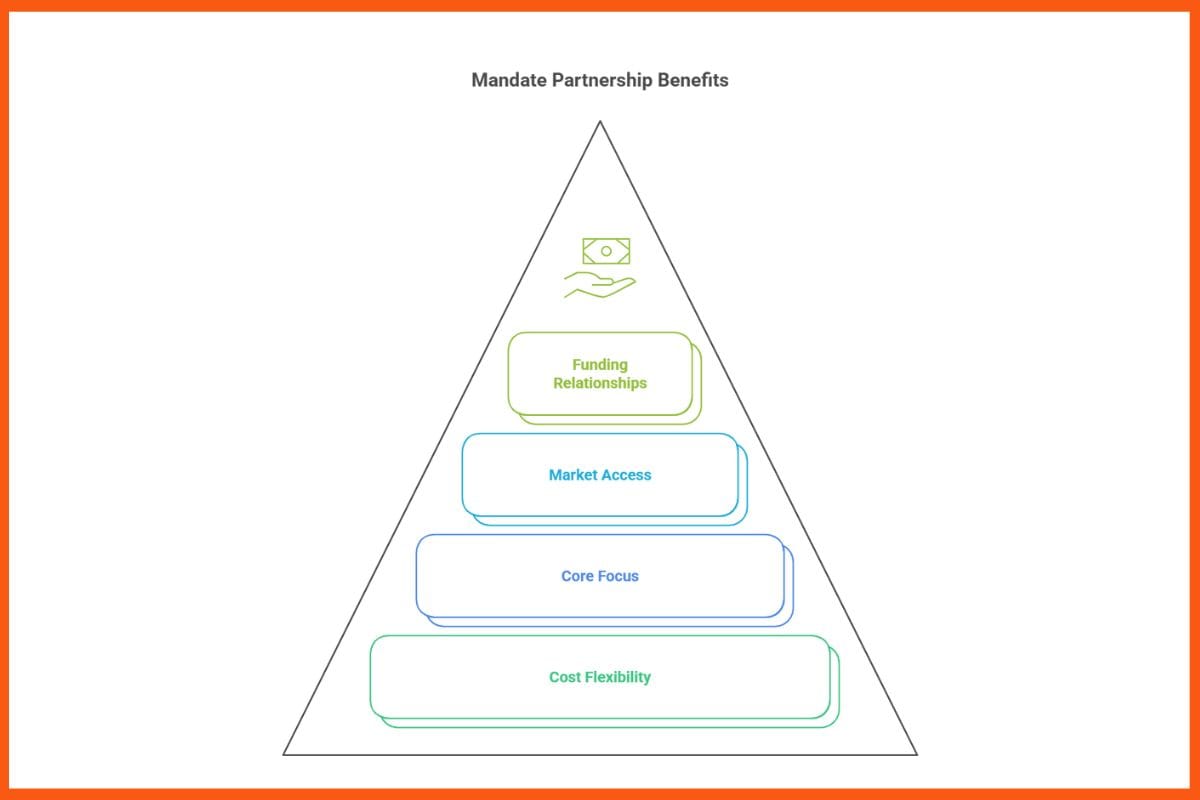
There are four ways how mandate partnerships help maximise ROI: -
- Converting Fixed Overheads into Variable Costs: Traditionally, developers have relied on large, in-house sales teams, a structure that adds fixed costs regardless of market performance. Mandate partnerships change that. By outsourcing a specialist team that operates on performance-linked models, developers convert fixed overheads into variable costs, paying for results rather than capacity. This flexibility is valuable in cyclical markets, allowing developers to preserve margins and scale operations more efficiently.
- Refocusing on Core Competencies: Every developer’s true strength lies in design, construction and delivery, not necessarily in managing day-to-day marketing, brokerage or customer engagement. Mandate partnerships allow leadership teams to refocus on what they do best while experts handle project orchestration, data insights and go-to-market strategy. This results in better quality projects and faster market execution, without operational distractions.
- Leveraging Large Broker Networks: Mandate firms maintain relationships with vast broker ecosystems, including thousands of RERA-registered channel partners. This network effect gives developers immediate market access and scalability without having to build or manage large distribution systems themselves. In competitive markets like MMR, NCR and Pune, such a reach improves sales velocity and brand visibility.
- Strengthening Institutional Funding Relationships: In today’s capital-conscious market, access to the right funding channels is a strategic advantage. Mandate firms, through their institutional partnerships and financial advisory arms, help developers connect with lenders and investors, enabling better cash flow management and structured project financing. This professional ecosystem ensures that developers can focus on delivery while maintaining financial discipline.
 Muskaan Kapoor
Unlocking Returns Through Integration
The mandate model is redefining how projects are marketed and sold by creating a single, unified ecosystem for strategy, outreach and execution.
Instead of coordinating with multiple vendors, developers work with one partner who manages everything from brand positioning and digital engagement to broker activation and customer experience. This integration eliminates overlap, improves accountability and ensures that every marketing rupee contributes directly to measurable results.
Whether it’s a mid-income housing project in Pune, a commercial tower in Gurugram or a redevelopment in Andheri, mandate-led execution brings transparency, agility and predictability, qualities that are fast becoming non-negotiable in modern real estate.
Technology: The Real Differentiator
In an industry that has traditionally relied on relationships and instinct, the new differentiator is data and technology.
Modern mandate companies use CRM systems, performance dashboards and AI-powered analytics to monitor every stage of the customer journey. Developers gain real-time visibility into lead sources, campaign efficiency and sales performance, allowing them to pivot instantly when needed.
This tech-driven transparency not only improves ROI but also builds trust and accountability, reinforcing the developer’s reputation with both customers and investors.
The Road Ahead: From Projects to Partnerships
India’s real estate market is entering a decisive decade. With residential, commercial and redevelopment segments gaining momentum, the mandate model is fast becoming the preferred approach for developers looking to grow without overextending their teams or capital. For developers, this means predictable sales cycles, disciplined finances and a sharper brand identity, all essential ingredients for sustainable ROI.
In an industry where trust builds brands and execution drives success, mandate-led collaboration is the future of how real estate will be built, sold and experienced across India.
Beyond Numbers: Building for the Future
The real power of the mandate model lies in transforming the developer’s experience, turning real estate into a business of predictability and partnership. By blending market intelligence with technology, relationships and empathy, these firms help developers focus on their core strengths while ensuring performance, profitability and credibility grow together.
As India’s real estate story continues to expand, the mandate partnership represents a new kind of growth, one that’s smarter, scalable and built on trust. It’s not just a way to sell better but also to build better for developers, investors and for the future of Indian real estate.
Varun Bhardwaj