

How to Structure Fintech Partnerships Between Startups and Banks Safely
✍️ Opinions
This article has been contributrd by Devarsh Saraf, Founder & CEO, Bombay Founders’ Club
India’s financial system is no longer defined by where money is stored, but by how it moves. Banks bring the guardrails through regulated capital, settlement infrastructure and risk governance, while fintechs drive user journeys, distribution and real-time execution. This synergy shapes the fabric of finance.
Over the past decade, a rapid API adoption by banks, modular financial infrastructure and cloud-native architectures have accelerated the shift from asset-heavy banking to orchestration-led finance. Fintechs have evolved beyond wallets and small-ticket credit now powering customer acquisition for banks, enabling MSME invoicing and collections, distributing insurance and mutual funds, automating compliance, and embedding financial products across logistics, retail and B2B platforms. In effect, fintech has become the digital front end of India’s financial system.
According to Research and Markets findings, India’s fintech sector is poised for rapid expansion, with the market projected to reach almost $1 trillion by 2032, growing at a CAGR of 30.2%.
The Risk Concentration Problem
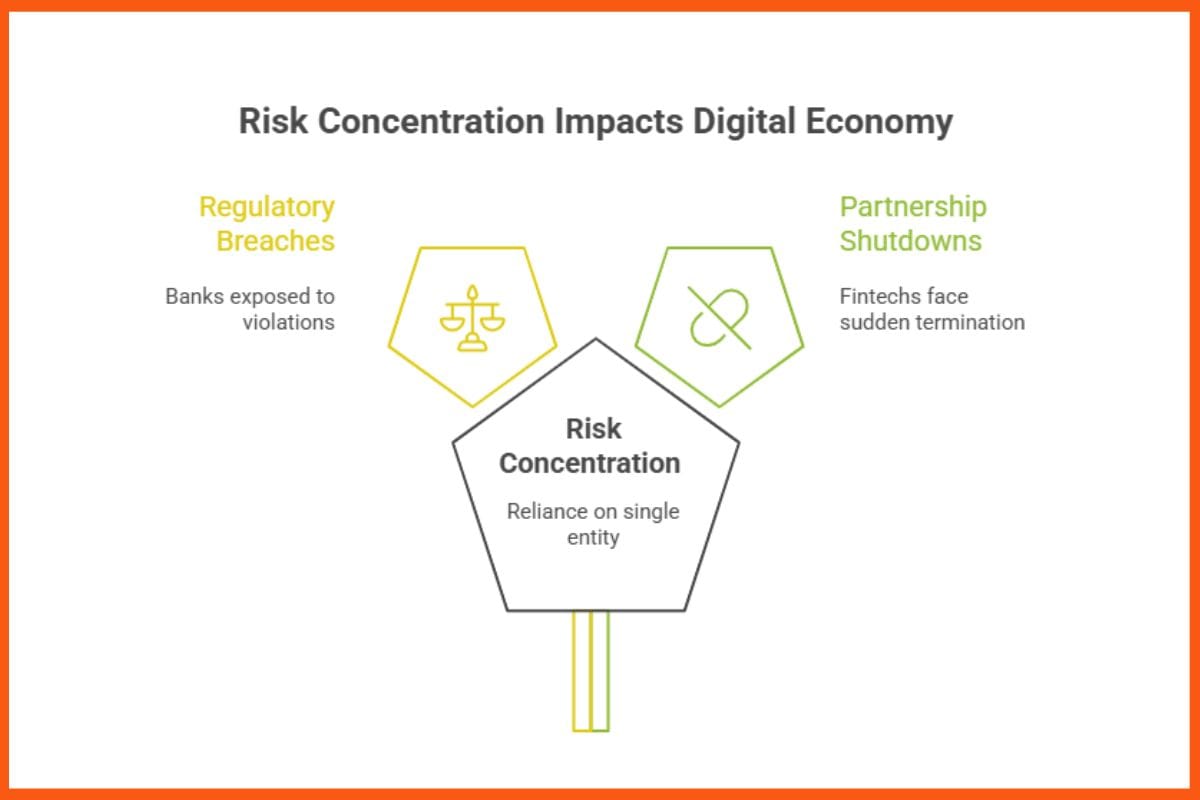
Every rupee that moves in these journeys relies on a licensed entity for custody, compliance and final settlement. Even the most technology-led fintechs operate on top of a bank’s core systems or balance sheet, resulting in interdependence that enables speed but concentrates risk. Partnerships are the economic infrastructure in this model, driving reach and efficiency for banks and product velocity for startups. But without structured governance, risk sharing and operational clarity, the same partnerships can expose banks to regulatory breaches and fintechs to sudden partnership shutdowns. Safe and well-architected bank–fintech partnerships are central to the resilience of India’s digital economy.
The Regulatory Centre of Gravity
RBI has intervened across key areas of bank–fintech collaboration from sourcing and first-loss default guarantee structures to data localisation, KYC, digital lending and cross-border payments. The speed of fintech product design, embedded finance, and API-led distribution often advances faster than formal supervisory guidance. While fintechs chase speed and growth, banks seek clarity and insulation. As Sushim Aryan, Principal Associate at Khaitan and Co. puts it, these companies operate close to regulatory guardrails, and banks seek growth. When technology evolves faster than regulation, both sides turn cautious, making partnership negotiations more complex but also disciplined.
Building Partnerships That Scale Safely
India’s digital finance growth now depends on strong partnerships between banks and fintechs that are built on three fundamentals: regulatory alignment, operational clarity and system resilience. Scale cannot come at the cost of stability and compliance cannot be an afterthought. The most durable partnerships are the ones structured with clear principles rather than reactive fixes.
There are three partnership principles that separate sustainable models from short-lived ones:-
Principle 1: Align with the spirit of regulation
The RBI has made it clear through its actions over the last five years that working around regulation is not the same as complying with it. Some fintechs try to operate in narrow legal interpretations to move faster, but this approach eventually leads to business disruption. The list of enforcement examples is long and instructive. With recurring payment, businesses struggled for months when subscription mandates were tightened, Co-branded card programmes were paused when issuer responsibilities became blurred. Credit flows through wallets seemed clever until they violated core lending norms. Each of these disruptions had a common pattern. The firms were compliant on paper but not aligned with the intent of regulation.
Partnerships that stay resilient follow three simple rules:
- The regulated entity is the system of record: All customer accounts, balances and settlements must sit with the licensed bank or NBFC. Ownership of records cannot shift to a fintech layer.
- Lending flows must remain pure: Disbursals must move from the regulated entity to the borrower. Repayments must be returned to the regulated entity. Fintechs should never hold, route or intermediate borrower funds.
- Transparency is non-negotiable: Customers and regulators must clearly see fees, APR, lender identity, data usage and responsibilities. Clean disclosures reduce friction, protect trust, and prevent enforcement shocks.
When these three rules are built into the model from day one, documentation becomes simpler, audits move faster and regulatory confidence rises. Compliance is not a constraint on innovation but the foundation that allows it to scale without getting shut down.
 Devashish Shrivastava
Principle 2: Do not sign liability you cannot carry
Poorly structured liability is one of the biggest reasons partnerships fail. When a new model is introduced, banks often transfer risk to the fintech because contractual liability looks like protection. Founders under pressure to close partnerships agree to indemnities and exposure they cannot support. What begins as a temporary compromise becomes a long-term threat because every funding round, new partner and regulatory review eventually exposes these weaknesses.
Under outsourcing rules, the regulated entity is always accountable in the eyes of the supervisor. A fintech’s role is to strengthen that accountability with visibility and shared control, not to become the insurer of last resort. A responsible founder must avoid unlimited indemnities for fraud outside their control, custody of principal or repayment flows, side agreements that alter formal risk-sharing terms, overreach in co-branded card programmes or single points of failure like reliance on one KYC vendor or one payment rail. When enough startups sign unfair clauses, they do not just hurt themselves, instead, create a market standard that damages the entire sector. Liability should be negotiated with discipline, not desperation.
Principle 3: Use public standards with private clauses
Partnerships work when both sides agree on outcomes before negotiating clauses. Alignment on operating standards builds trust and eliminates ambiguity. The language of the contract can evolve later, but the foundation must be built on outcomes that can be measured and audited. There are five outcomes that keep partnerships healthy and compliant.
- Follow-the-money: Any stakeholder should be able to trace a rupee across user, fintech and bank flows in under a minute.
- Safe custody of funds: Only regulated entities should hold borrower money.
- Honest screen: Customers must always see clear and accurate information on rates, fees and lender identity.
- Continuity: No single vendor failure should halt disbursals, repayments or onboarding.
- Clean exit: Either side must be able to exit the partnership without creating customer harm or operational chaos.
These outcomes translate into simple execution disciplines. Build a single-page system map that shows flows and hand-offs without footnotes. Maintain complete logs and reconciliation evidence. Design secondary rails and test them through real drills. From a bank perspective, these outcomes should become audit checkpoints. Replace heavy liability clauses with real-time dashboards, stronger reconciliation and joint risk reviews. Practical checks matter. Can a product manager explain the full flow on one page? Do ledger breaks close every next day? Has the backup rail been tested this quarter? If a new circular lands tomorrow, does the business lose a feature or lose its model?
Partnerships should be designed so that a supervisor can review flows, controls and accountability at a glance. That helps companies stay in business while navigating regulatory changes.
Structure for Survival
India’s financial system is not choosing between banks and fintechs but models that can combine trust with innovation and scale with stability. The next decade of growth in digital finance will not come from aggressive shortcuts or regulatory arbitrage but from disciplined partnerships that are designed to handle supervision, audits, outages and policy shifts without breaking.
Lasting partnerships require clarity on risk, honesty in customer communication, shared visibility across systems and alignment with the spirit of regulation. When these fundamentals are in place, innovation becomes sustainable instead of fragile, banks get defensible growth, fintechs get predictable scale, customers get reliability and the system becomes safer.
If you are a founder, banker or a risk leader building such partnerships, this is the moment to raise the standard. Design for clarity, document flows, test failovers, audit jointly and structure for survival. The strongest partnerships are not the ones launched quickly but the ones built to last.
Kinnary Nensee