

India’s Logistics Vision 2030: The Role of Startups in Building a $5 Trillion Economy
✍️ Opinions
This article has been contributed by Umang Shukla, Co-Founder & CEO, Edgistify
India is stepping into a decade defined by scale. The ambition to become a $5 trillion economy by 2030 is not merely a macroeconomic target; it represents a structural transformation in how the country manufactures, distributes, and consumes. At the centre of this transformation lies a sector that rarely gets the spotlight it deserves—logistics.
Logistics is the circulatory system of the economy. It connects manufacturers to markets, farmers to cities, and online brands to customers. Whether India achieves its economic vision will depend heavily on how efficiently this system can move goods across a fragmented yet fast-growing geography.
In recent years, the logistics sector has grown to become a $317 billion industry, projected to reach $484 billion by 2029. This growth reflects not only rising consumption but also the rapid evolution happening within the ecosystem itself. Much of this evolution is being driven by startups, which are rethinking logistics with the same disruption that fintech brought to payments.
Technology as the Core Engine of India's Logistics Leap
For decades, India’s logistics infrastructure suffered from structural inefficiencies—high costs (often 14% of GDP), unpredictable transit times, fragmented networks, and minimal visibility. However, the last few years have marked a turning point. Today, technology is rewriting the logistics playbook.
Artificial Intelligence (AI) for Predictability Startups are deploying AI-led forecasting and route optimisation to help businesses anticipate demand, plan replenishments, and reduce fuel consumption. What was once a reactive industry is rapidly becoming predictive.
IoT for Real-Time Visibility Sensors embedded in shipments, vehicles, and warehouse systems now allow brands to track temperature, location, and handling conditions in real-time. This is especially critical for sectors like pharma, food, and electronics, where product integrity matters more than speed.
Automation to Accelerate Fulfilment Digital SOPs, automated sorting, and high-throughput workflows are enabling same-day deliveries and significantly lower error rates. This shift is turning warehouses into tech-enabled fulfilment centres capable of serving multi-channel demand with precision. Startups are leading this wave—not by digitising old processes, but by redesigning them for a modern, high-velocity India.
The Green Imperative: Sustainability as a Non-Negotiable
As we race toward the $5 trillion mark, we cannot ignore the carbon footprint of moving goods. Logistics is traditionally a high-emission sector, but startups are turning this challenge into an innovation playground.
We are witnessing a massive shift toward Electric Vehicles (EVs) in the last-mile delivery segment. Startups are not just deploying EVs; they are building the battery-swapping infrastructure and charging networks required to keep them running. Beyond transport, "Green Warehousing" is gaining traction, with startups designing energy-neutral facilities that utilise solar power and rainwater harvesting.
By 2030, sustainable logistics won’t just be a Corporate Social Responsibility (CSR) checkbox; it will be a compliance requirement and a customer preference. Brands that can promise "carbon-neutral delivery" will win loyalty, and startups are the enablers making this possible today.
The Rise of Bharat: Tier-2 and Tier-3 Cities Will Define 2030
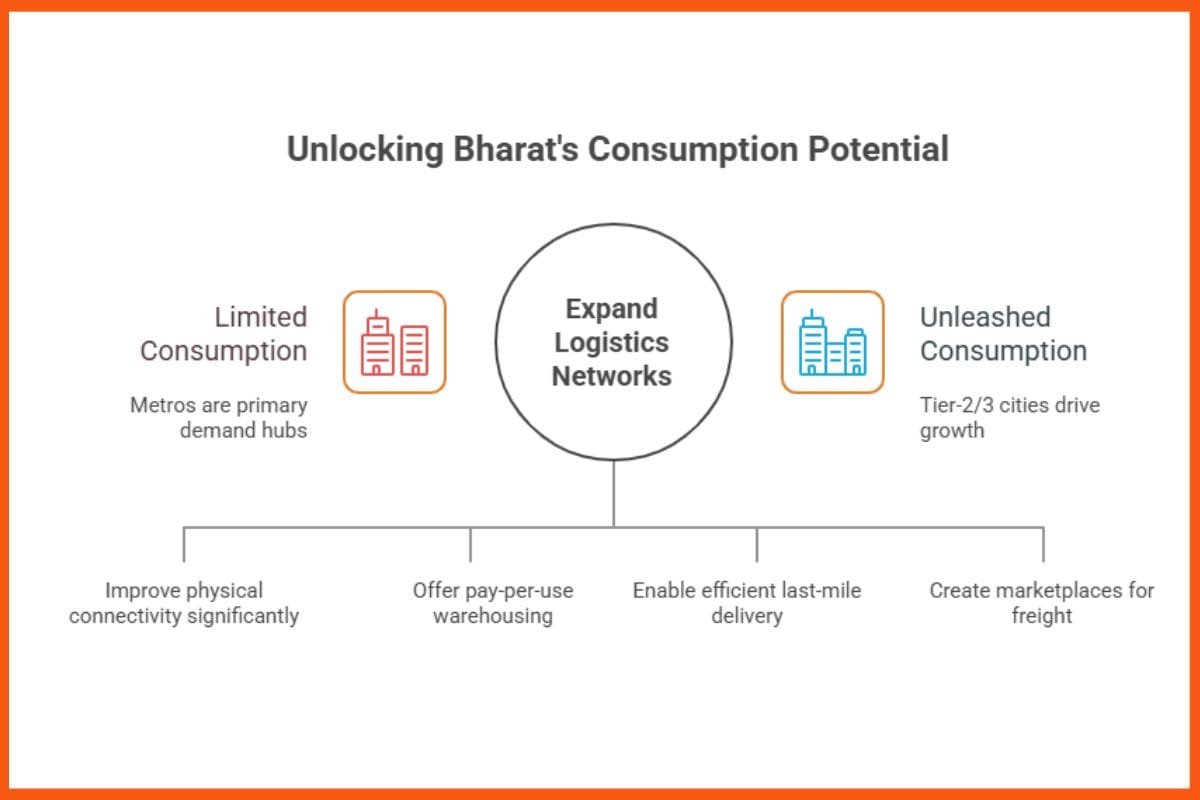
India’s consumption story is no longer confined to metros. Cities like Jaipur, Lucknow, Indore, Surat, Coimbatore, Guwahati, and Nagpur are becoming powerful demand hubs—driving e-commerce adoption, retail expansion, and D2C growth at an unprecedented pace.
However, to unlock this consumption fully, logistics networks must expand beyond the traditional golden quadrilateral. The government’s PM GatiShakti initiative, multimodal corridor projects, and investments in highways and freight hubs are significantly improving physical connectivity. These infrastructural shifts are being complemented by startups offering:
- Pay-per-use warehousing
- Hyperlocal fulfilment
- Digital freight marketplaces
- Rural last-mile delivery networks
This creates an environment where MSMEs, farmers, and regional manufacturers can now participate in national supply chains—a vital requirement for inclusive economic growth.
Policy as a Force Multiplier: NLP and ULIP
While infrastructure builds the hardware of logistics, policy builds the software. The government's launch of the National Logistics Policy (NLP) aims to bring India’s logistics cost down to single digits, aligning us with global benchmarks.
A game-changer here is the Unified Logistics Interface Platform (ULIP). By integrating 30+ systems from seven different ministries, ULIP provides a single window for data. For startups, this is gold. It democratises access to data that was previously siloed, allowing a young company to build a multimodal tracking tool that rivals global giants. This public digital infrastructure, much like what UPI did for payments, is laying the groundwork for startups to build scalable, low-cost solutions.
 Muskaan Kapoor
A Multi-Channel Commerce Era Demands Orchestration
The biggest shift in Indian commerce is the explosion of channels through which brands now sell—Marketplaces, Quick-commerce platforms, D2C websites, Modern Trade, and B2B wholesale networks.
Each channel operates differently, with distinct SLAs, PO formats, compliance rules, and reconciliation frameworks. This complexity has outpaced the capabilities of traditional fulfilment models. Startups are solving this through orchestration platforms that unify inventory visibility, order flows, transport networks, and financial reconciliation. This integration is redefining fulfilment from a linear operation into a connected ecosystem, where brands can scale without operational chaos.
Manufacturing and “Make in India” Depend on Smart Logistics
As India strengthens its position as a global manufacturing hub, logistics will play an increasingly strategic role. Manufacturers need just-in-time material supply, predictable factory-to-warehouse movement, and integrated multimodal transport.
Startups are enabling this through digital freight management, predictive replenishment platforms, and smart warehousing solutions. This convergence of technology and infrastructure directly increases output, reduces inefficiencies, and enhances export competitiveness.
Human Capital: Upskilling the Workforce that Moves India
Technology is often viewed as a replacement for human effort, but in Indian logistics, it is an enabler. The sector employs millions—from truck drivers to warehouse pickers—and startups are playing a pivotal role in dignifying this labour.
We are seeing platforms that focus entirely on driver welfare and fintech for logistics, offering insurance, working capital, and fuel credit to truckers. Inside warehouses, "Pick-to-Light" systems and voice-guided technologies are helping semi-skilled workers operate with 99% accuracy, effectively upskilling them on the job. By 2030, the "blue-collar" workforce of logistics will be a "grey-collar" workforce—tech-literate, better paid, and more efficient, thanks to the tools startups are providing.
The Startup Advantage: Agility, Innovation, and Execution
India now has over 1,500 logistics startups innovating across freight, fulfilment, warehousing, cold chain, last mile, and analytics. What sets startups apart is not only technology but mindset. They bring:
- Agility to build for the realities of modern commerce.
- Data-led decision-making for predictable performance.
- Modular networks that allow rapid scaling.
- Inclusion, enabling MSMEs to access logistics capabilities previously available only to large enterprises.
They are not just improving logistics; they are democratising it.
Looking Ahead: Logistics as a Growth Multiplier
By 2030, the logistics sector will be more than a service industry—it will be a growth multiplier. A modern logistics ecosystem will reduce national costs, strengthen export competitiveness, enable faster manufacturing cycles, and support the rise of thousands of new-age brands.
As Prime Minister Narendra Modi noted, “Strengthening logistics will not only make life easier for citizens, but it will also increase the dignity of our workforce.”
Startups are at the heart of this transformation. They are bringing the intelligence, discipline, and innovation required to redesign India’s fulfilment engine for the next decade. India’s economic rise will depend not only on how much the country produces, but how reliably, efficiently, and predictably it can move what it produces.
If logistics becomes reliable, India’s growth becomes unstoppable.
Sayantan Mondal