

Kailash Anwala on How UniSteps Consulting Turns Bold Architectural Visions into Flawless Execution
📰 News
In this interaction with StartupTalky, Kailash Anwala, Founder & Managing Director of UniSteps Consulting Pvt. Ltd., outlines a clear and practical view of construction consulting in India. He explains how UniSteps was created to ensure that architectural vision is supported by engineering and execution, not weakened by it. By integrating structural design, MEP, and project management, the firm focuses on smoother execution, early problem identification, and better on-site coordination.
He also highlights the role of technology and system-driven processes in reducing delays, risks, and rework. Overall, the discussion presents UniSteps as a reliable, execution-focused consultancy working to bring structure, clarity, and consistency to complex construction projects.
StartupTalky: What was the founding vision behind UniSteps Consulting, and what gap in the construction consulting space were you aiming to solve at the time?
Mr. Anwala: Visionary developers and architects often imagine bold, future-ready projects, but these ideas frequently lose their essence when engineering fails to support the original vision. What begins as a landmark concept often ends up as a conventional build. UniSteps was founded on the belief that visions created with intent, effort, and responsibility toward customers deserve to be executed as conceived. This is especially true in cities like Mumbai, where redevelopment demands consensus and trust. In such environments, structural, MEP, and construction planning must strengthen the vision, not dilute it or force repeated re-convincing.
On-site challenges are inevitable, but with an experienced, solution-oriented consultant embedded in execution, these constraints become manageable. This approach reduces pressure on teams and leads to better outcomes. Today, UniSteps is trusted as a go-to consultant for practical, reliable, and innovative problem-solving across every stage of execution.
StartupTalky: What core services does UniSteps offer today, and how do these services typically integrate within a single project lifecycle?
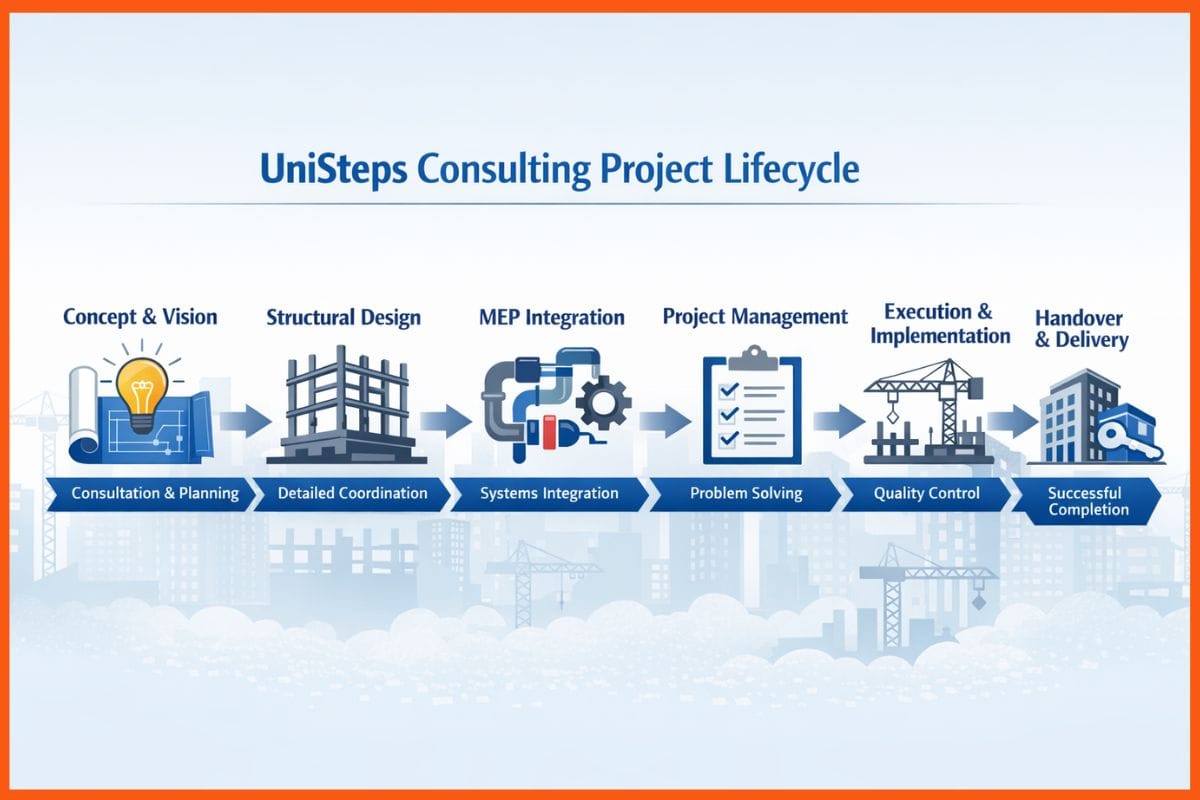
Mr. Anwala: UniSteps Consulting (formerly Nexus Project Solutions Pvt. Ltd.) was established to deliver integrated engineering solutions across structural design, MEP, and construction project management. Once architects finalise the concept, UniSteps develops and embeds the right structural and MEP strategies seamlessly within the architectural framework.
Backed by deep experience in construction planning and on-ground execution, UniSteps anticipates challenges across project stages and enables a smoother, more predictable execution journey for developers. While complexities are inevitable, the involvement of an experienced consultant significantly reduces uncertainty and ensures timely, effective problem-solving, especially in Tier 1 and Tier 2 cities where space and planning constraints intensify execution challenges.
StartupTalky: In terms of scale, approximately how many projects has UniSteps delivered so far, and what proportion of them are large or high-rise developments?
Mr. Anwala: UniSteps has successfully delivered over 600 projects to date and is currently designing and managing more than 400 projects. Of these, approximately 75% are large-scale or high-rise developments.
StartupTalky: What differentiates UniSteps from other engineering and project management consultancies operating in the same segment?
Mr. Anwala: UniSteps differentiates itself by preserving and strengthening the original architectural and development vision through engineering and execution, instead of diluting it. Unlike conventional consultants who operate in silos, UniSteps integrates structural design, MEP, and project management with a clear execution-first mindset. Its teams bring strong on-site experience, enabling practical, flexible, and timely solutions to real construction challenges.
The firm’s indigenously developed ERP system ensures end-to-end control over drawings, RFIs, checklists, and documentation, even with frequent site team changes. This proactive approach to coordination, accountability, and decision support reduces execution risk, delays, and rework, positioning UniSteps as a trusted go-to consultant for complex and high-stakes projects.
StartupTalky: At what stage of a project does UniSteps’ involvement create the maximum impact on cost, timelines, or risk reduction for clients?
Mr. Anwala: Ideally, potential issues that could lead to delays or cost overruns should be addressed during the concept planning stage, as they often require planning-level corrections. However, in India, engineering consultants are usually engaged only after the developer and architect have finalised the concept. Once UniSteps is involved, inputs on cost optimisation, timeline control, and risk reduction are immediately shared with developers and architects to strengthen efficiency and improve execution outcomes.
StartupTalky: Can you share a project where UniSteps’ value engineering or integrated approach led to a measurable improvement in feasibility or execution?
Mr. Anwala: 63 GMA, an H. Rishabraj project, was highly complex from both design and execution perspectives. The architecture featured multiple 3m and 4m cantilevers at almost every level, along with a major 8m cantilever at nearly 70m height, from which the upper floors were floated. Executing these cantilevers at such heights posed significant design and site challenges, especially with multiple projections in different directions and a terrace-level swimming pool adding further structural and service complexity.
While the vision was bold and clearly defined, feasibility concerns were inevitable. UniSteps ensured the architectural intent was executed without compromise. Not a single design dimension was altered, and the project was delivered exactly as conceived. Today, the building stands as a landmark, recognised for its distinctive form and precise execution.
StartupTalky: From your project management experience, what are the most common reasons real estate projects in India face delays or cost overruns today?
Mr. Anwala: Timely, on-budget execution depends on consistent and effective support from design consultants across all project stages. Rigid or inflexible consulting approaches disrupt early planning and eventually lead to delays and cost escalation, especially during execution when unforeseen, project-specific challenges demand quick and adaptive decisions.
In India, slow decision-making is a major cause of delays, quality compromise, and rising costs. Project execution relies on a coordinated and sequential flow of activities. When decisions are delayed, this flow breaks down, forcing overlaps that extend timelines and affect build quality.
Delayed decisions also disrupt contractor planning for materials and manpower. These losses are often irrecoverable, as contractors struggle to recover costs from idle labour caused by stoppages. As a result, contractors plan resources based on the decision-making efficiency of developers and consultants, making timely approvals critical.
Further delays arise from procedural formalities and the slow certification of contractors’ bills. Anticipated payment delays force contractors to carry additional working capital. To manage this risk, site manpower is reduced, slowing on-ground progress and impacting overall project delivery.
StartupTalky: How does UniSteps manage coordination between structural, MEP, and site teams to avoid execution-stage conflicts?
Mr. Anwala: Frequent changes in site teams across PMC, developers, and contractors disrupt coordination with design teams and often derail projects that were otherwise progressing smoothly. These transitions lead to delays and directly impact execution quality.
When outgoing teams fail to hand over responsibilities properly, design offices struggle to maintain control and consistency on site. Poorly maintained drawing registers worsen the issue, creating uncertainty around which drawings are being followed and whether the latest issued-for-construction sets have reached contractors, resulting in incorrect or non-compliant execution.
To address this, UniSteps has developed an indigenous ERP system through its IT division. The system manages drawing requests from PMC and developer teams, tracks issuance by design teams, and ensures all site stakeholders work from a single, controlled set of drawings issued directly by UniSteps. Any revised drawing is automatically notified to the PMC, developer, and contractors, ensuring traceability and compliance.
The ERP also tracks RFIs, ensuring responses are communicated to new team members and implemented on-site, while maintaining records of test reports for completed and ongoing works. It further ensures that site instructions and inspection observations are implemented, monitored remotely by consultants, and flagged if unresolved. Checklist compliance, test report reviews, and timely closure of quality issues are continuously tracked, reducing dependence on repeat site visits and improving overall execution control.
StartupTalky: What internal processes or technical standards does UniSteps follow to maintain consistency and quality across projects in different cities?
Mr. Anwala: At the design level, comprehensive checklists are issued to structural and MEP teams, covering all execution-critical requirements during design and detailing. The indigenously developed ERP system ensures that drawing lists approved by senior teams are tracked through a maker-checker workflow and delivered to site teams on time.
All design revisions are systematically monitored. Revisions arising from design gaps are flagged to management, and delays in RFI responses are automatically escalated. During frequent site team transitions, the design team links important project matters to specific construction stages and issues focused notes, enabling new site personnel to clearly understand critical checks and execution priorities.
At the PMC site level, work checklists define mandatory checks before execution and verifications after execution. The ERP enables site teams to raise, track, and close RFIs while ensuring all required site reports and documentation are properly recorded and monitored.
An integrated message and mail system tied to active tasks ensures continuous engagement across design and site teams. Any inactivity or delay is automatically identified and reported to management through system alerts. This structured framework ensures consistency, accountability, and quality from design through execution.
StartupTalky: Looking ahead, what kind of projects, sectors, or capabilities will define UniSteps Consulting’s next phase of growth?
Mr. Anwala: UniSteps currently delivers Structural Design, MEP Design, and PMC services across residential, commercial, institutional, hospital, and hotel projects, with plans to expand into infrastructure. In parallel, the firm aims to strengthen and scale its construction-focused IT services.
The construction industry has traditionally remained software-light and largely unorganised. As project scale and complexity increase, continued reliance on manual processes exposes projects to delays, cost overruns, and quality risks. The industry needs IT systems that connect the full construction lifecycle, from design through execution.
Even in 2026, project management in India is still driven by conventional, individual-dependent practices. Existing ERP systems fail to reflect real on-site workflows and do not fully integrate consultants, vendors, drawings across stages, contracts, materials, testing, checklists, snags, notices, billing, and documentation. Most systems also operate separately from everyday email, messaging, and task management, forcing reliance on individual memory rather than structured processes.
In its next phase, UniSteps aims to bridge design and execution by integrating design workflows, site execution, communication, and task management into a single ecosystem. This approach removes operational gaps, improves collaboration, and enables system-driven control across teams and management.