

Nidhi Saxena of Delulu – iShots Beverages Pvt. Ltd. on Functional Nutrition, Gen Z Branding, and Building Trust-First Consumer Products
📝Interviews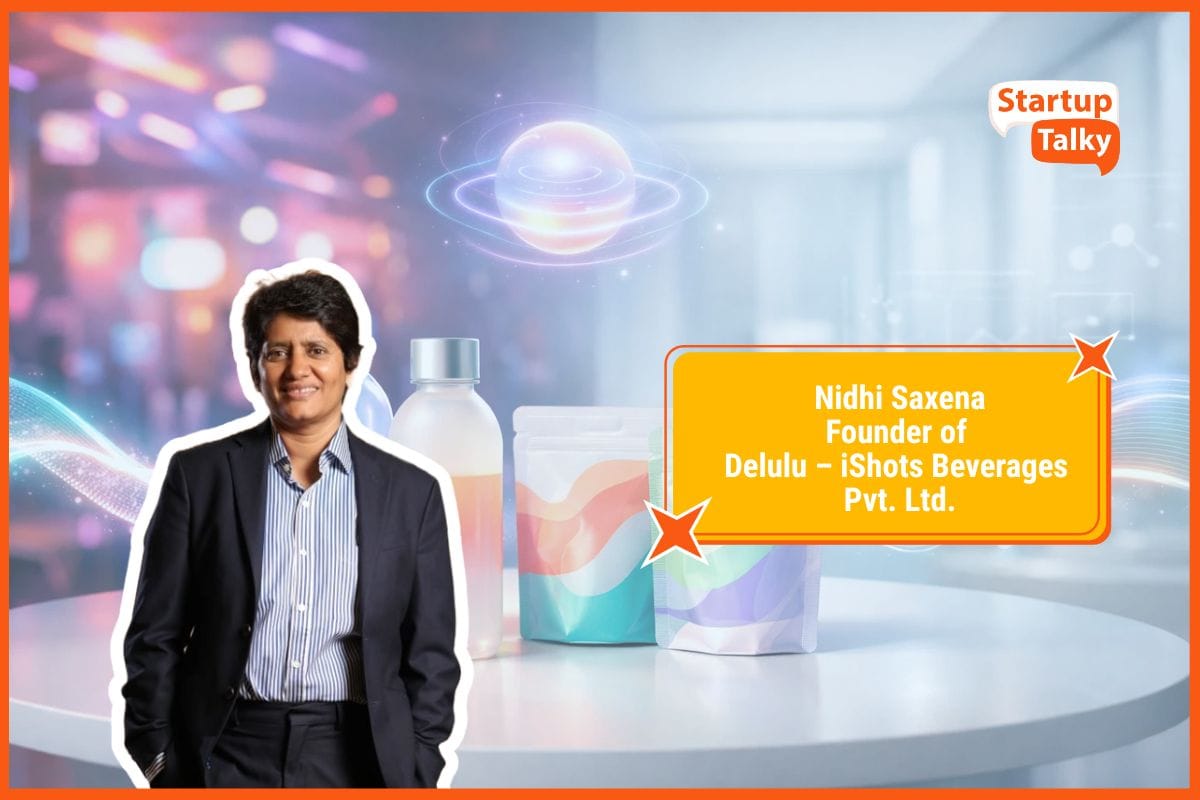
StartupTalky presents Recap'25, a series of exclusive interviews where we connect with founders and industry leaders to reflect on their journey in 2025 and discuss their vision for the future.
In this edition of Recap’25, StartupTalky speaks with Nidhi Saxena, Founder of Delulu – iShots Beverages Pvt. Ltd., who reflects on the hard realities of building a functional food and beverage brand in India’s fast-evolving wellness market. At the intersection of Gen Z culture and serious functional nutrition, Delulu has focused not just on bold branding, but on earning trust the difficult way — through discarded batches, reformulations, packaging setbacks, and relentless quality control.
Saxena shares how 2025 became a defining year for the brand, as early manufacturing failures and stability challenges forced the team to slow down, rebuild formulations from the ground up, and prioritize consistency over speed. The conversation explores the non-obvious metrics Delulu tracks to measure true product efficacy and repeat behavior, the discipline required to balance culturally bold marketing with responsible scientific communication, and why operational execution — not virality — is the real moat in functional CPG.
StartupTalky: Delulu operates at the intersection of functional nutrition and Zen Z culture. What was the most significant challenge you overcame in 2025 to establish credibility and trust in the crowded functional beverage market?
Nidhi Saxena: In 2025, our biggest challenge in erecting credibility wasn’t mindfulness; it was proving that we could execute functional products reliably in the real world, not just on paper.
The trip started in March 2025, when we decided to bring functional drinks to India with a strong focus on clean markers and natural constituents. We began by studying gaps in the Indian request and demurred off product development from scrape. We did deep request exploration across India and global requests, bought contending products for sensitive benchmarking, and erected a detailed design detail grounded on what we learned.
But the real test began after the exploration phase turning proposition into a stable, shelf-ready product.
We searched for well- equipped labs across India, visited multiple installations, checked them, and shortlisted the right expert to begin lab- scale R&D trials while maintaining strict quality parameters. It took 7 – 10 nonstop duplications, with several lapses where constituents that looked perfect on paper didn’t bear the same way when combined. That’s when we truly understood how different functional expression is in real operation.
We felt ready to move to our first marketable run especially for our idol products, spark and Manifest. product dates were locked, the platoon was agitated, and the process began. But marketable scale exposed fresh issues the drink color didn’t match what we had perfected, and during routine QC and sensitive checks( Day 1, Day 7, Day 14), we discovered commodity worse. On Day 10, the flavor profile had collapsed. The entire lot had to be discarded.
It was a hard moment- morale dropped, and we indeed considered removing the idol products entirely. What changed effects was leadership and continuity. Our Chief Delulu Officer pushed us to reset, and we went into root- cause mode. We literally turned our kitchens into mini labs and followed an elimination system suggested by a mate, tasting and testing constituents collectively to identify the “ monster constituents ” destabilizing the expression. We set up 2 – 3 lawbreakers, removed them, and rebuilt.
To reduce destruction, we shifted to lower- batch trials with the right support system. With expert help, we developed a revised expression and ran small- scale trials again. After two more duplications, nonstop evaluation, and consumer feedback, we eventually reached a product we could stand before. We were also ready to run the coming marketable batch and aimed to hit shelves before New Year but peak season meant product places weren’t available. That detention hurt, but our leadership stepped in, and we managed to secure product.
That final drive set us up for what we believe will be one of the most instigative launches of 2026. And it wasn’t only potables. Our chips and airs were planned for request post-Diwali, but during stuffing we realized the packaging material wasn’t over to standard size, design, and quality all fell suddenly. The product was ready, and we couldn’t leave it unpacked due to impurity threat, so we packaged it but we refused to go to request with sub-standard sacks. We renewed poke printing, which caused detainments due to color matching challenges. Thankfully, that has now been resolved, and the product will be out soon.
Looking back, credibility wasn’t erected through claims it was erected through the amenability to discard batches, decelerate down when demanded, fix fundamentals, and keep repeating until the product matched the standard we wanted consumers to trust.
StartupTalky: Beyond sales and social media engagement, what are the two or three non-obvious KPIs you track to measure the true efficacy and repeat purchase behavior of your functional products?
Nidhi Saxena: In functional products, “ did it vend? ” is a weak question. The better question is did it come a habit, and did the experience remain harmonious enough for someone to trust it again? So we track a set of KPIs that sit near to real operation than top- line figures.
1) Time- to-alternate- purchase( and the shape of reprise, not just the rate)
We study how long it takes a first- time buyer to come back, segmented by channel, terrain, and entry SKU. reprise rate can hide a lot. Someone can reorder months latterly because of a reduction. Time- to- reprise tells you if the product is moving from “ trial ” to “ routine. ”
We also track whether the alternate purchase is the same SKU, a different variant, or a pack. That pattern tells us whether the consumer actually understood the product and set up the right use- case.
2) “Expectation alignment score” from reason-coded feedback
We tag feedback into categories like: taste mismatch, timing confusion, sensitivity concerns, “felt too mild,” “felt too strong,” packaging experience, and clarity of instructions.
This KPI is powerful because it separates two problems that look similar on dashboards:
- A product issue (formulation stability, taste, sensory endurance)
- A communication issue (wrong promise, wrong usage guidance, wrong audience targeting)
3) Shelf-life sensory consistency (internal stability + consumer confirmation)
For beverages especially, we track how the sensory profile holds across time aroma, taste, aftertaste, and overall acceptance at defined intervals. A product can be great on Day 1 and disappointing later, and that destroys trust silently.
This KPI connects directly to repeat behavior because it reflects the customer’s real second experience: “Did it taste the same as last time?”
These KPIs keep us honest. They push us to fix fundamentals early, instead of masking issues with marketing.
StartupTalky: The brand name "Delulu" is provocative and culturally resonant. How do you balance this bold, Zen Z - focused marketing strategy with the serious scientific claims of your zero-sugar, zero-calorie functional ingredients?
Nidhi Saxena: We balance it by running the brand on a “two-layer system” . One layer is culture, the other is science and we don’t allow them to blur.
Layer 1: Culture (how we speak)
Delulu is intentionally Zen Z culture. It’s meant to feel like it belongs in the world our audience actually lives in: fast, online, overloaded, and constantly switching contexts. The cultural layer helps people notice us and relate to us.
Layer 2: Science and responsibility (what we claim)
The moment we talk about ingredients or function, we switch to discipline: clear language, no miracle framing, no medical implications, and no exaggerated promises. We maintain an internal “claims matrix” that defines:
- What we can say safely and consistently
- What requires qualifiers or context
- What we will not say, even if it would sell
How we execute this in real life
- Every product-facing communication goes through a compliance and accuracy filter.
- Creatives can be bold, but education has to be precise.
- We train internal teams and creators on what “responsible functional” messaging looks like, especially because the internet rewards overstatement, and we choose not to play that game.
This approach keeps the brand expressive without making the product conversation careless. In a crowded category, clarity becomes a competitive advantage.
StartupTalky: The quick closure of your pre-seed funding round validated your vision. How will this capital be strategically deployed in 2026 to scale manufacturing, distribution, and R&D for new product lines?
Nidhi Saxena: In 2026, the capital deployment is structured around one principle: scale should not dilute trust. We learned in 2025 that functional products can fail in ways that aren’t obvious on Day 1 so our plan is built to prevent that.
1) Manufacturing: consistency, not just capacity
A major portion goes into strengthening manufacturing systems:
- Tighter SOPs and QC checkpoints
- Better control over batch-to-batch sensory consistency
- Stronger vendor discipline and ingredient verification
- Backup sourcing options to reduce dependency risk
- Packaging improvement processes (because even a great product loses trust if packaging fails)
2) Distribution: expanding only where we can protect experience
We’re building distribution in phases:
- First, channels where we can learn fast and resolve issues quickly
- Then, broader rollout once supply planning, service levels, and shelf readiness are stable
We’re also investing in the unglamorous parts of distribution inventory planning, dispatch discipline, and partner alignment because these are what keep a brand reliable.
3) R&D: a gated pipeline, not a launch race
R&D funds are being used with clear “launch gates”:
- Ingredient logic and safety alignment
- Stability and shelf-life confidence
- Taste acceptance and real consumer validation
If a concept doesn’t clear all three, it doesn’t ship. We are optimizing for repeat, not headlines.
4) People and systems
We’re also investing in the right hires and systems quality leadership, regulatory support, and data infrastructure so the brand can make decisions with discipline as it grows.
StartupTalky: The Indian functional beverage market is poised for rapid growth. What is Delulu's core strategic differentiator that will ensure sustained leadership in 2026 against both established CPG giants and emerging D2C brands?
Nidhi Saxena: Our differentiator is not a single product feature, it's the operating model behind the product.
1) Culture-led discovery + systems-led retention
Many brands can win attention. Few can win a repeat. We aim to do both:
- Zen Z culture helps us enter the conversation naturally
- But retention is built through product integrity, stable experience, and honest expectation-setting
2) A disciplined feedback loop that actually changes the product
A lot of brands “collect feedback.” We treat it as an R&D input. We track confusion patterns, sensory drift, and expectation mismatch, and we use that data to make specific formulation, packaging, or messaging decisions.
3) Execution as a brand asset
Large CPG companies are strong at scale, but can be slower at adapting quickly. D2C brands can be fast, but often struggle with manufacturing consistency. Our focus is building a bridge between the two: fast learning, but with operational seriousness.
In 2026, leadership will belong to brands that don’t just sound functional, they behave functional, consistently, at scale.
StartupTalky: Looking ahead to 2026, what is Delulu's biggest product or market bet? Will the focus be on expanding the adaptogenic/thermogenic lines, entering new geographies, or developing entirely new functional food categories?
Nidhi Saxena: Our biggest bet in 2026 is ritual-first functional consumption.
Instead of thinking in terms of “more products,” we’re thinking in terms of more repeatable moments situations where functional support is genuinely useful and where a product can become a default:
- Long work blocks and late-night productivity
- Training and performance routines
- Social fatigue and high-stimulation environments
- High-pressure days where people want steady energy without feeling “wired”
From there, expansion becomes logical:
- Yes, we will deepen and refine existing functional lines where we see strong repeat behavior.
- Geography expansion will happen, but only where we can protect consistency and supply reliability.
- We are also exploring adjacent functional food categories but we will only enter spaces where we can deliver the same discipline on formulation, sensory experience, and shelf stability.
The bet is simple: build a portfolio that people reach for automatically, not occasionally.
StartupTalky: Five years from now, what do you hope will be the lasting legacy of Delulu on the Indian CPG landscape, particularly in transforming consumer perception of functional wellness products?
Nidhi Saxena: Five years from now, I’d like Delulu’s legacy to be that it helped raise the standard for “functional” in India culturally and operationally.
1) Making functional claims more responsible
If consumers become more label-literate, more skeptical in a healthy way, and brands respond with clearer language and fewer exaggerated promises, that’s a meaningful shift for the category.
2) Proving that Zen Z culture can coexist with seriousness
Wellness in India is often marketed as either clinical or aspirational. We want to show a third lane: functional products that fit real life fast, messy, high-pressure life without being careless about quality or claims.
3) Normalizing consistency as the baseline expectation
Functional should mean: if I buy it again, I get the same experience again. If Delulu helps make that consistency the consumer’s default expectation across the market, we’ll have pushed the industry forward.
StartupTalky: What is the single most important, hard-won lesson you would share with a founder building a consumer-facing brand in the highly competitive and trend-driven food and beverage industry?
Nidhi Saxena: Do not scale chaos.
In food and beverages, it’s easy to mistake a spike for good packaging, a viral moment, a seasonal push for real product-market fit. But the business is built on what happens after the spike: the second purchase, the third purchase, the quiet recommendation, the trust.
The hard-won lesson is that execution is not a department; it is the strategy:
- If your product isn’t stable, marketing will eventually amplify disappointment.
- If your supply chain is weak, growth will expose it brutally.
- If your claims are louder than your product experience, you will lose credibility fast.
Build for repeat before you build for reach. Trends bring people in once. Trust brings them back.
Explore more Recap'25 interviews here.