

S Raghav Bharadwaj of Bolt.Earth on Scaling 100,000 EV Chargers and Powering India’s Fast-Charging Future
📝Interviews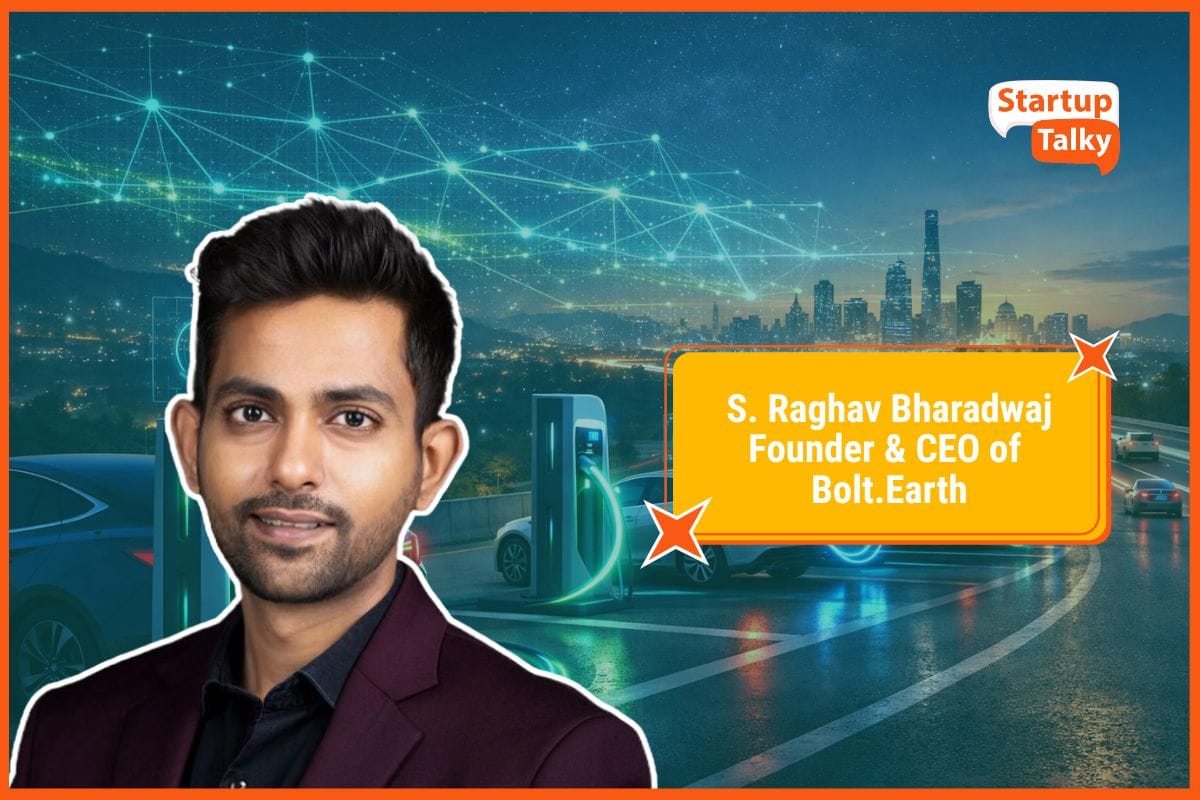
StartupTalky presents Recap'25, a series of exclusive interviews where we connect with founders and industry leaders to reflect on their journey in 2025 and discuss their vision for the future.
In this edition of Recap’25, StartupTalky speaks with S Raghav Bharadwaj, Founder & CEO of Bolt.Earth, who reflects on the year India’s EV charging ecosystem moved from early adoption to nationwide scale. As electric mobility accelerated across two-, three-, and four-wheelers in 2025, the focus shifted from simply installing chargers to building a reliable, intelligent, and interoperable charging network that drivers could trust every day.
Bharadwaj shares how Bolt.Earth crossed the milestone of deploying over 100,000 chargers across India, while also introducing proprietary fast-charging technology designed specifically for Indian mobility patterns. The conversation explores the operational metrics that truly define network health — from uptime and utilization to energy throughput and app stickiness — as well as how regulatory shifts toward open standards and digital payments helped accelerate interoperability and network usage.
StartupTalky: Bolt.Earth claims to be India's largest EV charging network. What was the most significant technological or strategic milestone achieved in 2025 that solidified this leadership position?
S. Raghav Bharadwaj: The biggest milestone in 2025 was scaling our network to an unprecedented size and capability. By September 2025, Bolt.Earth had deployed over 1,00,000 EV chargers across India, cementing our position as the country’s largest EV charging network.
Equally crucial was the launch of our proprietary fast chargers for two- and three-wheelers. In May 2025, we unveiled Blaze DC, India’s first universal DC fast charger for 2W/3W vehicles, capable of delivering up to 120 km of range in just 15 minutes. Blaze DC supports both Type 6 and upcoming Type 7 connectors, covering over 90% of scooters and e-rickshaws on the road, and is built to national BIS standards.
These efforts ensured that we are not only the largest network by charger count, but also the leader in technology and innovation.
To measure true network health, we focus on operational and behavioral performance, not just installed capacity. The key KPIs we track include:
Charger Availability (Uptime) –This measures the percentage of chargers that are online and functioning at any given moment. Maintaining high availability (typically above 97% across our network) ensures drivers rarely encounter non-functional chargers. We monitor uptime in real time through our Charger Management System (CMS), which automatically flags faults and triggers rapid response.
Utilization Rate –This reflects the fraction of time a charger is actively used, calculated as hours in use ÷ total hours available. It helps us identify over- or under-utilized locations. For instance, a 30 kW highway DC charger may run at 60–70% utilization, while a neighborhood AC charger may average 5–10%. Tracking utilization across our 100,000+ chargers directly informs where we expand capacity or rebalance infrastructure.
Energy Throughput (kWh Delivered) –This measures the total energy dispensed per charger or per user and represents the true output of the network. Using real-time meter data, we currently dispense megawatt-hours of clean energy daily. Variations in throughput often highlight grid constraints, seasonal demand, or emerging mobility patterns.
App User Retention / Booking Stickiness (Brand & Customer Stickiness) –Beyond infrastructure metrics, we track how often users come back to charge on our network. In 2025, our average charger booking stickiness on Android stood at 40%, which is industry-leading for EV charging apps in India. This metric reflects trust, reliability, and habit formation, users repeatedly choosing Bolt.Earth because chargers work, payments are seamless, and availability is predictable.
In addition, we closely monitor fault frequency and mean time to repair (MTTR). Rising fault rates or longer repair times signal reliability issues that require immediate intervention. Our vertically integrated hardware-software model, combined with a 24×7 operations and support team, allows us to keep these metrics tightly controlled at scale.
StartupTalky: The EV charging policy landscape in India is rapidly evolving. What was the most critical regulatory challenge you navigated in 2025, and how did you turn policy changes into a competitive advantage?
S. Raghav Bharadwaj: Rather than being a hurdle, evolving regulations worked in our favor. Government guidelines in 2025 reinforced EV charging as an unlicensed activity and mandated open protocols (OCPP/OCPI) and universal digital payments such as UPI. Since Bolt.Earth designs and manufactures both hardware and software in-house, we were able to adopt these standards quickly.
For instance, we had already integrated Bharat DC Type 6 and Type 7 as well as CCS2 connectors, so when the Union government and NITI Aayog pushed for connector harmonization, our hardware was already compliant.
We also joined national roaming platforms early. As interoperability increased, our network utilization jumped from below 10% to over 20%, driven by seamless access across multiple CPO networks. Policy alignment, combined with early execution, gave us a clear competitive edge.
StartupTalky: Bolt.Earth operates a peer-to-peer charging model. How do you balance the need for a seamless, reliable user experience with the inherent variability and maintenance challenges of a decentralized network?
S. Raghav Bharadwaj: Our peer-to-peer model enables independent hosts to share chargers, which naturally introduces variability. To counter this, we built strong control mechanisms to ensure a consistent user experience.
First, hardware quality is standardized. Every Bolt.Earth charger—ranging from AC sockets to DC fast chargers—undergoes rigorous testing at our 13,000 sq. ft. R&D facility and meets global safety certifications. We monitor all chargers 24×7 via our cloud CMS, tracking uptime, usage, and faults in real time. Our fast chargers use a modular, field-replaceable design, enabling service teams to swap faulty modules onsite within hours.
Second, we provide end-to-end operational support. Every charger includes built-in connectivity and is fully managed by Bolt.Earth. Our app and backend enable real-time alerts, predictive maintenance, and instant support. If a rider reports an issue, our 24×7 support team can troubleshoot remotely or dispatch technicians immediately.
Finally, we align host incentives with reliability. Hosts earn revenue per charging session, so uptime directly impacts their earnings. We also enforce minimum uptime requirements in our agreements. This combination of in-house control, real-time monitoring, fast servicing, and host accountability allows us to deliver reliable performance across a decentralized network.
StartupTalky: The market is seeing a push for fast-charging and battery-swapping. What is Bolt.Earth's core strategic differentiator that will ensure sustained leadership in 2026, and how do you view the battery-swapping trend?
S. Raghav Bharadwaj: Bolt.Earth’s core differentiator is an end-to-end fast-charging platform. We believe DC fast charging is the most scalable solution for India’s EV ecosystem.
For two- and three-wheelers, Blaze DC (3–12 kW) can add up to 120 km of range in 15 minutes, delivering fuel-station-like convenience. For four-wheelers, our Lightning DC (30–240 kW) chargers enable highway-speed charging. Importantly, all our chargers are universal and interoperable, Blaze DC supports current and upcoming connector standards, while Lightning DC uses CCS2.
By mid-2025, Bolt.Earth had deployed a fast-charging footprint an order of magnitude larger than battery-swapping networks. India currently has over 26,000 public fast chargers compared to roughly 2,600 swap bays. Fast charging offers higher ROI across most segments and is essential for four-wheelers, where swapping is not viable. While battery swapping serves niche, high-utilization 2W/3W fleets, it requires significant capital and vehicle standardization—challenges India has yet to fully address.
We view swapping as a complementary niche, not a substitute. Our focus remains on fast charging that is interoperable, scalable, and universally compatible.
StartupTalky: Looking ahead to 2026, what is Bolt.Earth's biggest product or market bet? Will the focus be on expanding into new geographies, integrating with Vehicle-to-Grid (V2G) technology, or deepening software services for OEMs?
S. Raghav Bharadwaj: Our biggest bet for 2026 is doubling down on Bolt.Earth-designed hardware and intelligence. Blaze DC for 2W/3W and Lightning DC for 4W+ will remain our core products.
Blaze DC is currently the only universal fast charger for two-wheelers in India, supporting government-standard Type 6/7 connectors and covering approximately 90% of scooters and e-rickshaws. Lightning DC serves highways, fleet hubs, and depots with 30 kW and higher chargers using CCS2.
To support scale, we opened a 13,000 sq. ft. R&D and assembly facility in Bengaluru in 2025, which now assembles our entire hardware portfolio, from home chargers to 240 kW DC stations. Vertical integration allows rapid iteration and quality control. In 2026, we plan to launch higher-power Lightning DC variants, a dual-gun Blaze DC, and expand our Level 2 AC offerings.
On the software side, we are enhancing our CMS, apps, and APIs for OEMs and fleets, including deeper vehicle integration and advanced data services. However, our primary bet remains physical fast-charging infrastructure, scaled intelligently with software.
StartupTalky: Five years from now, we hope Bolt.Earth is remembered as the company that truly “wired” India for electric mobility, making charging as accessible and intelligent as fueling once was.
S. Raghav Bharadwaj: By 2030, with an estimated 30% of new vehicles being electric, our goal is that no EV buyer hesitates due to charging concerns. We envision a dense, intelligent charging grid across neighborhoods, workplaces, and highways, capable of predicting demand, optimizing grid load, and eventually enabling vehicle-to-grid functionality.
Our legacy will be defined by accessibility and intelligence. Accessibility through universal standards, open roaming, and seamless UPI payments. Intelligence through data-driven optimization, dynamic pricing, and predictive deployment of new stations.
Ultimately, we want Bolt.Earth to be the default choice—“Bolt.Earth first”—for every EV ecosystem stakeholder, while enabling millions of clean, confident electric journeys across India.
StartupTalky: What is the single most important, hard-won lesson you would share with a founder scaling a capital-intensive, infrastructure-focused business in a nascent, government-regulated industry?
S. Raghav Bharadwaj: The hardest lesson is that infrastructure requires patience and discipline. EV charging cannot be treated like a pure software startup. Every station’s economics must be optimized from day one.
Adaptability is equally critical. Regulations evolve quickly, so building in-house capabilities is essential. By supporting all emerging standards and investing in local manufacturing and testing, we retained control over quality, costs, and timelines.
Finally, we focus on impact over vanity metrics. We measure success not just by installed charger counts, but by uptime, utilization, energy delivered, trips enabled, carbon saved, and, critically, user retention. High app booking stickiness tells us that drivers trust the network enough to return repeatedly, which is the ultimate proof of reliability and value. In infrastructure, real success is measured by how often people come back and how seamlessly the system works in the real world.
In short: grow thoughtfully, partner deeply with governments and ecosystem players, and ensure every rupee invested improves real usage. That mindset, stay lean, agile, and user-focused, is the key lesson we’d share with any founder building critical infrastructure.
Explore more Recap'25 interviews here.